


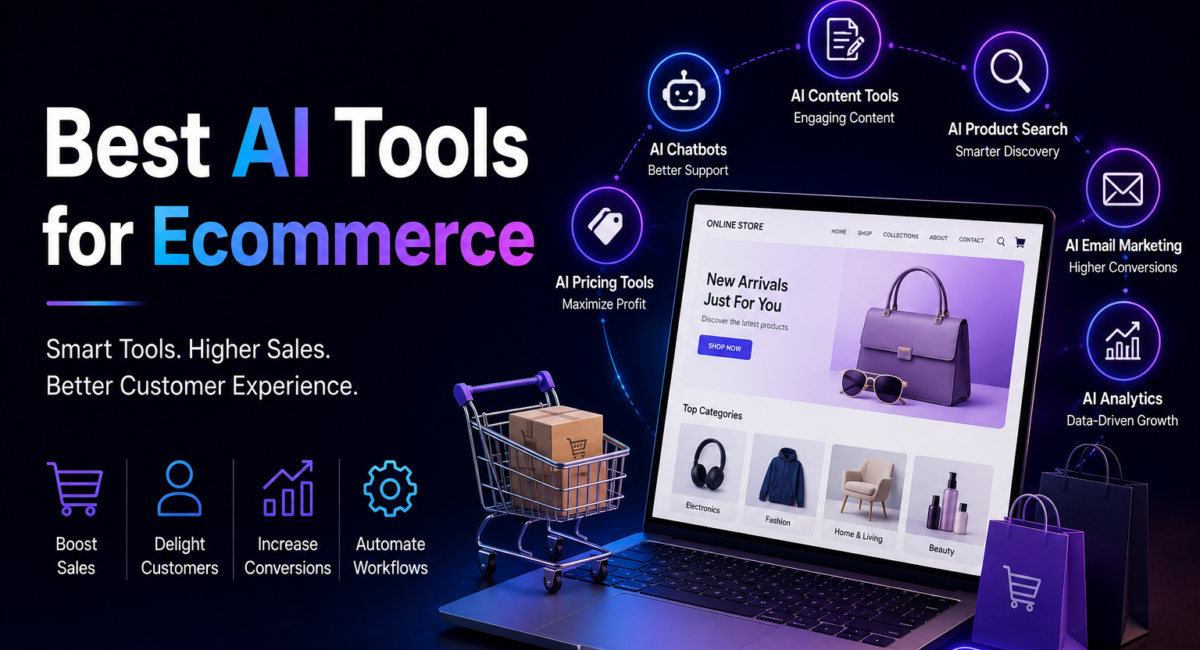
Two years ago the pitch for ecommerce AI was simple: it writes your product descriptions. That pitch now looks quaint. In 2026 AI sits inside the platform you already pay for, closes a measurable share of your support queue on a pay-per-resolution contract, and has quietly become a discovery channel of its own – one that sends shoppers who convert better than the ones classic search sends. The useful question is no longer “which AI writer should I buy?” but “where does my store actually leak, and what will fixing it with AI cost once it starts working?”
| Quick answer: For most stores the winning stack is small: Shopify Sidekick (or your platform’s built-in AI) for store operations, Claude Opus 5 or ChatGPT for brand-voice content, Klaviyo for email and SMS, Gorgias for support automation, Rebuy for on-site personalization, and Photoroom for product imagery. Start with your worst bottleneck, not the longest feature list. |

Table of Contents
What changed for ecommerce AI in 2026?
Three things, and none of them is a better copywriter.
The first is traffic. Working from more than a trillion visits to US retail sites, Adobe Analytics found AI-referred traffic up 138% year over year in May 2026 and – the number that should reorder your roadmap – converting 54% better than non-AI traffic. A year earlier the same channel converted at roughly half the rate of everything else.
The second is plumbing. The Agentic Commerce Protocol, an open standard co-developed by Stripe and OpenAI, gives merchants a single integration for selling through AI agents while keeping catalog, branding and fulfillment on their own side. Whether or not you switch on agent checkout this year, the machine-readable product data it expects is the same data that gets you quoted inside AI answers, which is why AI search optimization for ecommerce has stopped being a side project.
The third is packaging. Shopify folded its Magic features into Sidekick, an assistant included with your plan rather than sold as an add-on, and Klaviyo and Gorgias both moved their AI from a feature checkbox to a metered product. The practical effect: the interesting decisions are now about cost models, not capabilities.
What are the best AI tools for ecommerce right now?
How we compare: we favour tools that read a real store’s data natively, publish their pricing, and survive contact with a two-person team. We re-check pricing pages at each update and run tools against live catalogs, not demo data.
Shopify Sidekick — best platform-native option
Platform-native AI earns first place by default. Sidekick is included with your Shopify plan – usage limits vary by tier – and drafts product copy, edits product photography, builds discounts and answers questions about your own sales data. Because it can act inside the admin with your approval, it beats a general chatbot at store chores it can actually see.
Claude Opus 5 and ChatGPT — best for copy and campaigns
One general model for anything with a voice. Claude Opus 5, released on 24 July 2026, and ChatGPT are the two workhorses for collection copy, ad variants, briefs and lifecycle sequences. Opus 5 ships a 1M-token context window – enough to hold your brand guide, past campaigns and a catalog export at once – at $5 per million input tokens and $25 per million output. ChatGPT Business runs $20 per seat per month billed annually ($25 monthly, two-seat minimum).
Klaviyo — best for email and SMS lifecycle
Email and SMS remain the highest-return line item. Klaviyo now prices on active profiles and stays free to 250 profiles and 500 sends a month with $5 of mobile messages included. Its 2026 AI layer matters more than the old subject-line generator ever did: Composer audits and builds whole flows and campaigns from a prompt, and Customer Agent answers and sells using your store data.
Gorgias — best for support automation
Support automation has moved to outcome pricing. Gorgias puts an AI Agent on every plan and charges only when it resolves a conversation – roughly $0.90 to $1.00 per resolution depending on billing term – while the helpdesk itself scales by ticket volume instead of per seat. That is fairer than seat licences and easier to underestimate: a thousand automated resolutions a month is its own budget line. If support is your largest drain, weigh it against a dedicated AI agent for ecommerce.
Rebuy and Photoroom — best for personalisation and imagery
Personalization and imagery finish the stack. Rebuy is usage-based from about $25 a month, tiered by orders per month, and covers smart carts, post-purchase upsells and dynamic bundles. Photoroom is still the cheapest route from a phone photo to something that looks studio-shot: a free tier, Pro around $7.99 a month, a separate API price list, and 2026 additions such as ghost-mannequin and virtual-model shots for apparel.

| Tool | Best for | 2026 pricing signal | Watch for |
| Shopify Sidekick | Store operations, copy, images | Included with your plan | Usage limits vary by tier |
| Claude Opus 5 / ChatGPT | Brand-voice content at scale | $20 per seat/mo; $5-$25 per M tokens | Every fact needs checking |
| Klaviyo | Email and SMS lifecycle | Free to 250 active profiles | Cost scales with list growth |
| Gorgias | Support automation | ~$0.90-$1.00 per AI resolution | Bill grows as deflection works |
| Rebuy | Cart and post-purchase AOV | Usage-based from ~$25/mo | Tiered on orders per month |
| Photoroom | Product photography | Free tier; Pro ~$7.99/mo | Credits and API billed apart |
Affiliate disclosure: some links on TechieHub are affiliate links. If you buy through one we may earn a commission at no extra cost to you. It never changes which tools we recommend or the order they appear in.
How do you choose without buying six overlapping tools?
Start with arithmetic, not features. Outcome pricing inverts the usual logic: a tool billed per resolution or per order gets more expensive precisely as it succeeds, so run the numbers on a good month. If a thousand deflected tickets costs less than the part-time hire you would otherwise make, buy it; if not, keep the human.
Then weigh integration depth over raw capability. A model that cannot see your inventory, order history or customer segments produces work you must reconcile by hand, and that reconciliation is where the promised time saving evaporates. Native access to store data beats a marginally better writer.
Data governance is the third filter, and it is not paperwork. Personalization runs on customer records, so check what each vendor retains and whether your prompts feed model training. Say plainly in your privacy policy how you use AI.
The last filter is sameness. When every store prompts similar models with similar instructions, product copy converges into a beige middle. Tools you can ground in your own brand guide and real product detail keep you sounding like yourself. The same logic runs through AI tools for small business and the wider landscape of AI tools for business.

A 40-SKU candle brand, one week, two fixes
Sofia Almeida runs a 40-SKU candle brand doing about $28,000 a month on Shopify with one part-time helper. Her problem was not content. Support replies were taking eleven hours on average, most of them variations of “where is my order”, and average order value had sat flat at $34 for three quarters.
She resisted buying five tools and picked the two leaks she could measure. In week one she used Sidekick to rewrite 40 thin product pages against her actual scent notes and burn times, then Photoroom to restage the fourteen worst photos from her phone. In week two she connected Gorgias, pointed it at her shipping policy and order data, and let it handle only tracking, returns windows and stock questions – everything else escalated to her.
Six weeks later first-response time was under four minutes in the automated categories, and the AI was clearing roughly half her ticket volume at a cost she could read off one invoice line. AOV moved to $39 after a Rebuy cart recommendation – bought only once the saved time freed her to test properly. The sequencing was the whole trick: fix, measure, then add.
This example is a composite of the storefront rollouts we see most often, not a single client account; the figures are typical rather than measured from one engagement.
Where does ecommerce AI still get stores in trouble?
Accuracy first. Models state wrong dimensions, materials and compatibility with total confidence, and in ecommerce a confident error becomes a return, a chargeback or a liability. Treat every generated specification as a draft to be checked against the physical product.
Then honesty, which is not a matter of taste but of law. The FTC’s final rule banning fake reviews and testimonials took effect in October 2024 and explicitly covers AI-generated reviews, with civil penalties reaching $51,744 per violation for knowing offenders. There is no clever prompt that makes a fabricated testimonial acceptable. The same care applies to imagery: an AI-staged photo may not imply a feature the product does not have.
Finally, customer data. Personalization engines and support agents both ingest personal information, so limit what leaves your systems, prefer vendors with clear retention terms, and keep sensitive tickets in human hands. Every one of these risks shares a root: ecommerce is a promise that what the shopper sees is what arrives. AI makes it effortless to produce at scale, and equally effortless to overstate without meaning to.
Frequently Asked Questions
What are the best AI tools for ecommerce in 2026?
A platform-native assistant like Shopify Sidekick, a general model such as Claude Opus 5 or ChatGPT for brand voice, Klaviyo for email and SMS, Gorgias for support, Rebuy for on-site personalization and Photoroom for imagery. Pick the one that fixes your biggest bottleneck before adding a second.
Do I need paid AI tools if I am on Shopify?
Not at first. Sidekick is included with your Shopify plan, Klaviyo is free to 250 active profiles, and Photoroom has a free tier. That covers copy, imagery and early email. Add paid personalization or support automation once order volume makes the monthly fee obviously cheaper than the hours it saves.
How much does an ecommerce AI stack cost?
A lean stack runs near zero using free tiers. A growing store typically spends $100 to $500 a month across email, personalization and imagery, plus per-resolution support charges. Usage-based pricing means the bill rises with success, so model your busiest month before committing to an annual contract.
Is AI-written product copy safe to publish?
Only after a human check. Models invent specifications, sizes and materials with complete confidence, and an inaccurate description is a returns problem and a legal exposure at once. Use AI for structure and tone, then verify every factual claim against the actual product before it goes live.
Can AI-generated reviews ever be acceptable?
No. The FTC’s final rule, effective October 2024, bans fake and AI-generated reviews and testimonials, with civil penalties reaching $51,744 per violation for knowing offenders. AI can help you request, summarise and respond to genuine reviews, but it must never manufacture one.
Should I optimise my store for AI shopping assistants?
Yes, and structured product data is the actual work. Clean schema, accurate stock and pricing, and crawlable specifications are what assistants read. Adobe’s data shows AI-referred shoppers converting 54% better than other traffic, so the channel already repays the effort of being machine-readable.
What is the best AI software for ecommerce personalization?
In this guide Rebuy is the pick for on-site personalization, with Klaviyo covering email and SMS. The best AI software for ecommerce is usually a small stack rather than one app: a platform-native assistant such as Shopify Sidekick, a general model for brand voice, then one personalization tool once traffic justifies it.
Conclusion
The best AI stack for a store in 2026 is embarrassingly short and chosen against a bottleneck you can name. Turn on what your platform already includes, add one general model for voice, and buy metered tools only when the arithmetic works on your busiest month rather than your slowest. Then spend the time you save on the two things no model supplies: accurate product knowledge and a brand people recognise. The channel data is already clear that shoppers arriving through AI convert well – what they meet when they land is still entirely your work.
