Close Menu

    Subscribe to Updates

    Get the latest creative news from FooBar about art, design and business.

    What's Hot

    Best AI Search Monitoring Tools 2026

    May 10, 2026

    Best AI APIs: Complete Developer Guide 2026

    April 29, 2026

    What Are AI Hallucinations? Complete Guide 2026

    April 27, 2026
    Facebook X (Twitter) Instagram
    Facebook X (Twitter) Instagram
    TechiehubTechiehub
    • Home
    • Featured
    • Latest Posts
    • Latest in Tech
    TechiehubTechiehub
    Home - Featured - Who Created Generative AI? The Complete History 2026
    Featured

    Who Created Generative AI? The Complete History 2026

    TechieHubBy TechieHubUpdated:May 25, 20266 Comments21 Mins Read
    Facebook Twitter Pinterest LinkedIn Tumblr Email
    who created generative ai
    Share
    Facebook Twitter LinkedIn Pinterest Email

    The definitive guide to the origins of generative AI — the researchers, institutions, breakthroughs, and companies that built the technology powering ChatGPT, Claude, Midjourney, and every major AI tool in use today.

    Generative AI — Key Historical Numbers

    1950s First Neural Network Concepts (McCulloch & Pitts)2014 GANs Invented by Ian Goodfellow2017 Transformer Architecture Published (Google)2022 ChatGPT Launches — 100M Users in 60 Days$1.8T AI Industry Valuation by 2030 (Grand View Research)

    Table of Contents

    1. Who Created Generative AI? — The Short Answer
    2. The Early Foundations (1940s–1980s)
      1. The First Neural Networks
      2. Backpropagation — The Algorithm That Made Deep Learning Possible
    3. Neural Networks and Deep Learning Take Shape (1986–2012)
      1. Yann LeCun and Convolutional Neural Networks
      2. The 2012 ImageNet Moment — Deep Learning’s Public Debut
    4. The Generative Revolution — GANs, VAEs, and Diffusion (2013–2016)
      1. Variational Autoencoders — 2013
      2. Generative Adversarial Networks — Ian Goodfellow, 2014
      3. Diffusion Models — The Architecture Behind Stable Diffusion and DALL-E 2
    5. The Transformer Era — How Modern Language AI Was Born (2017–2019)
      1. The Attention Mechanism — Why Transformers Transformed AI
      2. BERT and GPT — Two Directions from the Transformer
    6. Scaling Laws and the GPT Breakthrough (2018–2020)
      1. DALL-E, CLIP, and Multimodal Breakthroughs
      2. ChatGPT and the Public Inflection Point
    7. The Key Organizations That Built Generative AI
    8. The Landmark Models Timeline
    9. Frequently Asked Questions
      1. Who invented generative AI?
      2. Did OpenAI invent generative AI?
      3. What was the first generative AI model?
      4. Who are the Godfathers of AI?
      5. Who invented the ChatGPT technology?
      6. When was generative AI invented?
      7. Is Geoffrey Hinton the father of AI?
      8. What is the role of Google in creating generative AI?
      9. Who is responsible for AI safety in generative AI?
    10. Conclusion

    1. Who Created Generative AI? — The Short Answer

    Generative AI was not created by a single person, company, or moment in time. It is the cumulative product of more than seven decades of research across mathematics, computer science, neuroscience, and statistics — conducted at universities, government research labs, and private companies across the United States, Canada, United Kingdom, France, and beyond.

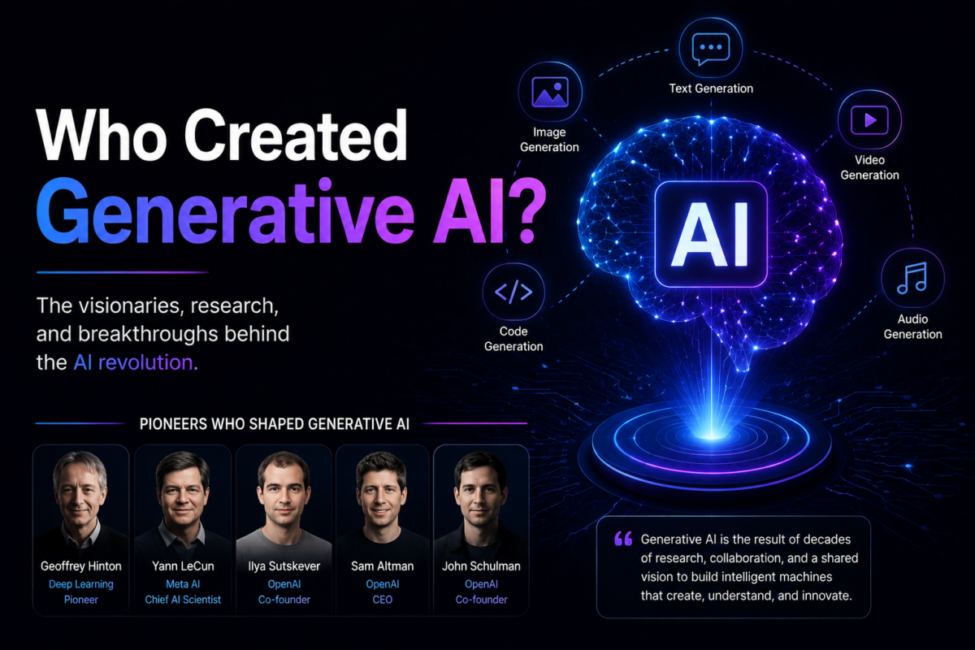
    If forced to identify the most pivotal contributors, five names and one research paper stand out above all others. Ian Goodfellow invented Generative Adversarial Networks (GANs) in 2014 — the first major architecture for generating realistic synthetic content. The Google Brain team published the Transformer architecture in 2017 — the foundational structure behind every major language model today. Geoffrey Hinton, Yann LeCun, and Yoshua Bengio (the so-called Godfathers of Deep Learning) made the mathematical breakthroughs in the 1980s–2000s that made neural networks practical. And OpenAI, Anthropic, Google DeepMind, and Stability AI built the frontier models that brought generative AI to mass adoption.

    The story of who created generative AI is really the story of how an academic research thread running from the 1940s to the 2020s suddenly crossed a capability threshold — the point where AI-generated content became indistinguishable from human-generated content at scale. Understanding that history explains both why generative AI exists and where it is going next.

    💡 Pro TipGenerative AI is often treated as a sudden phenomenon that appeared with ChatGPT in November 2022. In reality, ChatGPT was the public-facing culmination of a research program spanning decades. The key insight for anyone building on or with generative AI in 2026 is that the breakthroughs that matter most — transformers, attention mechanisms, scaling laws — happened years before the tools went viral. The next wave of generative AI capability is already in research labs today.

    2. The Early Foundations (1940s–1980s)

    The intellectual foundations of generative AI begin not with computers generating images or text, but with a simple question posed in 1950: can machines think? Alan Turing published Computing Machinery and Intelligence in 1950, proposing the now-famous Turing Test as a benchmark for machine intelligence. Turing did not build generative AI, but he established the conceptual framework — the idea that machines could produce outputs indistinguishable from human outputs — that generative AI researchers have been pursuing ever since.

    2.1 The First Neural Networks

    Warren McCulloch and Walter Pitts published the first mathematical model of a neural network in 1943, describing how interconnected nodes could perform logical computations — an abstract model loosely inspired by how biological neurons fire. Frank Rosenblatt built the Perceptron in 1958 — the first physical implementation of a learning neural network, funded by the US Navy and demonstrated on an IBM 704 computer. The Perceptron could learn to classify simple visual patterns, which seemed to herald rapid progress toward thinking machines.

    That optimism collapsed in 1969. Marvin Minsky and Seymour Papert published Perceptrons, demonstrating mathematically that single-layer neural networks could not solve non-linear problems — including the simple XOR function. Their critique triggered the first AI Winter: a period of reduced funding and interest in neural network research that lasted through the 1970s. The academic community largely abandoned neural networks in favor of symbolic AI and rule-based expert systems.

    2.2 Backpropagation — The Algorithm That Made Deep Learning Possible

    The critical breakthrough that ended the first AI Winter came in 1986. Geoffrey Hinton, David Rumelhart, and Ronald Williams published Learning representations by back-propagating errors in Nature — introducing backpropagation as a practical algorithm for training multi-layer neural networks. Backpropagation solved the fundamental problem that had stalled neural network research: it provided an efficient method for calculating how much each weight in a network should change to reduce prediction error, making it computationally feasible to train networks with multiple hidden layers.

    Hinton, based at the University of Toronto, would continue refining neural network research for the next three decades — eventually sharing the 2024 Nobel Prize in Physics with John Hopfield for their foundational contributions to the field. His students and collaborators built much of what became modern deep learning: Yann LeCun, who pioneered Convolutional Neural Networks (CNNs) for image recognition; and Yoshua Bengio at Université de Montréal, whose research on sequence modeling and distributed representations became foundational to natural language processing.

    💡 Pro TipThe 1986 backpropagation paper is the most important paper in the history of modern AI — more so than the 2017 Transformer paper, which built directly on the mathematical infrastructure that backpropagation established. Understanding why backpropagation matters (it makes gradient descent practical for deep networks) is the same as understanding why neural networks became powerful enough to generate coherent text and images.

    3. Neural Networks and Deep Learning Take Shape (1986–2012)

    Despite the backpropagation breakthrough, the 1990s brought a second AI Winter. Neural networks still required enormous computational resources that were unavailable on the hardware of the time, and alternative approaches — Support Vector Machines, decision trees, statistical methods — often outperformed neural networks on practical tasks. Research interest in neural networks declined again, though the core researchers continued their work in relative obscurity.

    3.1 Yann LeCun and Convolutional Neural Networks

    At Bell Labs in the late 1980s and 1990s, Yann LeCun developed Convolutional Neural Networks (CNNs) — a specialized architecture for processing grid-structured data like images. LeCun’s LeNet-5 system, published in 1998, could read handwritten digits and was deployed by the US Postal Service for zip code recognition. CNNs introduced parameter sharing (the same filter applied across the entire image), which dramatically reduced the number of parameters compared to fully connected networks and made image processing computationally tractable. CNNs became the foundational architecture for all modern image AI — including the image encoders used in every multimodal generative AI system in 2026.

    3.2 The 2012 ImageNet Moment — Deep Learning’s Public Debut

    The moment that changed the public perception of neural networks happened at the ImageNet Large Scale Visual Recognition Challenge (ILSVRC) in 2012. Geoffrey Hinton’s team at the University of Toronto — including his PhD students Alex Krizhevsky and Ilya Sutskever — entered a Convolutional Neural Network called AlexNet. It achieved a top-5 error rate of 15.3% — more than 10 percentage points better than the second-place entry and far beyond what any previous approach had achieved. The AI research community took notice immediately.

    AlexNet demonstrated three things simultaneously: that deep neural networks could dramatically outperform alternative methods on a hard real-world task, that GPUs (Graphics Processing Units) enabled training that was computationally infeasible on CPUs, and that large datasets combined with architectural innovations could unlock qualitative capability jumps. These three lessons — deep architectures, GPU computation, and large data — became the foundation of the deep learning era and ultimately the generative AI era that followed. Ilya Sutskever later co-founded OpenAI and served as its Chief Scientist through the development of GPT-4 and ChatGPT.

    4. The Generative Revolution — GANs, VAEs, and Diffusion (2013–2016)

    By 2013, deep learning had convincingly demonstrated its power for discriminative tasks — classifying, detecting, and recognizing. The next challenge was generative: could neural networks not just recognize content but create it? Three breakthrough architectures answered this question in rapid succession.

    4.1 Variational Autoencoders — 2013

    Diederik Kingma and Max Welling published Auto-Encoding Variational Bayes in 2013, introducing Variational Autoencoders (VAEs). A VAE compresses an input (an image, for example) into a compact latent representation, then learns to reconstruct the original input from that compressed representation. The generative insight was that by sampling from the latent space — choosing points near but not identical to the encoded inputs — the VAE could generate new, plausible outputs that resembled the training data without being exact copies. VAEs produced blurry outputs by the standards of later architectures, but they established the latent space concept that became central to every major image generation system, including Stable Diffusion’s latent diffusion architecture in 2022.

    4.2 Generative Adversarial Networks — Ian Goodfellow, 2014

    The most famous single moment in generative AI history occurred in 2014. Ian Goodfellow, then a PhD student at the Université de Montréal working under Yoshua Bengio, had the core idea for Generative Adversarial Networks at a party. The legend — supported by Goodfellow himself — is that he went home that night and implemented the first working GAN before going to sleep.

    The GAN architecture pits two neural networks against each other: a Generator that produces synthetic content (starting from random noise), and a Discriminator that tries to distinguish real content from generated content. The Generator learns to fool the Discriminator; the Discriminator learns to detect the Generator’s fakes. This adversarial process — two networks competing in a minimax game — produced the first neural network-generated images that were genuinely convincing to human viewers. Goodfellow published Generative Adversarial Nets in 2014, which became one of the most cited papers in AI history.

    GANs powered the first wave of viral generative AI content: photorealistic face generation (This Person Does Not Exist, launched 2019, runs on StyleGAN), DeepFakes, and early AI art tools. Every major image generation capability of the 2017–2021 period was built on GAN variants. Goodfellow later worked at Apple and Google before founding a safety-focused AI lab — his 2014 paper remains the intellectual origin point of image generation AI.

    4.3 Diffusion Models — The Architecture Behind Stable Diffusion and DALL-E 2

    Jascha Sohl-Dickstein and colleagues at Stanford published the first paper on diffusion models in 2015, with Jonathan Ho, Ajay Jain, and Pieter Abbeel significantly advancing the approach at UC Berkeley in 2020. Diffusion models work by gradually adding random noise to training images until they become pure noise, then training a neural network to reverse the process — learning to denoise images step by step until a coherent image emerges from random noise.

    This denoising approach proved dramatically more stable and controllable than GANs, which suffered from mode collapse (generating repetitive outputs) and training instability. Diffusion models produce higher quality and more diverse outputs. Stable Diffusion (released 2022 by Stability AI, based on research from CompVis at Ludwig Maximilian University of Munich and Runway ML), DALL-E 2 (OpenAI, 2022), and Midjourney all use diffusion as their core generation mechanism. As of 2026, diffusion models remain the dominant architecture for high-quality image generation.

    5. The Transformer Era — How Modern Language AI Was Born (2017–2019)

    The single most important paper in the history of generative AI for text was published by a Google Brain team in 2017. Attention Is All You Need, authored by Ashish Vaswani, Noam Shazeer, Niki Parmar, Jakob Uszkoreit, Llion Jones, Aidan Gomez, Łukasz Kaiser, and Illia Polosukhin, introduced the Transformer architecture. Every major language model in use in 2026 — GPT-5.5, Claude Opus 4.7, Gemini 3.1, Llama 4, Mistral, DeepSeek — is built on the Transformer.

    5.1 The Attention Mechanism — Why Transformers Transformed AI

    Prior to transformers, language models used Recurrent Neural Networks (RNNs) or Long Short-Term Memory networks (LSTMs), which processed text sequentially — one word at a time, in order. This sequential processing created two problems: it was slow (could not be parallelized), and it struggled to maintain context over long sequences because information from early in the sequence was compressed and lost before the model reached the end.

    The Transformer replaced sequential processing with the self-attention mechanism. Self-attention allows every word (token) in a sequence to attend to every other word simultaneously — computing relevance scores that determine how much each token should influence the representation of every other token. This attention over the full sequence is computed in parallel rather than sequentially, enabling dramatically faster training on GPUs and maintaining coherent context across much longer input sequences. The paper’s title — Attention Is All You Need — was a direct provocation: you do not need RNNs or LSTMs at all.

    5.2 BERT and GPT — Two Directions from the Transformer

    Google’s BERT (Bidirectional Encoder Representations from Transformers, 2018) used the Transformer encoder to produce contextual word representations — bidirectional, meaning the model saw the full context around each word. BERT became the dominant architecture for language understanding tasks.

    OpenAI’s GPT (Generative Pre-trained Transformer, 2018) used the Transformer decoder for text generation — trained to predict the next word in a sequence, seeing only previous words, making it naturally suited for generative tasks. GPT-1 demonstrated that a large Transformer model pre-trained on internet text could be fine-tuned for diverse downstream tasks with minimal task-specific data. GPT-2 (2019) generated coherent paragraphs that prompted OpenAI to initially withhold the full model over concerns about misuse — the first public AI safety debate about a specific language model. GPT-3 (2020) scaled to 175 billion parameters and demonstrated emergent capabilities: the model could perform tasks it had never been explicitly trained for, just from context in the prompt.

    6. Scaling Laws and the GPT Breakthrough (2018–2020)

    The scaling laws insight — published by OpenAI researchers Jared Kaplan, Sam McCandlish, and colleagues in 2020 — established one of the most important empirical findings in AI: model performance improves predictably as a power law of model size, dataset size, and compute. More parameters plus more data plus more compute equals better models, reliably and predictably. This finding justified the investment in increasingly large models and set the trajectory for the frontier model race that characterizes the AI industry in 2026.

    6.1 DALL-E, CLIP, and Multimodal Breakthroughs

    OpenAI published CLIP (Contrastive Language-Image Pre-training) and DALL-E in 2021. CLIP trained jointly on image-text pairs from the internet, learning to match images to their text descriptions — creating the first powerful bridge between language and vision representations. DALL-E used CLIP’s image-text alignment to generate images from text descriptions, demonstrating for the first time that a language-trained model could produce coherent visual content when prompted in natural language. These two papers are the direct ancestors of every text-to-image and multimodal generative AI system in use in 2026.

    6.2 ChatGPT and the Public Inflection Point

    On November 30, 2022, OpenAI launched ChatGPT — a conversational interface to GPT-3.5 fine-tuned with Reinforcement Learning from Human Feedback (RLHF). RLHF, developed by researchers including Paul Christiano at OpenAI and later Anthropic, trained the model to be helpful, harmless, and honest by having human raters evaluate and rank model responses, then using those rankings to fine-tune the model toward outputs humans preferred.

    ChatGPT reached one million users in five days and 100 million users within 60 days — the fastest product adoption in recorded technology history. The public demonstration that a language model could hold coherent multi-turn conversations, write code, draft essays, explain complex topics, and assist with creative work made generative AI a mainstream business and cultural topic overnight. Every major AI product launched since November 2022 — Claude, Gemini, Copilot, Perplexity, Midjourney v5, Stable Diffusion XL — is a response to or extension of the paradigm that ChatGPT demonstrated.

    7. The Key Organizations That Built Generative AI

    Generative AI was built across a distributed network of academic institutions and private organizations. Here are the most important contributors and their specific roles.

    OrganizationTypeKey PeriodPrimary Contribution
    University of TorontoAcademic1980s–2012Backpropagation (Hinton), deep learning foundations
    Bell Labs / NYUAcademic/Industry1990s–2000sCNNs and image recognition (LeCun)
    Université de MontréalAcademic2000s–2014Sequence modeling (Bengio), GANs (Goodfellow)
    Google Brain / DeepMindIndustry Research2011–presentTransformer architecture, BERT, Gemini models
    OpenAIIndustry Research2015–presentGPT series, DALL-E, CLIP, ChatGPT, Sora
    AnthropicIndustry Research2021–presentClaude models, Constitutional AI, RLHF advances
    Stability AIIndustry2020–presentStable Diffusion (with CompVis Munich)
    Hugging FaceIndustry2016–presentOpen-source model ecosystem, Transformers library
    Meta AI ResearchIndustry Research2013–presentLLaMA series, PyTorch, self-supervised learning
    DeepSeekIndustry Research2023–presentDeepSeek-R1, cost-efficient frontier training
    💡 Pro TipMany of the most important generative AI breakthroughs came from academic researchers who later moved into industry. Ian Goodfellow (GANs) went to Google Brain, then Apple, then founded a lab. Ilya Sutskever (AlexNet co-creator) co-founded OpenAI. Aidan Gomez (Transformer co-author) co-founded Cohere. The academic research pipeline that trained these researchers — particularly at Toronto, Montréal, Stanford, MIT, and Cambridge — is the foundation that the commercial AI industry is built on.

    8. The Landmark Models Timeline

    YearModelCreatorTypeSignificanceImpact
    2013VAEKingma, WellingImage GenFirst practical latent space generative modelHigh
    2014GANIan GoodfellowImage GenAdversarial training for realistic image synthesisTransformative
    2015DiffusionSohl-DicksteinImage GenDenoising-based generation — foundation of SDHigh
    2017TransformerGoogle BrainArchitectureAttention mechanism — powers all modern LLMsTransformative
    2018BERTGoogleNLPBidirectional contextual language understandingVery High
    2018GPT-1OpenAINLPGenerative pre-training on internet textHigh
    2019GPT-2OpenAINLPCoherent long-form text — first safety controversyVery High
    2020GPT-3OpenAINLP175B parameters, in-context learning emergesTransformative
    2021DALL-E / CLIPOpenAIMultimodalText-to-image from language promptsVery High
    2021GitHub CopilotGitHub / OpenAICodingFirst mass-adopted AI coding assistantVery High
    2022ChatGPTOpenAIChatbot100M users in 60 days — public inflection pointTransformative
    2022Stable DiffusionStability AIImage GenOpen-source image generation for everyoneTransformative
    2022Claude 1AnthropicLLMConstitutional AI approach to safetyHigh
    2023GPT-4OpenAILLMMultimodal, near-human benchmark performanceTransformative
    2023Llama 2MetaOpen LLMOpen-weight frontier model for research and businessVery High
    2024Claude 3AnthropicLLMOpus leads MMLU, best long-context reasoningVery High
    2025DeepSeek-R1DeepSeekLLMFrontier reasoning at $6M training costTransformative
    2025Gemini 2 ProGoogleLLM94%+ GPQA Diamond, fastest frontier outputVery High
    2026GPT-5.5OpenAILLMRebuilt architecture, leads Intelligence Index at 60Transformative
    2026Llama 4 ScoutMetaOpen LLM10M token context, 2600 t/s, open-weight recordTransformative

    9. Frequently Asked Questions

    Who invented generative AI?

    Generative AI does not have a single inventor. The technology is the product of decades of cumulative research. The most pivotal individual contributions are: Ian Goodfellow (GANs, 2014), Ashish Vaswani and the Google Brain team (Transformer, 2017), Geoffrey Hinton, Yann LeCun, and Yoshua Bengio (deep learning foundations, 1986–2012), and the OpenAI team (GPT series and ChatGPT, 2018–2022). If forced to name one person as the most directly influential on generative AI as it exists in 2026, Ian Goodfellow’s GAN paper and the Google Brain Transformer paper are the two most cited foundational contributions.

    Did OpenAI invent generative AI?

    No. OpenAI made critical contributions — the GPT series, DALL-E, CLIP, ChatGPT, and RLHF fine-tuning — but they built on decades of academic research they did not initiate. The Transformer architecture that powers all OpenAI models was invented at Google Brain. The deep learning foundations were established at the University of Toronto, Université de Montréal, and Bell Labs. OpenAI’s contribution was scaling these architectures aggressively, applying RLHF to make models helpful and safe, and building the consumer products (ChatGPT) that brought generative AI to public awareness. OpenAI is the company most associated with the public launch of the generative AI era, but it is not the origin of the underlying technology.

    What was the first generative AI model?

    The first practically significant generative AI model was the GAN (Generative Adversarial Network) introduced by Ian Goodfellow in 2014. Earlier models like Boltzmann Machines (1980s) and Variational Autoencoders (2013) had generative capabilities, but GANs were the first to produce convincingly realistic synthetic content at scale. If the question is specifically about text generation, the Transformer-based GPT-1 (OpenAI, 2018) is the most direct ancestor of modern text generative AI, though earlier statistical language models from the 1990s and 2000s had limited text generation capabilities.

    Who are the Godfathers of AI?

    The three researchers most frequently called the Godfathers of AI or Godfathers of Deep Learning are Geoffrey Hinton (University of Toronto, then Google Brain), Yann LeCun (Bell Labs, then Meta AI), and Yoshua Bengio (Université de Montréal). All three received the 2018 Turing Award — computing’s Nobel Prize — for their foundational contributions to deep learning. Hinton shared the 2024 Nobel Prize in Physics with John Hopfield for their contributions to neural network research. Their decades of work on backpropagation, convolutional networks, and representation learning created the mathematical and architectural foundations that make generative AI possible.

    Who invented the ChatGPT technology?

    ChatGPT is built on multiple technologies invented by different teams. The Transformer architecture was invented at Google Brain (Vaswani et al., 2017). The GPT pre-training approach was developed by the OpenAI team including Alec Radford, Karthik Narasimhan, Tim Salimans, and Ilya Sutskever (2018). The RLHF fine-tuning method that makes ChatGPT helpful and safe was developed by researchers including Paul Christiano (then at OpenAI, later Anthropic), John Schulman, and colleagues. The specific ChatGPT product was developed by the OpenAI team led by Sam Altman (CEO) and with Ilya Sutskever as Chief Scientist. ChatGPT’s launch on November 30, 2022 was the product of all these contributions combined.

    When was generative AI invented?

    There is no single invention date because generative AI evolved gradually across decades. Key dates: 1986 (backpropagation, which made training neural networks practical), 2014 (GANs, the first architecture specifically designed for generating realistic content), 2017 (Transformer, the architecture behind all modern language models), 2020 (diffusion models refined, powering Stable Diffusion), 2022 (ChatGPT and Stable Diffusion launch, bringing generative AI to mainstream public awareness). If a single year must be chosen, 2014 marks the first architecture specifically designed for content generation, while 2022 marks the public inflection point when generative AI became a mainstream technology used by hundreds of millions of people.

    Is Geoffrey Hinton the father of AI?

    Geoffrey Hinton is frequently described as the Godfather of Deep Learning or the Godfather of AI — a fair characterization given his foundational contributions over four decades. His 1986 backpropagation paper made training deep neural networks practical. His lab produced AlexNet (2012), which demonstrated deep learning’s superiority on image recognition and launched the modern AI era. His students and collaborators built much of what became the AI industry: Ilya Sutskever (OpenAI), Yann LeCun (Meta AI), Brendan Frey, and many others. Hinton received the 2024 Nobel Prize in Physics alongside John Hopfield for their neural network contributions. He left Google in 2023 to speak freely about AI safety risks — a decision that itself shaped the public AI safety discourse significantly.

    What is the role of Google in creating generative AI?

    Google’s contributions to generative AI are arguably the most foundational of any single organization. The 2017 Transformer paper — the architecture behind every modern LLM — was written by Google Brain researchers. BERT (2018) defined how Transformers are used for language understanding. Google’s research on scaling laws informed the GPT-3 and subsequent frontier model design. Google DeepMind produced AlphaGo (2016) and AlphaFold (2020), demonstrating AI’s capability in strategic reasoning and protein structure prediction. In 2026, Google’s Gemini 3.1 Pro leads scientific reasoning benchmarks at 94.3% GPQA Diamond. Despite often being second to market on consumer products (Bard launched after ChatGPT, Google Pixel struggled to match iPhone AI features in early releases), Google’s research output has been more consistently foundational than any other single organization.

    Who is responsible for AI safety in generative AI?

    AI safety as a formal research discipline was pioneered at several organizations simultaneously. Anthropic — founded in 2021 by Dario Amodei, Daniela Amodei, and colleagues who left OpenAI — was created specifically around the mission of AI safety research, developing Constitutional AI as a training method for producing helpful, harmless, and honest models. OpenAI’s Superalignment team (before significant departures in 2024) worked on scalable oversight for superintelligent AI. DeepMind’s safety team has published extensively on specification problems and reward hacking. The Machine Intelligence Research Institute (MIRI) and Center for Human-Compatible AI (CHAI) at UC Berkeley have contributed formal theoretical frameworks. Geoffrey Hinton’s 2023 departure from Google was specifically to advocate publicly for AI safety concerns, elevating the issue’s public profile significantly.

    10. Conclusion

    Generative AI was created by no single person and no single moment. It emerged from a lineage of mathematical insights stretching from Warren McCulloch and Walter Pitts’s 1943 neural network model through Alan Turing’s 1950 intelligence framework, through Geoffrey Hinton’s 1986 backpropagation algorithm, through Yann LeCun’s CNN breakthroughs, through Ian Goodfellow’s 2014 GAN invention, through the Google Brain team’s 2017 Transformer architecture, through OpenAI’s GPT series and ChatGPT launch in 2022.

    What the history makes clear is that generative AI’s public arrival in 2022 was not a surprise to anyone who had been watching the research trajectory. The capability curves had been climbing steadily for decades — the 2022 moment was when they crossed the threshold of public usefulness simultaneously across text generation (ChatGPT), image generation (Stable Diffusion, Midjourney), and code generation (GitHub Copilot). The next decade’s generative AI developments are already visible in research labs in 2026 — just as the 2022 wave was visible in the 2017 Transformer paper to those who were looking.

    Share. Facebook Twitter Pinterest LinkedIn Tumblr Email
    Previous ArticleHow Does Generative AI Work? Complete Guide 2026
    Next Article What is Optimization in Engineering? Complete AI-Powered Guide [2026]
    TechieHub

      Related Posts

      Best AI Search Monitoring Tools 2026

      May 10, 2026

      Best AI APIs: Complete Developer Guide 2026

      April 29, 2026

      What Are AI Hallucinations? Complete Guide 2026

      April 27, 2026
      View 6 Comments

      6 Comments

      1. AI Music Generator on December 26, 2025 5:27 am

        I didn’t realize how much the development of generative AI has relied on earlier innovations like GANs and VAEs. It’s amazing to see how these foundational models set the stage for things like GPT-5 and Claude. I’m excited to see how the field will continue to evolve!

        Reply
      2. Pingback: Why Is Generative AI Important? Complete Impact Guide 2026

      3. Pingback: Generative AI for Content Creation: Complete Guide 2026

      4. Pingback: What is Claude? Complete Guide to Anthropic's AI Assistant 2026

      5. seedream on March 9, 2026 4:15 pm

        It’s fascinating to see how generative AI evolved from the foundational work of Hinton, LeCun, and Bengio, especially their contributions to deep learning and neural networks. The mention of the Transformer architecture really highlights how pivotal that 2017 paper was in enabling the language models we use today. Understanding the lineage of GANs, VAEs, and diffusion models helps put into perspective just how much innovation was built on previous breakthroughs.

        Reply
        • TechieHub on April 9, 2026 6:57 pm

          Thank you for taking the time to share your thoughts! We truly appreciate the support and are glad you found value here. Stay connected—there’s more helpful content coming your way.

          Reply
      Leave A Reply Cancel Reply

      Editors Picks

      Best AI Search Monitoring Tools 2026

      May 10, 2026

      Best AI APIs: Complete Developer Guide 2026

      April 29, 2026

      What Are AI Hallucinations? Complete Guide 2026

      April 27, 2026

      What is Prompt Engineering? Complete Guide 2026

      April 27, 2026
      Techiehub
      • Home
      • Featured
      • Latest Posts
      • Latest in Tech
      • Privacy Policy
      • Terms and Conditions
      Copyright © 2026 Tchiehub. All Right Reserved.

      Type above and press Enter to search. Press Esc to cancel.