


A clear, complete guide to generative AI — what it is, how it actually works, the main types and tools, why it matters for business, and the honest limitations everyone should understand before relying on it.
| $53.7B Generative AI Market (2025) | $1T+ Projected by 2035 | ~30% Annual Growth (CAGR) | 92% Fortune 500 Use OpenAI Tech | 88% Leaders Prioritizing AI |
| Quick answer: Generative AI is a type of artificial intelligence that creates new content — text, images, video, audio and code — by learning patterns from massive datasets. Tools like ChatGPT, Claude, Gemini, Midjourney and DALL·E are generative AI. It works through large neural networks, mainly transformers for text and diffusion models for images, trained to predict and produce human-like output. |
Key Takeaways
- Generative AI creates new content (text, images, video, audio, code) rather than just analyzing existing data.
- It is powered by large neural networks — transformers for text and large language models, diffusion models for images — trained on enormous datasets.
- The market is roughly $53.7B (2025) and heading past $1 trillion by 2035; 92% of Fortune 500 companies already use OpenAI’s technology.
- It is powerful but imperfect — outputs can be wrong (hallucinations) or biased, so human review remains essential.
Table of Contents
1. What Is Generative AI?
Generative AI is a branch of artificial intelligence that produces brand-new content — written text, images, video, audio, code and more — rather than simply classifying or analyzing data that already exists. Where a traditional machine-learning model might look at an email and label it “spam” or “not spam,” a generative model can write the email from scratch. That shift from recognizing to creating is what makes the technology feel so different, and why it has moved from research labs into everyday tools in just a few years.
The defining trait is that generative AI learns the underlying patterns of its training data and then uses those patterns to generate plausible new examples. A model trained on billions of sentences learns how language is structured and can compose a coherent paragraph; a model trained on millions of captioned images learns the relationship between words and pixels and can paint a picture from a description. The output is original in the sense that it did not exist before, even though it is assembled from patterns the model absorbed during training.
You have almost certainly used it already. ChatGPT, Claude and Gemini are generative AI for text; Midjourney, DALL·E and Stable Diffusion are generative AI for images; tools like Suno and ElevenLabs generate music and voice; and GitHub Copilot generates code. All of them rest on the same core idea — a large model trained to predict and produce content — even though they specialize in different media. Understanding that shared foundation makes the whole landscape far easier to navigate.
A useful way to frame it is the difference between discriminative and generative models. A discriminative model draws boundaries — it decides which category something belongs to, like telling a cat photo from a dog photo. A generative model learns the distribution of the data well enough to produce convincing new examples — it can draw a brand-new cat. That generative capability is what lets a single tool answer a question, summarize a report, write a poem and draft code, because it has learned the deep patterns of language rather than memorizing fixed answers. It is also why generative AI is often described as a “general-purpose” technology: the same underlying capability applies to an enormous range of tasks, which is rare and is a big part of why its impact is so broad.
2. How Generative AI Works
At the heart of modern generative AI is the neural network — a system loosely inspired by the brain, made of layers of interconnected nodes that adjust as they learn. During training, the model is shown vast amounts of data and repeatedly asked to predict the next piece (the next word, the next pixel), checking its guess against reality and nudging its internal settings, or parameters, to be a little more accurate each time. Repeat this across trillions of examples and billions of parameters, and the model gradually encodes a rich statistical understanding of language, images or sound.
Two architectures dominate today. For text, the breakthrough was the transformer, introduced by Google researchers in 2017. Transformers use a mechanism called attention to weigh how much each word relates to every other word in a passage, which lets them capture context and meaning far better than earlier approaches. Large language models (LLMs) like GPT, Claude and Gemini are transformers scaled up to enormous size — to understand them in depth, see our guide to the best AI models. For images, the leading approach is the diffusion model, which learns to turn random noise into a coherent image step by step, guided by a text prompt. Both share the same logic: learn patterns from data, then generate new content that fits those patterns.
It helps to demystify what a model is doing when it answers you. A text model is, at its core, predicting the most likely next token (a word or word-fragment) given everything before it, one token at a time, until the response is complete. That simple-sounding process — next-token prediction at massive scale — is enough to produce essays, code and arguments, because so much of human knowledge is encoded in the patterns of language. It also explains the technology’s biggest weakness: a model optimized to produce plausible text will sometimes produce confident, fluent statements that are simply wrong. We return to that below.
Modern models are built in stages, and knowing them clears up a lot of confusion. First comes pre-training, where the model learns general patterns from a vast corpus of text or images — this is the expensive, compute-heavy phase that builds raw capability. Next is fine-tuning, where the model is further trained on narrower, higher-quality data to specialize its behavior. Finally, many assistants go through reinforcement learning from human feedback (RLHF), where human raters score responses so the model learns to be more helpful, honest and safe. The same base model can be adapted for very different uses depending on how it is fine-tuned, which is why two products built on similar technology can feel quite different to use.
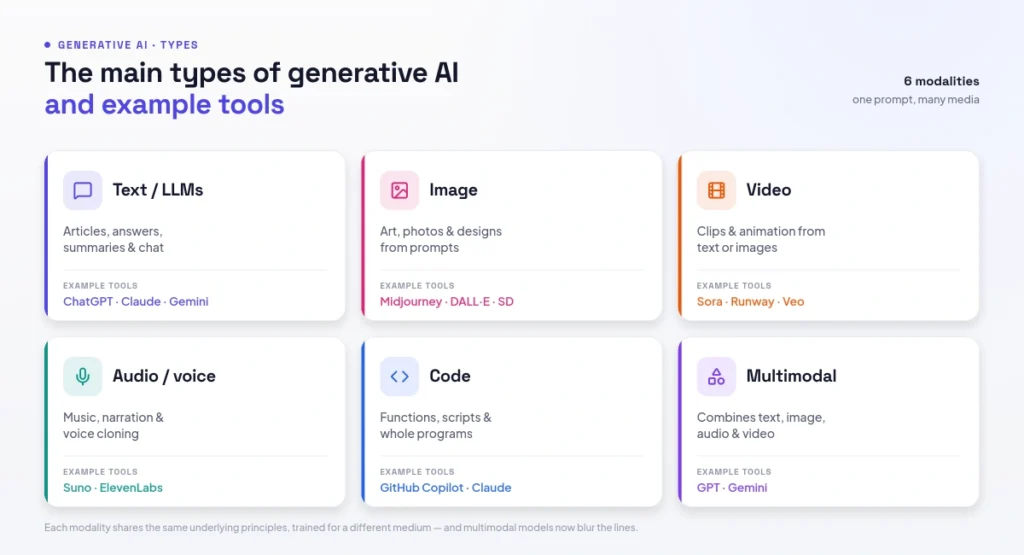
Figure 2: How generative AI learns patterns and generates new content
3. The Main Types of Generative AI
Generative AI is best understood by the kind of content it produces. Each type uses similar underlying principles but is trained and tuned for a different medium.
| Type | What it generates | Example tools |
|---|---|---|
| Text / LLMs | Articles, answers, summaries, chat | ChatGPT, Claude, Gemini |
| Image | Art, photos, designs from prompts | Midjourney, DALL·E, Stable Diffusion |
| Video | Clips and animation from text or images | Sora, Runway, Veo |
| Audio / voice | Music, narration, voice cloning | Suno, ElevenLabs |
| Code | Functions, scripts, whole programs | GitHub Copilot, Claude |
| Multimodal | Combines text, image, audio, video | GPT, Gemini |
The fastest-growing frontier is multimodal AI — single models that can read an image, listen to audio and respond in text, or take a text prompt and return a video. This convergence is why the same assistant can now describe a photo you upload, write code, and draft an email in one conversation. For most people, text generation through LLMs is the entry point, but image, video and audio generation are advancing just as quickly, and the lines between them are blurring fast.
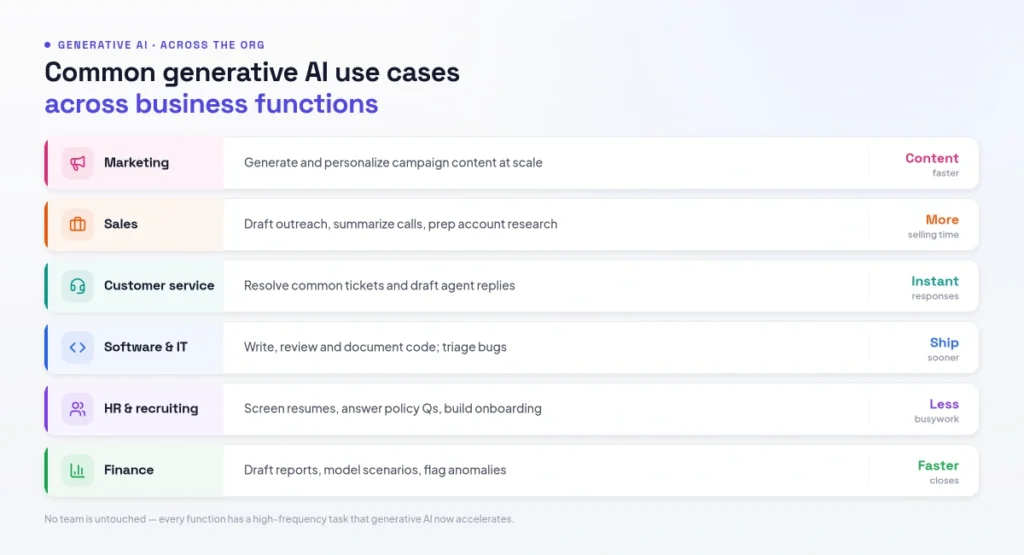
Figure 3: The main types of generative AI and example tools
4. A Short History of Generative AI
Generative AI did not appear overnight. Its roots run back decades, through early neural networks and statistical language models, but the modern era is usually traced to a few pivotal breakthroughs: generative adversarial networks (GANs) in 2014, which pitted two networks against each other to create realistic images; the transformer architecture in 2017, which unlocked today’s language models; and the public release of large, capable models that brought the technology to a mass audience. The launch of ChatGPT in particular turned generative AI from a specialist tool into a household phenomenon almost overnight.
The story is also one of organizations and researchers — OpenAI, Google DeepMind, Anthropic, Meta and others — building on each other’s work, alongside academic labs that published the foundational ideas. The “who” and “when” of that history is rich enough to deserve its own treatment; for the full story of the people and labs behind the technology, see our guide to who created generative AI. What matters here is the trajectory: each breakthrough made models more capable, more general and more accessible, compounding into the rapid adoption we see today.
5. Why Generative AI Matters
The simplest reason generative AI matters is leverage: it compresses tasks that used to take hours into minutes, and puts capabilities that once required specialists — writing, design, coding, analysis — into far more hands. A marketer can draft a campaign, a founder can prototype an app, and a researcher can summarize a stack of papers, all with the same kind of tool. That broad applicability is why it is being adopted across virtually every industry at once rather than in a single niche.
The numbers reflect the scale of the shift. The generative AI market was valued at roughly $53.7 billion in 2025 and is projected to grow past $1 trillion by the mid-2030s at around a 30% annual rate (Global Market Insights). Adoption among large enterprises is already mainstream: about 92% of Fortune 500 companies use OpenAI’s technology, and the vast majority of business leaders rank accelerating AI adoption as a top priority. A small group of providers — OpenAI, Anthropic, NVIDIA, Adobe and Microsoft — account for well over half the market, signaling a fast-consolidating but still rapidly expanding industry.
For businesses specifically, the value shows up in three places: productivity (automating drafting, summarizing and routine analysis), creativity (generating options and first drafts faster than any team could alone), and personalization (tailoring content and experiences at scale). We explore the strategic stakes in depth in our guide to why generative AI is important, and the practical toolkit in our roundup of the best AI tools for business.
The impact also varies sharply by industry, which is part of why adoption is so broad. In healthcare and life sciences, generative models accelerate drug discovery, draft clinical documentation and power patient-support assistants. In finance, they summarize filings, draft reports and assist with analysis. In retail and e-commerce, they generate product descriptions and personalized recommendations at scale. In media and design, they produce copy, images and video. And in software, they have already changed how code is written. Each sector adopts the same core technology but applies it to its own highest-volume, most repetitive work first — and that pattern, more than any single use case, is what makes generative AI a general-purpose technology rather than a niche tool.
| 💡 Pro Tip The biggest early wins from generative AI come from the boring, repetitive work — first drafts, summaries, formatting, brainstorming — not from trying to automate your hardest judgment calls. Start where the task is high-volume and low-risk, and keep a human reviewing the output. |
6. Generative AI Tools & Use Cases
The practical power of generative AI lives in its use cases. In marketing and content, teams use it to draft articles, ad copy, social posts and email campaigns, then edit for brand voice — a workflow we cover in our guide to generative AI tools for content creation. In software development, AI assistants generate, explain and debug code. In customer service, chatbots and assistants handle routine questions and draft replies. In design, image and video generators turn briefs into visuals in seconds. And in research and operations, models summarize documents, extract insights and automate reporting.
Choosing the right tool depends on the job. For open-ended writing, reasoning and analysis, a general assistant like ChatGPT, Claude or Gemini is the workhorse. For images you want Midjourney, DALL·E or Stable Diffusion; for video, tools like Runway or Sora; for code, GitHub Copilot or Claude. The ecosystem is large and changing weekly, so the right approach is to match the tool to the task rather than chase a single “best” app. Our regularly updated roundup of generative AI tools breaks down the leading options by category.
A practical pattern is emerging across teams: use generative AI for the first 80% — the draft, the outline, the rough cut — and reserve human effort for the final 20% of judgment, accuracy and taste. That division of labor captures most of the speed benefit while keeping quality and accountability where they belong, with people. The organizations getting real value are the ones building this workflow deliberately, not the ones expecting the AI to do the whole job unsupervised.
Getting good results comes down to how you ask. The skill of writing clear, specific instructions — known as prompt engineering — has an outsized effect on output quality. A vague request (“write about marketing”) produces generic filler; a specific one (“write a 150-word LinkedIn post for B2B founders on why AEO matters, with a data point and a call to action”) produces something usable. The basics are simple: give context, state the format and length you want, provide an example if you can, and iterate on the result rather than expecting perfection on the first try. These habits matter across every type of generative AI, from text to image to code.
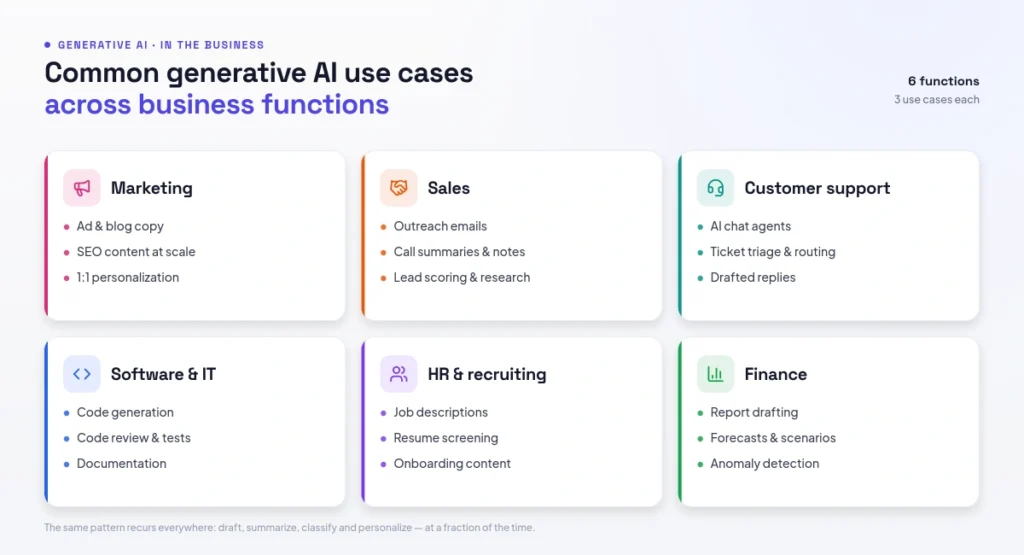
Figure 4: Common generative AI use cases across business functions
7. Benefits and Limitations
The benefits are substantial and well documented: dramatic speed on content and code, lower cost for tasks that once required specialists, the ability to generate and test many options quickly, and round-the-clock availability. For many routine tasks, a capable model produces a usable first draft in seconds that would have taken a person far longer — and that compounding time savings is the core of the business case.
Beyond raw speed, generative AI lowers the barrier to capabilities people did not have before. Someone who cannot draw can generate an illustration; someone who cannot code can scaffold a working script; someone facing a blank page gets a first draft to react to, which is often the hardest part of any creative task. It scales effortlessly — the same assistant can help one person or ten thousand — and it is available instantly at any hour. For small teams especially, this is transformative: it gives a handful of people the output leverage that used to require a much larger headcount, which is why startups and solo operators have been among the fastest and most enthusiastic adopters.
But the limitations are just as real, and ignoring them is where organizations get burned. The most important is hallucination: because models generate plausible text rather than retrieve verified facts, they can state false information — invented statistics, fake citations, confident errors — with total fluency. Our guide to AI hallucinations covers why this happens and how to manage it. Models can also reflect bias present in their training data, raise privacy and copyright questions about what data they were trained on and what you feed them, and carry real compute and cost footprints. None of these are reasons to avoid the technology — they are reasons to use it with a human in the loop.
| ⚠️ Important Never treat generative AI output as automatically accurate. Verify facts, figures and citations before publishing or making decisions, and avoid pasting confidential or personal data into consumer tools unless you know how that data is used. The technology is an accelerator for human judgment, not a replacement for it. |
8. The Future of Generative AI
Three trends are shaping what comes next. The first is multimodality — models that fluidly combine text, images, audio and video are becoming the norm, making assistants more capable and more natural to work with. The second is agentic AI: systems that do not just generate content but take actions — browsing, using tools, completing multi-step tasks on your behalf. This is the leap from a model that answers questions to one that gets work done, and it is the focus of our guide to the best AI agents.
The third trend is specialization and efficiency: smaller, cheaper, domain-tuned models that run faster and even on local devices, alongside the giant frontier models. Together these point to a future where generative AI is less a single chatbot you visit and more an invisible layer woven through the software you already use — drafting, designing, coding and deciding alongside you. The organizations preparing now, by building AI literacy and sensible guardrails, will be best placed to benefit as the capability curve keeps rising.
Alongside the technology, expect the rules around it to mature. Questions of copyright, training-data provenance, transparency and AI regulation are moving quickly, and businesses will increasingly need clear internal policies on what data can be fed to which tools and how AI-generated content is reviewed and disclosed. None of this slows the underlying trajectory, but it does mean that the winners will be the organizations that treat governance as part of their AI strategy rather than an afterthought — pairing aggressive adoption with deliberate guardrails so that speed never comes at the expense of trust, accuracy or compliance.
9. Frequently Asked Questions
What is generative AI in simple terms?
Generative AI is artificial intelligence that creates new content — text, images, video, audio or code — instead of just analyzing existing data. It learns patterns from huge datasets and uses them to produce original, human-like output. ChatGPT, Claude, Midjourney and DALL·E are all examples of generative AI.
How is generative AI different from regular AI?
Traditional AI mostly recognizes, classifies or predicts based on existing data — for example, labeling an email as spam. Generative AI goes further by creating something new, such as writing the email itself. The difference is recognizing versus creating, and it is what makes generative AI feel so novel.
How does generative AI actually work?
Generative AI uses large neural networks trained on massive datasets to learn patterns, then generates new content that fits those patterns. Text models use transformer architectures and predict the next word one token at a time, while image models often use diffusion, turning noise into a picture step by step guided by a prompt.
What are examples of generative AI tools?
For text, ChatGPT, Claude and Gemini; for images, Midjourney, DALL·E and Stable Diffusion; for video, Sora and Runway; for audio, Suno and ElevenLabs; and for code, GitHub Copilot. Many are multimodal, handling several content types in one tool.
Is generative AI safe to use for business?
Yes, when used thoughtfully. The keys are verifying outputs for accuracy, protecting confidential data, and keeping a human in the loop for decisions. Most enterprises already use generative AI — about 92% of Fortune 500 companies use OpenAI’s technology — but with governance and review processes in place.
Can generative AI replace human jobs?
Generative AI automates tasks more than whole jobs. It excels at drafting, summarizing and routine creation, freeing people for higher-value judgment, strategy and relationships. Most organizations are using it to augment teams and boost productivity rather than to replace people outright, though roles are evolving.
What are the main risks of generative AI?
The biggest risks are hallucinations (confident but false output), bias inherited from training data, privacy and copyright concerns, and over-reliance without verification. These are manageable with human review, clear data policies and fact-checking, but they should never be ignored.
Do I need technical skills to use generative AI?
No. Modern tools use plain-language prompts, so anyone can get value without coding. The main skill is learning to ask clearly and iterate — sometimes called prompt engineering. Better prompts produce better results, but the barrier to entry is low and getting lower.
10. Conclusion & Key Takeaways
Generative AI is the most consequential technology shift of the decade because it changes what computers can do — from recognizing patterns to creating content. It rests on a simple idea executed at enormous scale: learn from data, then generate. That foundation now powers text, images, video, audio and code, and it is being adopted across every industry at a pace few technologies have matched. The opportunity is real, and so is the responsibility: use it to accelerate human work, not to replace human judgment. To go deeper, explore the best AI models behind these tools and the best AI tools for business.
- Generative AI creates new content rather than just analyzing data — that shift from recognizing to creating is the core idea.
- It works via large neural networks: transformers for text and LLMs, diffusion models for images, trained on massive datasets.
- The market is ~$53.7B (2025) heading past $1 trillion by 2035; 92% of Fortune 500 already use OpenAI’s technology.
- Its main types span text, image, video, audio, code and multimodal — with multimodal and agentic AI as the next frontier.
- It is powerful but imperfect: verify outputs, protect data, and keep a human in the loop.
Generative AI has turned creation itself into something software can do — and we are still early. Learn the fundamentals, adopt it where it saves real time, and pair its speed with human judgment to get the best of both.

2 Comments
I love how this post shows the real potential of integrating AI into the workflow. It’s not just about efficiency, but also the creativity it brings to the table. Using AI to enhance both the writing and design process feels like the future of content creation.
Thank you for taking the time to share your thoughts! We truly appreciate the support and are glad you found value here. Stay connected—there’s more helpful content coming your way.