


How we compare: TechieHub tests generative-search tactics against live answers in ChatGPT, Perplexity and Google AI Overviews, and weighs them against the peer-reviewed research below rather than vendor marketing. Affiliate disclosure: some links to third-party tools may earn us a commission at no extra cost to you — it never changes which tools we recommend. Our guide to AI citation analysis tools compares the tools for that job.
Related: our LLMEO strategies playbook covers the execution side of earning AI citations.
| Quick answer: Generative engine optimization (GEO) is the practice of shaping your content so AI engines like ChatGPT, Perplexity and Google AI Overviews cite and recommend your brand inside their answers. Instead of chasing ranking positions, GEO earns citations through authority, clear structure, defined entities, original statistics and expert quotes. It layers on top of SEO, not instead of it. |
Table of Contents
What is generative engine optimization?
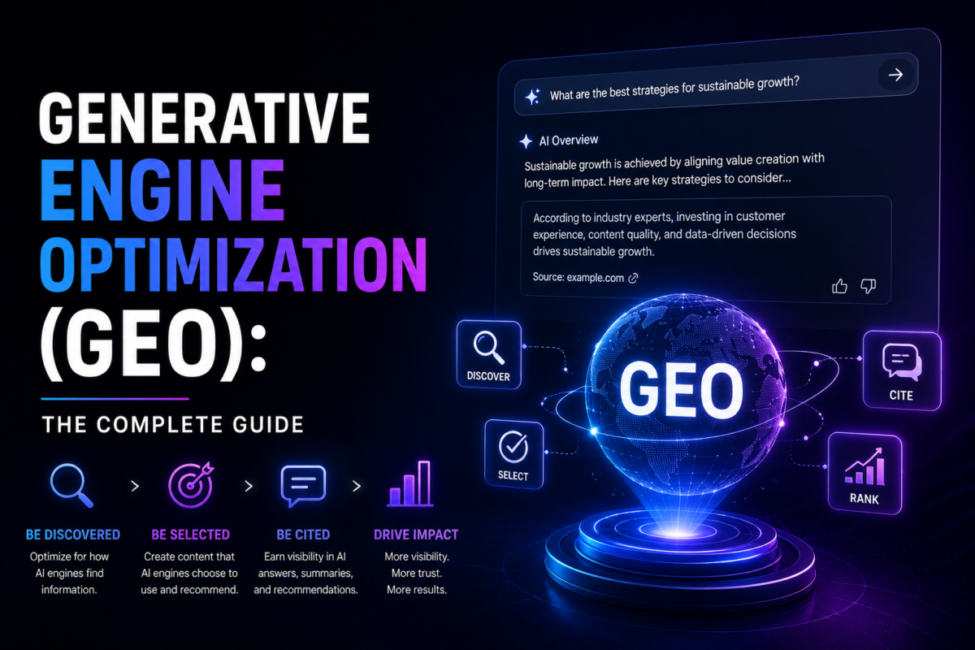
Generative engine optimization is the discipline of optimizing content so AI search engines discover it, trust it, and cite it when they generate an answer. The name comes from a 2023 study by researchers at Princeton, Georgia Tech, IIT Delhi and the Allen Institute for AI, later presented at ACM KDD 2024, which ran controlled experiments across roughly 10,000 queries to measure which content changes actually increase the odds of being cited (Aggarwal et al., arXiv).
You will see the same idea called answer engine optimization or LLMEO.
Why does GEO matter in 2026?
The behavioral shift is already at scale. ChatGPT has surpassed 900 million weekly users, and Google’s AI Overviews now reach more than two billion monthly users across 200-plus countries, appearing on roughly half of all searches.
The market is responding accordingly. The GEO market sits at roughly $848 million and is projected to reach $33.7 billion by 2034 at a 50.5% CAGR, according to Dimension Market Research.
GEO vs SEO vs AEO: what is the difference?
In practice the three are layered, not rival. You still need SEO, because most engines read from the same web and frequently pull from top-ranking pages.

The three differ by what the engine returns, not by tactics. SEO optimises for a ranked list of links — you win by occupying a position. AEO optimises for a direct answer, whether that is a featured snippet, a voice result or an AI summary — you win by being the extracted passage. GEO narrows AEO to engines that generate prose rather than retrieve a snippet, which is where citation, not position, becomes the unit of success.
| SEO | AEO | GEO | |
|---|---|---|---|
| What the engine returns | A ranked list of links | A direct answer | Generated prose with citations |
| What you are competing for | Position | The extracted passage | Being cited among 2–7 sources |
| How success is measured | Rank and clicks | Snippet ownership | Citation frequency and share of voice |
| What moves the needle | Links, relevance, technical health | Clear question-and-answer structure | Statistics, quotations and cited sources |
They stack rather than replace each other: GEO work sits on top of an SEO foundation, because engines still read from the same web and frequently draw from top-ranking pages. Doing GEO on a site crawlers cannot reach achieves nothing.
How do AI engines decide what to cite?
The defining constraint of GEO is scarcity. Where Google shows ten blue links, large language models cite only two to seven sources in an average answer — Perplexity, the most citation-dense engine, averages around 8.2 cited sources per response.
Four things decide it, in roughly this order.
1. Whether they can reach the page at all
Retrieval crawlers do not reliably execute JavaScript, so an answer that only exists after hydration is invisible. Blocked search crawlers or a CDN returning 403s remove you from consideration before quality is assessed.
2. Whether a passage can be lifted cleanly
Models extract a self-contained chunk, not a whole page. A direct answer in the first forty to sixty words under a heading that matches the question is far more liftable than the same point buried in paragraph nine.
3. Whether the claim carries evidence
This is the strongest measured lever. The Princeton-led research that named GEO found that adding statistics, direct quotations and cited sources lifted visibility in generated answers by up to 30–40%. Keyword density did nothing — retrieval compares meaning, not string frequency.
4. Whether anyone else says the same thing
Models cross-check claims against other sources before repeating them. Third-party corroboration — being referenced, reviewed or quoted elsewhere — is the hardest signal to manufacture and the one that most often decides between two otherwise equal pages.
Which generative engine optimization strategies actually work?
2. Structure content for extraction. Lead each section with a concise, direct answer to the heading, then expand. Use question-based headings, short paragraphs, and well-formed tables and lists for comparative data, plus FAQ and Article schema. This is where GEO and answer engine optimization overlap most.
4. Earn third-party mentions. Because models cross-reference, your presence on Reddit, Wikipedia, G2 and reputable publications is often more influential than your own page. This “surround sound” of consistent mentions is the part of GEO that looks most like digital PR — the tactic-level playbook lives in our LLMEO guide.
5. Keep content fresh and crawlable. Treat your most important pages as living documents, refreshing statistics on a schedule to beat the 90-day cliff. And make sure engines can read you: serve clean server-rendered HTML, allow the AI crawlers you want, use semantic markup and structured data (Google Search Central), and consider an llms.txt file pointing engines to your best pages.
How does GEO differ across ChatGPT, Perplexity and Google AI Overviews?
Each engine behaves differently, and a mature GEO program tailors its approach. Google AI Overviews pull heavily from top organic results, so your traditional SEO foundation is your Overviews strategy — one benchmark found that 83% of AI Overview citations come from outside the organic top ten, so ranking well and being cleanly summarizable both matter. Perplexity rewards freshness and multi-source presence and is the most transparent engine for measurement, because every answer shows numbered citations — the best place to start tracking. ChatGPT blends broad training-data authority with live retrieval, so trusted third-party mentions matter as much as your own page.
How do you measure GEO performance?
You cannot improve what you cannot see, and traditional analytics are blind to AI answers — rank trackers report SERP positions and Google Analytics reports clicks, but neither tells you whether ChatGPT mentioned you or cited a competitor. Track different metrics: citation frequency (how often you are cited across your priority prompts), share of voice (your percentage versus competitors), sentiment (how the AI describes you), and which sources each engine cites.
The method matters as much as the metrics. Build a fixed prompt set — twenty to forty questions a buyer would actually type, phrased as full sentences — and run the same set against each engine on the same date every month. Changing the prompts between runs destroys comparability, which is the most common mistake. Record which sources each engine cited, not only whether you appeared, because the competitor set tells you what to publish next. Dedicated trackers automate this; see our comparison of answer engine optimization tools for what they cost. Expect movement over months rather than weeks, and treat AI mentions as brand rather than traffic — referral volume from AI answers is very low relative to the crawling they do.
Common GEO mistakes to avoid
- Treating GEO as separate from SEO. Abandoning SEO to “do GEO” removes the foundation that feeds your AI visibility in the first place.
- Vague, unsourced claims. Content without statistics, data or named quotes gives a model nothing concrete to cite — specificity is what gets quoted.
- Thin, single-keyword pages. AI systems favor comprehensive coverage; a shallow page rarely earns a citation no matter how well it ranks.
- Ignoring third-party mentions. Optimizing only your own site misses that models cross-reference Reddit, G2, Wikipedia and reviews.
- Publishing once and walking away. The 90-day citation cliff means stale content silently loses visibility; maintenance is part of the strategy.
- Measuring with the wrong metrics. Rankings and raw traffic miss AI performance entirely — track citations and share of voice instead.
GEO in practice: a real-world use case
Consider Solveig, a content lead at a mid-market project-management SaaS. Her team ranked on page one for “best project management software” but noticed demo signups from organic search were flattening — buyers told sales they had “asked ChatGPT” and it never mentioned the product.
She ran a GEO program in three moves. First, she baselined share of voice: using an AI search monitoring tool, she tracked 30 buyer prompts (for example, “best project management tools for remote teams”) across ChatGPT, Perplexity and Google AI Overviews, and confirmed competitors were cited while her brand was not.
Within a couple of monitoring cycles, Perplexity — the most transparent engine — began citing the refreshed comparison page by name, and the brand started surfacing in ChatGPT shortlists for its priority prompts. The lesson mirrors the research: the wins came not from a single trick but from evidence, clean structure and third-party corroboration working together, then maintained past the 90-day cliff.
This example is a composite of the visibility projects we see most often, not a single client account; the figures are typical rather than measured from one engagement.

A practical 90-day GEO roadmap
Ninety days is the right planning window because it matches the citation cliff described above: whatever you publish in month one needs maintaining by month four or it quietly stops being cited. The sequence below runs the four citation factors in dependency order, because there is no point earning evidence on a page an engine cannot reach.
Days 1–14: fix reachability and set a baseline. Confirm your pages render as server-side HTML, that the AI crawlers you want are allowed in robots.txt, and that nothing important is behind client-side rendering. Then write down your baseline before you change anything: pick 20 to 30 questions a buyer would actually type, ask each one in ChatGPT, Perplexity and Google AI Mode, and record whether you are mentioned, whether you are cited with a link, and which competitors and third-party sources appear instead. Keep it in a spreadsheet with the date. Without this, you cannot prove anything later.
Days 15–45: make passages liftable and evidence-backed. Take the ten pages closest to those questions and restructure each so the answer appears in the first two sentences under a heading that matches how the question is asked. Add the specifics engines quote: dated figures, named sources, a concrete number instead of “many”. One honest test per page — read the heading, then read the next two sentences, and ask whether that alone would answer the question for someone who never scrolls. If not, the passage is not extractable yet.
Days 46–75: build corroboration. Engines weight agreement across sources, so a claim only on your own site is weaker than the same claim on your site plus two independent ones. Get your entity details consistent and current on the places these engines actually read — your own about and author pages, industry directories, review platforms, and any comparison or listing sites in your category. This is the slowest part of the ninety days and the part most teams skip, which is exactly why it moves the needle.
Days 76–90: re-test and decide what to keep. Re-run the same 20 to 30 prompts, on the same days of the week, and compare against your day-one sheet: mentions, cited links, and share of the answer versus competitors. Expect uneven results — some questions move, some do not, and a few get worse because a competitor also shipped work. Keep the changes that produced citations, revert the ones that only produced word count, and put the surviving pages on a refresh schedule before the ninety-day cliff arrives. Then repeat the loop with the next ten pages.
How to test what actually gets cited, rather than guessing. Three checks separate real progress from noise. Ask the same prompt several times in a fresh session, because these answers vary run to run and a single lucky response proves nothing. Ask it without your brand name in the prompt, since “best X for Y” is the question buyers ask and “what does your brand do” is not a test. And check your server logs or analytics for AI-crawler hits and referrals from the assistants, which tells you whether you are being read as well as whether you are being quoted.
Frequently Asked Questions
What is generative engine optimization (GEO)?
Generative engine optimization is the practice of optimizing content so AI engines like ChatGPT, Perplexity and Google AI Overviews cite and recommend it in their answers. Unlike SEO, which targets ranking positions, GEO targets citations earned through authority, structure, entities, statistics and expert quotes.
Is GEO the same as SEO?
No, but they are complementary. SEO optimizes for ranking in a list of links, while GEO optimizes for being cited inside an AI-synthesized answer. AI engines use live web search, so strong SEO directly feeds GEO results. The best approach is to optimize for both at the same time.
What is the difference between GEO and AEO?
Answer engine optimization makes content easy to extract into a direct answer using concise responses, question-based headings and FAQ schema. GEO goes further, convincing AI systems to cite your brand using authority, statistics, expert quotes and cross-platform consistency. AEO is about extraction; GEO is about citation.
How do AI engines decide what to cite?
AI engines cite only two to seven sources per answer and favor content that is comprehensive, clearly structured, rich in statistics and expert quotes, and corroborated across trusted third-party sources. Freshness matters too, with content often losing visibility within about 90 days if it is not maintained.
Does GEO actually work?
Yes, and there is research behind it. The Princeton GEO study found that adding quotations lifted AI visibility by roughly 41% and statistics by about 31%, with methods reaching up to a 40% gain overall. AI citations are volatile, so GEO improves your odds and share of voice over time rather than guaranteeing placement.
How do I measure my GEO performance?
Track citation frequency, share of voice versus competitors, sentiment, and which sources each engine cites, rather than rankings or raw traffic. Dedicated AI search monitoring tools measure these across engines, and Perplexity is the easiest starting point because it shows numbered citations for every answer.
Conclusion
Search is becoming an answer engine, and the brands that earn citations inside AI answers will own the discovery channel that replaces the ten blue links. GEO is how you get there: build genuine authority, structure content for extraction, back every claim with data and named expertise, earn consistent third-party mentions, and keep it all fresh. Then measure what actually matters — citations and share of voice — and treat the work as an ongoing program. The discipline is young and the playbook is still being written, which is exactly why moving now is the advantage.

22 Comments
Pingback: Top 20 Generative AI Tools for Content & Marketing [2026]
Pingback: LLMEO: Optimize Content for Large Language Models [2026 Guide]
Pingback: Perplexity SEO: Complete Optimization Guide 2026
Pingback: 15 Best AI Medical Research Tools 2026: Complete Guide
Pingback: How Does Generative AI Work? Complete Guide 2026
Pingback: 15 Best Answer Engine Optimization Tools 2026 Complete Guide
Pingback: 12 Best AI Tools for Academic Research 2026: Complete Guide
Pingback: Gong vs Chorus.ai 2026: Complete Comparison Guide
Pingback: Why Is Generative AI Important? Complete Impact Guide 2026
Pingback: 15 Best AI Sales Forecasting Tools 2026: Complete Guide
Pingback: Best AI Chatbot for WordPress 2026 Tested
Pingback: Generative AI for Content Creation: Complete Guide 2026
Pingback: Best Open Source AI Models 2026: DeepSeek vs Llama 4
Pingback: What Are the Best Generative AI Tools for Content Creation?
Pingback: Answer Engine Optimization to Get Cited by AI First
Pingback: Best Answer Engine Optimization Tools That Actually Work
Pingback: 10 Best AI Search Monitoring Tools 8 tools
Pingback: Generative AI Tools for Content Creation Worth Using
Pingback: LLMEO: Large Language Model Optimization Explained - Techiehub
Pingback: Perplexity SEO Guide to Rank in AI Powered Search
Pingback: LLMEO Strategies: Complete Guide for AI SEO Success
Pingback: AI Search Optimization for Ecommerce: A Practical Guide