



| Quick answer |
|---|
| The best answer optimization tools for improving AI visibility are Semrush AI Visibility Toolkit at $99 a month, which pairs prompt tracking with an AI Search Site Audit, and Scrunch AI for diagnosing missing or misrepresented content. Surfer SEO from $49 and Frase from $39 do the page work. |
| How we compare |
|---|
| Tools are ranked on whether they produce an instruction you can act on rather than only a chart, on published pricing, and on what each plan includes at its stated unit. Prices were checked on vendor pricing pages in September 2026; several vendors quote rather than publish. Every price was re-checked against the vendor’s own pricing page in September 2026, and figures available only from third-party trackers are marked as reported. No vendor paid for placement. We ran no head-to-head lab test — every figure here is public and re-checkable. |
Table of Contents
Measuring is not optimising
Most products marketed as answer optimisation tools are measurement tools with an optimisation label. Separate three jobs before you spend anything.
- Measure. Are you named in the answer, how often, and with a link. Otterly, Peec and most of the category.
- Diagnose. Which pages and which gaps explain the absence. Semrush’s AI Search Site Audit, Scrunch’s missing and misrepresented content reports.
- Change. Rewrite the page so it can be extracted. Surfer SEO, Frase, and a person who can write.
Only the third one moves anything, and it is the one no subscription performs for you. The strategy behind it sits in our guide to generative engine optimisation, and ranking inside ChatGPT specifically narrows it to the single engine most teams start with. A monitoring tool bought without page capacity produces a very precise record of your absence.
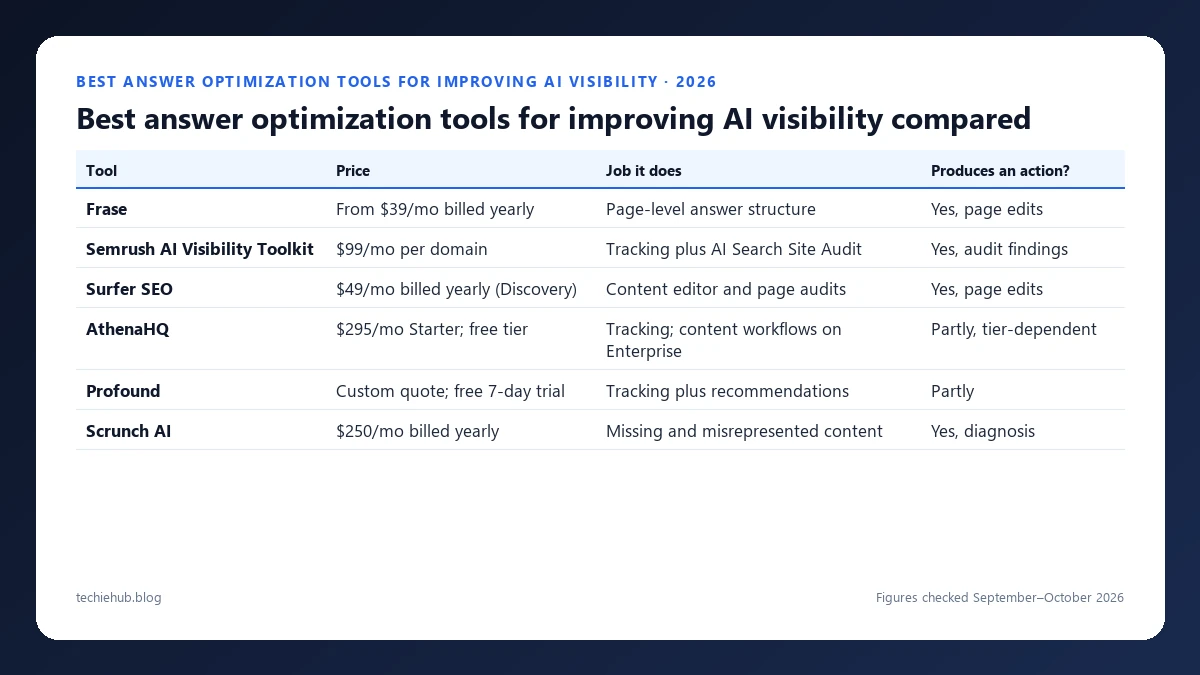
Best answer optimization tools for improving AI visibility compared
| Tool | Price | Job it does | Produces an action? |
|---|---|---|---|
| Frase | From $39/mo billed yearly | Page-level answer structure | Yes, page edits |
| Semrush AI Visibility Toolkit | $99/mo per domain | Tracking plus AI Search Site Audit | Yes, audit findings |
| Surfer SEO | $49/mo billed yearly (Discovery) | Content editor and page audits | Yes, page edits |
| AthenaHQ | $295/mo Starter; free tier | Tracking; content workflows on Enterprise | Partly, tier-dependent |
| Profound | Custom quote; free 7-day trial | Tracking plus recommendations | Partly |
| Scrunch AI | $250/mo billed yearly | Missing and misrepresented content | Yes, diagnosis |
Free graders and content optimizers: HubSpot AEO Grader, AirOps and more
Answer optimization splits into tools that only monitor and tools that help change what AI engines say. A few names in that second group, and one free starting point, are missing from most shortlists.
| Tool | Type | Best for |
|---|---|---|
| HubSpot AEO Grader | Free grader | A no-cost first check of how AI engines describe your brand |
| Writesonic | Tracking plus optimization workflows | Teams that want monitoring and content fixes together |
| AirOps | Content workflow platform | Large content libraries that need bulk optimization |
| Gauge | GEO analysis and recommendations | Structured GEO programmes |
| Clearscope and BrightEdge | Content optimization (Clearscope) and enterprise SEO with AI visibility (BrightEdge) | Established SEO teams adding AI answers |
What actually changes an AI answer
The page work is unglamorous and consistent across engines.
- Answer in the first 60 words. Put a direct, specific answer above the preamble. This is the block that gets extracted.
- Make each section self-contained. A chunk that depends on the paragraph before it cannot be quoted on its own.
- Be specific enough to quote. Prices, dates, named limits and version numbers survive summarisation. Adjectives do not.
- Render without JavaScript. If the answer only exists after hydration, assume it is not read.
- Match your schema to the visible text exactly. Hidden or mismatched markup is a policy problem, not a shortcut: Google’s structured data general guidelines require marked-up content to be visible to the user.
None of that requires a subscription. It requires knowing which pages to fix, which is the one thing the diagnostic tools genuinely provide.
What research says actually changes AI answers. The most-cited study, the GEO paper by Aggarwal and colleagues presented at KDD 2024, tested content edits on generative engine answers. Adding statistics, quotations from credible sources and citations to sources lifted visibility by up to around 30 to 40 percent, while keyword stuffing did not help. Every tool above is, in the end, a way to find which pages need those edits.
What one unit of work actually costs
Every tool here bills in a different unit — prompts, articles, credits, domains — which is why the sticker prices look interchangeable when they are not. Dividing each published price by the quantity that vendor publishes with it gives a figure none of them prints:
| Plan | Published price | Unit the vendor includes | Cost per unit (our calculation) |
|---|---|---|---|
| Surfer SEO Discovery, billed yearly | $49/mo | 120 documents a year | $49 × 12 ÷ 120 = $4.90 per document |
| Surfer SEO Standard, billed yearly | $99/mo | 360 documents a year | $99 × 12 ÷ 360 = $3.30 per document |
| Semrush AI Visibility Toolkit | $99/mo | 25 tracked prompts, 1 domain | $99 ÷ 25 = $3.96 per prompt |
| Semrush + the 50-prompt top-up | $99 + $60 = $159/mo | 75 tracked prompts | $159 ÷ 75 = $2.12 per prompt |
| AthenaHQ Starter | $295/mo | 3,600 credits, 3 seats | $295 ÷ 3,600 = $0.082 per credit; $295 ÷ 3 = $98.33 per seat |
| Profound Starter / Growth (withdrawn Sept 2026) | $99 / $399/mo | 50 / 100 tracked prompts | $1.98 / $3.99 per prompt |
| Frase Starter, billed yearly | $39/mo | 10 articles | $39 ÷ 10 = $3.90 per article |
Two things fall out of that column. First, the top-up is cheaper than the base plan: Semrush’s extra 50 prompts cost $60 ÷ 50 = $1.20 each, against $3.96 for the 25 bundled into the subscription, so the marginal prompt is roughly a third of the price of the first one. Second, Surfer counts documents per year, so a Discovery document costs $4.90 — more than a bundled Semrush prompt, and the unit to watch if you rewrite in volume.
The $100-a-month decision therefore has an arithmetic answer, not a taste one: $99 a month on Surfer Standard buys 360 documents a year, 30 a month at $3.30 each, while $99 on Semrush buys 25 tracked prompts at $3.96 each plus one site audit. For the measurement half of the market on its own, our pillar comparison of AI search monitoring platforms covers the trackers this list deliberately downgrades.
Every unit in the table is the one the vendor prints on its own pricing page, so you can re-run the division when prices move.
The tools in detail
Semrush AI Visibility Toolkit
The Semrush $99 a month add-on is one of the few that ships a diagnostic rather than only a dashboard: an AI Search Site Audit runs alongside Prompt Research, Competitor Research and Brand Performance. Covers one domain and 25 prompts, with 50 more at $60, each extra domain at $99 and extra users at $45.
Scrunch AI
Scrunch AI is built to identify where your content is missing, misrepresented or cited less often than a competitor, which is diagnosis rather than measurement. Acquired by Sitecore for about $225 million in June 2026 and now sold as part of a digital experience suite, and it lists Starter at $300 a month, or $250 billed yearly, for 350 prompts and three seats, with Growth at $500 ($417 yearly).
Profound
Starter is $99 a month covering ChatGPT only and Growth is $399 adding Perplexity and Google AI Overviews, with Enterprise custom up to nine engines. Goes further than most trackers into recommendations, but the useful engine coverage sits above the entry tier.
AthenaHQ
Starter is $295 a month with 3,600 credits, eight platforms, three seats and one country. Content creation workflows with deep research sit on the Enterprise tier alongside SAML SSO and API access, so the optimisation half of the product is the part you have to negotiate for.
Surfer SEO
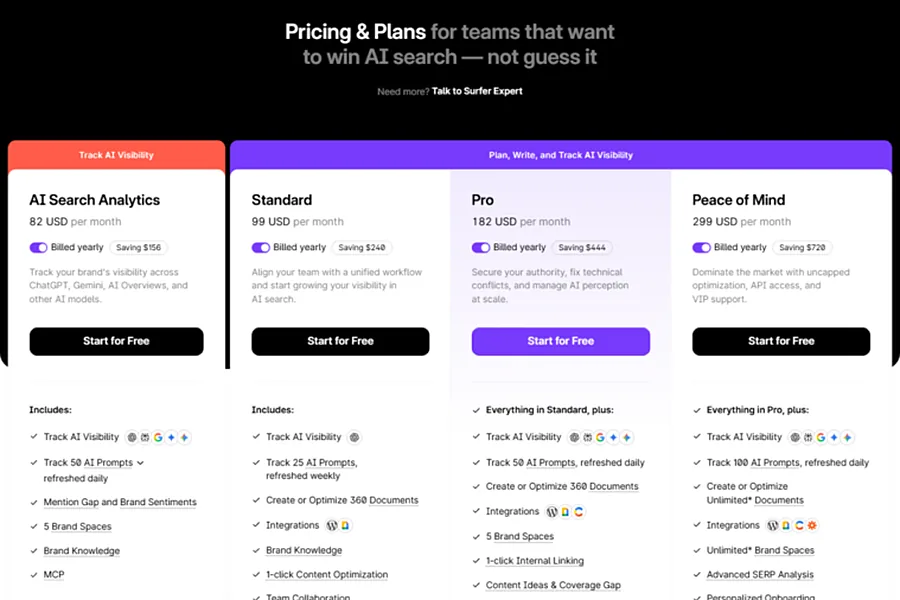
Surfer SEO does page-level content optimisation rather than AI tracking. Its pricing page lists Discovery at $49 a month billed yearly, Standard at $99 and Pro at $182, with document allowances counted per year, plus a separate AI Search Analytics product at $82 for 50 daily-tracked prompts. Useful because extractable structure and on-page coverage are what AI answers actually quote.
Frase
Frase is the cheapest way to work on answer structure at scale, and prices in articles you can count: Starter is $39 a month billed yearly for 10 articles, Professional $103 for 40 and Scale $239 for 100.
How to spend the budget
If you have $100 a month, spend it on Semrush AI Visibility Toolkit or on Surfer SEO — not half on each. The audit tells you which twenty pages matter; the editor helps you fix them. If you already know which pages are failing, skip straight to the editor, and Frase does the same job for a fraction of the price.
If you have $400 a month and multiple brands, AthenaHQ Starter or a Profound quote become reasonable (Profound withdrew its $399 Growth tier in September 2026), but check what sits behind the Enterprise wall first: at AthenaHQ the content workflows do, and content workflows are the reason you were buying.
Our guide to answer engine optimisation covers the discipline itself, answer engine optimization tools covers the wider tooling market, and how to rank in Google AI Overviews covers the page mechanics in detail. If the rewriting lands with a marketing team rather than an SEO, our roundup of AI tools built for marketers covers the production side.
Cost per engine: the figure this category never prints
Every vendor advertises a monthly price. None of them divides that price by the number of engines the plan actually includes. We did, using only the list prices and engine counts each vendor publishes, so you can re-run the arithmetic yourself.
| Plan | Published price | Engines in that plan | Cost per engine (our calculation) |
|---|---|---|---|
| Otterly.AI Lite | $29/mo | 4 | $29 ÷ 4 = $7.25 |
| Otterly.AI Lite + all three add-ons | $29 + $9 + $9 + $29 = $76/mo | 7 | $76 ÷ 7 = $10.86 |
| Profound | Custom quote | Up to 9 on Enterprise | Not derivable |
| Scrunch AI Core | ~$250/mo | Not published per tier | Not derivable |
| AthenaHQ | $295/mo Starter; free tier | Not published per tier | Not derivable |
| Semrush SEO + AI Search | $139–299/mo; Advanced custom | Bundled, not itemised | Not derivable |
Read across the row rather than down the price column. Otterly’s $29 Lite plan works out at $7.25 per engine, and still only $10.86 once every add-on is loaded. Profound used to be the sharp contrast in this table, because its $99 Starter tier covered ChatGPT alone, but it withdrew self-serve pricing in September 2026 and cannot be priced per engine any more. A per-engine figure is invisible if you compare headline prices.
Peec AI has to be measured differently because it meters prompts, not engines. Its own bands give a cost per tracked prompt of €85 (about $96) ÷ 50 = €1.70, €205 (about $232) ÷ 150 = €1.37, and €425 (about $480) ÷ 350 = €1.21 — so the largest band is about 29% cheaper per prompt than the smallest ((1.70 − 1.21) ÷ 1.70 = 0.288).
These are list prices, not negotiated quotes, and three rows are blank because those vendors publish no engine count for that tier — we left them empty rather than guessing. For the wider category, see our pillar guide to AI search monitoring tools.
How to test these tools yourself, with the prompt set
No vendor publishes a method you can repeat, so here is one you can run on a free trial in an afternoon.
- Fix ten prompts before you open any tool, five commercial and five informational. Freezing them first stops you from tuning the prompt set to flatter whichever product you are trialling.
- Name three competitors and track them on the identical prompts. Share of voice against named rivals is the only number that survives a budget meeting.
- Record three measures separately: presence (were you named), citation (was your URL linked), and position within the answer. Presence without citation builds awareness but sends no traffic.
- Re-run on the same weekday for four weeks. Answers drift, and a single snapshot tells you nothing about direction.
The raw prompt set, with [category] and [brand] swapped for yours:
- best [category] tools
- best [category] tools for small teams
- [brand] vs [competitor]
- is [brand] worth it
- [category] pricing compared
- what is [category]
- how does [category] work
- [category] tools with a free tier
- alternatives to [competitor]
- who are the leading [category] vendors
Optimizing AI search visibility: what to do once the dashboard shows a gap
- Answer the prompt directly, high on the page. A 40 to 55 word answer that names a specific tool or number is what gets extracted.
- Make the page renderable without JavaScript. If the answer only exists after hydration it may not be read at all — Google’s JavaScript SEO basics sets out how its own crawler handles the delay.
- Be quotable. Prices, dates and named limits survive summarisation; adjectives do not.
- Re-check after a full refresh cycle. With daily tracking, give a change a week before you judge it.
Our guides to generative engine optimization and ranking in Google AI Overviews cover that page-side work in detail, and AI search monitoring tools covers the tracking category more broadly. If ChatGPT is the engine you keep losing, our guide to getting cited in ChatGPT is the narrower brief.
Frequently Asked Questions
What are the best answer optimization tools for improving AI visibility?
Semrush AI Visibility Toolkit at $99 a month is the best all-round pick because it pairs prompt tracking with an AI Search Site Audit, and Scrunch is the strongest at diagnosing where your content is missing or misrepresented. Surfer SEO from $49 and Frase from $39 handle the page-level work that actually changes the answer.
Which answer engine optimization tools work best for AI visibility?
The ones that tell you what to change, not just what happened. Semrush ships an AI Search Site Audit, Scrunch flags content that is missing or misrepresented, and Profound and AthenaHQ add recommendation layers on their higher tiers. Pure trackers such as Otterly and Peec are cheaper and excellent at measurement, but they will not produce a single page edit.
What’s the best AI optimization tool for visibility?
It depends which half of the problem you have. If you do not know where you stand, buy measurement — Otterly from $29 or Peec from EUR 85 (about $96). If you already know you are absent from answers your competitors appear in, buy diagnosis and page tooling instead: Semrush at $99 for the site audit, plus Surfer SEO from $49 or Frase from $39 for the editing itself. Most teams buy measurement twice and page tooling never.
Which pages should you optimise first for AI answers?
The ones on prompts where competitors are named and you are not. Semrush’s AI Search Site Audit and Scrunch’s missing-content reports produce that list. Without either, take your twenty most commercial pages, check each against the prompt it should answer, and rewrite any whose answer is not in the first 60 words.
How long after a rewrite does an AI answer change?
Allow two to four weeks. After you rewrite a page the engine has to recrawl it and your tool has to refresh — weekly on entry plans, daily on higher tiers, with the cadence rarely published — so judging a change sooner mostly measures noise. Ask for the refresh figure in writing during the trial.
What are the best tools for brand visibility in AI answers?
Use a tracker to measure and an optimiser to act. Semrush’s AI Visibility Toolkit lists $99 a month for 25 tracked prompts and one domain, while Scrunch AI, Profound and AthenaHQ cover deeper tracking. Surfer SEO and Frase help rewrite the pages themselves, which is what actually changes the answers.
Is there a free answer engine optimization tool?
Yes. HubSpot’s AEO Grader is a free way to see how AI engines describe your brand, and you can track citations manually with a prompt set and a spreadsheet. Paid tools add scale, competitor share of voice and content recommendations.
How long do content changes take to show up in AI answers?
Give a change at least one full tracking cycle — a week on daily refresh — before judging it, and longer for engines that depend on their own crawl. A change to a page that is not indexed, or whose answer only appears after JavaScript runs, may never show up at all, so check those first.
Conclusion
Buy diagnosis and page tooling, not another dashboard. Semrush AI Visibility Toolkit at $99 is the most complete single subscription because the AI Search Site Audit turns a visibility gap into a page list, and Scrunch does the same job at enterprise scale inside Sitecore.
Then put the second $100 into content optimization rather than a second tracker. Surfer SEO from $49 or Frase from $39 will not tell you where you rank in AI answers — they will help you write the paragraph that gets quoted, which is the part every tool in this category measures and none of them does.
