


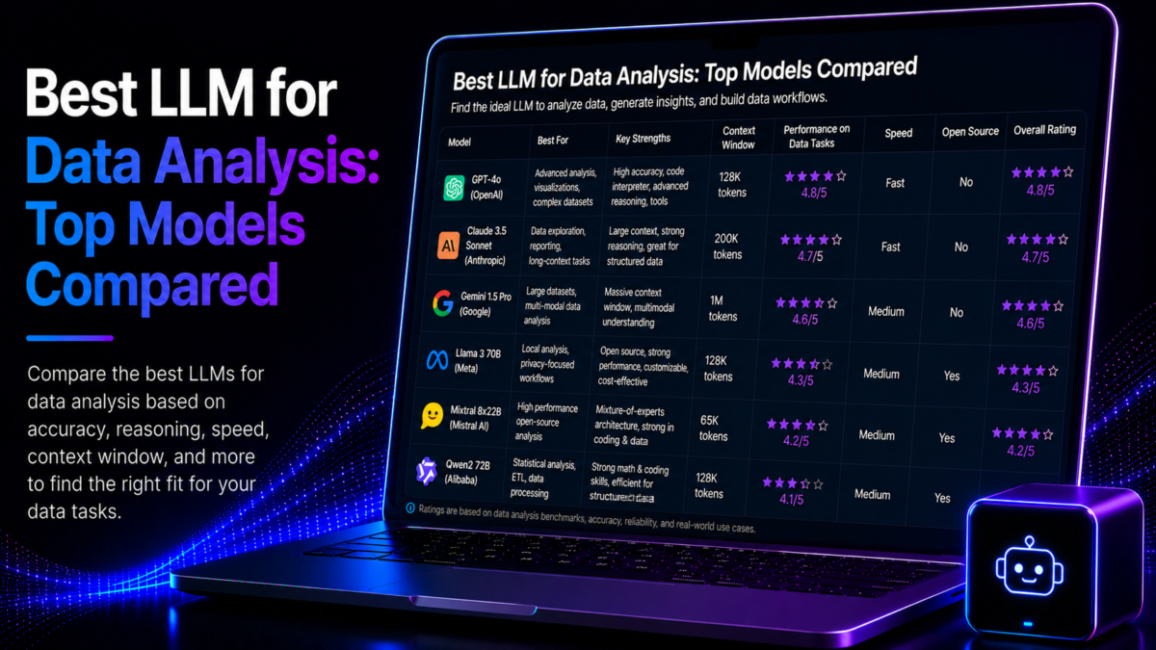
How we compare: We weigh each model on code execution, context-window size, numeric reliability, document parsing and privacy — drawing on official product documentation, public benchmarks and hands-on testing rather than vendor marketing. Standings and prices change fast, so verify current details before you commit.
Disclosure: TechieHub is reader-supported. Some links on this page may be affiliate links, and we may earn a commission at no extra cost to you. Our rankings stay independent.

Table of Contents
Quick answer: The best LLM for data analysis in 2026 is Claude Opus for multi-step reasoning over messy data, GPT-5 for its code-interpreter sandbox on uploaded files, and Gemini for very large context windows. For private or regulated data, run an enterprise deployment with a no-training agreement or an open-weight model locally — consumer tiers are not an appropriate destination for confidential datasets.
What is the best LLM for data analysis in 2026?
An LLM for data analysis is an AI system that interprets, computes over and explains structured or unstructured data — often by writing and running code — so you can turn raw numbers into insight in plain language. Because these are fundamentally language models, the same behaviours described in our guide to the best AI models apply here: they are superb at drafting, summarising and reasoning, but they can produce confident, wrong numbers. The right choice is the one whose strengths match your specific job.
Four very different tasks sit under the umbrella of “data analysis”: running calculations on a spreadsheet, ingesting an entire database, writing an executive summary, and analysing sensitive data privately. Different models lead each. The top proprietary systems all reason well over data — the meaningful differences are in code execution, context size, narrative quality and where the model runs. A useful 2026 rule of thumb is that the best model is often the one that sits closest to your data stack with the lowest friction.
How do the top LLMs compare for data work?
ChatGPT — the most complete hands-on tool
The three frontier assistants each own a distinct part of the analytical workflow. ChatGPT, running on GPT-5.6, is the most complete hands-on tool: upload a CSV or Excel file and its code interpreter writes and executes Python to compute statistics, build charts and iterate on its own errors. OpenAI positions GPT-5.6 explicitly around data analysis, document work and tool use, and it is the first OpenAI model to ship with a 1M-token API context window.

Gemini 3 Pro — large structured inputs
Gemini is uniquely capable on large structured inputs. Gemini 3 Pro carries a one-million-token context window, letting it hold entire databases, long CSVs or dozens of reports in a single prompt, and its Google Sheets integration lets Workspace users pipe data in without copy-pasting. Claude excels at the interpretation layer: Anthropic’s Claude Opus 5.5 synthesises findings across long reports, explains what the data means and writes clean executive summaries, and it is noted for being careful not to fabricate figures when the source data is in its context.
Claude Opus 5.5 — reasoning over verified numbers
Opus 5 launched on 24 July 2026, and it resets the price-performance maths for analysts. Anthropic pitches it as near-flagship — close to Claude Fable 5 on capability for roughly half the API cost, at $5 per million input tokens and $25 per million output tokens — and it posts 43.3% on Frontier-Bench v0.1 against Fable 5’s 33.7%, with its clearest gains in software engineering and knowledge work. It is the default on Claude Max, and Claude Pro at $20 a month includes Opus as well, so reaching the flagship does not require the $100 tier. In head-to-head 2026 comparisons the Opus line has been a repeat winner on complex reasoning and multi-step analysis, while Gemini 3 Pro often probes one layer deeper than the question asked.
What none of them replace
None of these replaces judgement. The strongest workflows treat the model as an accelerator that drafts and computes while a human checks the logic and the numbers at every important step.
| Model | Maker | Data-analysis edge |
| ChatGPT (GPT-5.6) | OpenAI | Runs Python on files; calculations, charts, iteration |
| Gemini 3.1 Pro | 1M context below 200k tokens; huge datasets; Google Sheets | |
| Claude Opus 5.5 | Anthropic | Analytical narrative and numeric reliability at half flagship cost |
| Qwen 3 / DeepSeek V4 (open) | Alibaba / DeepSeek | Private, local reasoning and long-context analysis |
| Llama 4 / Gemma (open) | Meta / Google | Runs on your own hardware for confidential data |
| Lightweight hosted models | Various | Cheap, fast, high-volume analytics |
Which model fits each data task?
This page compares the models themselves. Three sibling guides cover the same subject from other angles, and picking the wrong one wastes time: using AI for data analysis is the step-by-step method, AI tools for data analysis is the product roundup, and AI agents for data analysis covers software that investigates unprompted. Matching the model to the specific job gets the best results:
- Running calculations and charts on a file: GPT-5.6’s code interpreter is the standout — it executes real Python on your data and self-corrects on errors.
- Very large datasets or many tables: Gemini 3 Pro’s massive context holds entire databases at once; for files too big for any window, chunk the data or use a vector database with retrieval-augmented generation instead of pasting raw content.
- SQL generation: all the top models write strong SQL for joins, aggregations, window functions and CTEs; accuracy jumps when you supply your schema, sample rows and a clear question.
- Python data science: GPT-5.6 tends to produce idiomatic pandas and scikit-learn, while Claude often writes cleaner, better-documented code with thorough error handling — handy for notebook workflows. See our best AI model for coding comparison for the wider picture.
- Reading Excel and PDF: Claude and Gemini have the strongest native document parsing for messy, structured files.
- Analysis narrative and summaries: Claude Opus 5.5 is frequently preferred for clear, careful explanations that a stakeholder can act on.
How do you analyse private or regulated data?
When data cannot leave your infrastructure, open models are the answer. Qwen3.6-27B is the current pick for long-context and multilingual analytics under Apache 2.0 — a dense 27B model reporting 77.2 on SWE-bench Verified with a 262,144-token native context, so it fits one high-end GPU, DeepSeek V4 offers frontier-level reasoning with a one-million-token window at very low cost, and Llama 4 and Gemma run on a modern workstation to handle sophisticated data manipulation locally. Tools like Ollama and LM Studio let you launch these on a MacBook or consumer GPU with a single command. If you plan to self-host, our guide to the best local LLM to run on your own hardware walks through the hardware and setup.

The trade-off is that proprietary multimodal models still lead on the hardest analytical tasks, and open models need more setup. A common pattern is to run a local model for routine, sensitive analysis and reach for a cloud model on the toughest problems — keeping confidential data in-house while still tapping frontier capability when it is genuinely needed. For very high-volume, cost-sensitive analytics, smaller hosted or on-device models deliver solid quality at a fraction of a flagship’s cost per query; if that describes your workload, it is worth understanding what a small language model is and where it shines.
Data analysis in practice: a growth analyst’s workflow
Consider Freya, a growth analyst at a mid-sized SaaS company. Each Monday she needs to explain why weekly revenue moved and hand her VP a two-paragraph summary. Her raw export is a 40-column CSV of subscription events that is too messy to eyeball.
The compute pass
She uploads the file to ChatGPT’s code interpreter and asks it to compute quarter-over-quarter growth by region and flag the three fastest-moving segments. GPT-5.6 writes pandas code, runs it, catches a date-parsing error on its own, reruns and returns a clean table plus a chart. Freya spot-checks two of the numbers against her BI dashboard — they match. The verified figures then go into Claude Opus 5.5 with a request for a concise executive narrative, which turns the numbers into the plain-language story a VP actually reads. The result is a report that used to take a full morning, now finished before her first coffee — with a human verifying every figure that matters.
Why the routing is deliberate
Freya’s routing is deliberate, not accidental: she uses the code-executing model where arithmetic must be exact, and the narrative model where clarity and tone matter. That division of labour is the core lesson of picking the best LLM for any analytical pipeline — no single model wins every stage, so the smartest teams stitch two or three together and let a person own the hand-offs. Over a quarter, that habit compounds into faster reporting cycles and fewer numbers she has to walk back.
This example is a composite of the analyst workflows we see most often, not a single client account; the figures are typical rather than measured from one engagement.
How do you get more accurate analysis from any LLM?
The single biggest lever is context. Instead of asking “what are the trends in my data,” give the model the actual file or a representative sample, your table schema or column descriptions, and a specific question — for example, “using this sales CSV, which three regions grew fastest quarter over quarter, and what might explain it?” The more the model can see the real data and understand its structure, the less it has to guess and the less likely it is to invent numbers.
For tools that execute code, let the model run the calculation rather than estimating in its head, and always sanity-check outputs against what you would expect. Every LLM can hallucinate statistics — fabricating figures, miscalculating, or presenting flawed data as insight — so treat AI output as a draft analysis to validate, not a final answer, especially for decisions that matter.
Which LLM should you choose for data analysis?
Match the model to your data task. For hands-on analysis of a file, GPT-5.6’s code interpreter is the most complete. For very large datasets, multi-document analysis or Google Sheets workflows, Gemini 3 Pro’s huge context leads. For interpreting results, writing analytical narrative and trustworthy numbers, Claude Opus 5.5 is the strong pick — and at $4 and $20 per million input and output tokens it undercuts both the older Opus 5 at $5 and $25 and the Fable tier at $10 and $50. For private or regulated data, open models like Qwen, DeepSeek and Llama run locally, and cheaper lightweight models cover high-volume, cost-sensitive analytics. Many teams use more than one, routing each task to its strongest model. Whichever you choose, remember the model is a powerful assistant, not an oracle — feed it the real numbers, let it run the calculations, and check its work.
Frequently Asked Questions
What is the best LLM for data analysis?
It depends on the task. GPT-5.6 with its code interpreter is the most complete hands-on tool, running Python on your files. Gemini 3 Pro handles the largest datasets with a million-token context. Claude Opus 5.5, the current flagship of the Opus line at $4 and $20 per million tokens, excels at analytical reasoning and reliable numbers well below the Fable tier; Opus 5, launched on 24 July 2026, is still sold at $5 and $25. For private data, open models like Qwen and Llama run locally.
Is ChatGPT or Claude better for data analysis?
They have different strengths. ChatGPT’s code interpreter is better for hands-on analysis, executing Python to compute results and build charts. Claude Opus 5.5 is often better for interpretation — explaining what data means and writing summaries, and it is reliable at not fabricating numbers. Many teams use ChatGPT to run the analysis and Claude to write it up.
How much does Claude Opus 5.5 cost for data analysis?
Claude Opus 5.5 is priced at $4 per million input tokens and $20 per million output tokens — Anthropic lists the older Opus 5 at $5 and $25, and the Fable 5.1 tier at $10 and $50. Sonnet 5.5 at $2 and $10 is where most analysis layers end up once the easy queries are routed away from the flagship, and that $2/$10 rate is now permanent: the increase to $3/$15 announced for September 2026 was cancelled. Checked 4 October 2026. Opus 5 scored 43.3% on Frontier-Bench v0.1 against Fable 5’s 33.7%. It is the default on Claude Max, and Claude Pro at $20 a month includes Opus as well, so the flagship is not reserved for the $100 tier.
Which LLM is best for large datasets?
Gemini 3 Pro is generally best, thanks to a one-million-token context that ingests entire databases or dozens of reports in one prompt, plus Google Sheets integration. Claude’s large context also handles substantial reports well. For datasets too big for any window, chunk the data or use a vector database with retrieval-augmented generation instead.
Can LLMs write SQL for data analysis?
Yes. Modern LLMs are highly capable SQL writers for standard patterns — joins, aggregations, window functions, CTEs and subqueries — and all the top models do this well. Accuracy improves significantly when you provide your schema, sample data and a clear question. Review generated SQL before running it on production data.
Which LLM is best for private or regulated data?
For private data, open models that run locally are best, since data never leaves your infrastructure. Qwen3.6-27B is strong for long-context analytics and fits a single GPU, DeepSeek V4 offers frontier reasoning cheaply at $0.15 and $0.60 per million off-peak, and Llama 4 and Gemma run on a workstation. Tools like Ollama and LM Studio launch them with a single command.
Do LLMs hallucinate when analysing data?
Yes — this is the biggest risk in AI data analysis. LLMs can fabricate statistics, miscalculate, or present flawed data as insight, sometimes convincingly. Models that execute code on your actual data are more reliable than ones estimating from memory, but none is immune. Always give the model the real data and verify important figures independently.
Conclusion
There is no single best LLM for data analysis, because the three leaders are good at different stages of the same job. ChatGPT executes — upload the file, let the code interpreter run real Python and iterate on its own errors. Gemini ingests — very large structured inputs in one pass without chunking. Opus 5.5 reasons — explaining what a result means, where it is fragile, and what it does not support.
The practical setup is two of them, not one: something that computes and something that interprets. And whichever you pick, the accuracy discipline matters more than the model — supply a governed definition of your metrics, ask for the code rather than the conclusion, and verify one headline number against a figure you already know before trusting the rest. See fine-tuning vs RAG for when volatile data needs a retrieval layer instead.
