


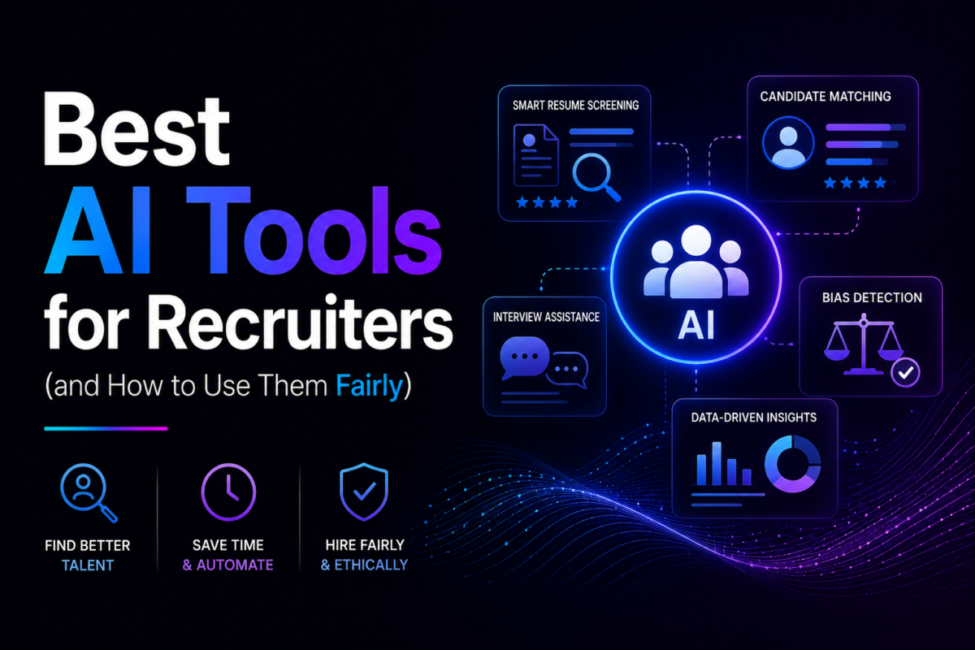
Recruiting is where artificial intelligence landed first and hardest. It is now the single most common AI use case inside HR, according to SHRM’s State of AI in HR 2026 study of 1,908 HR professionals, which put recruiting at 27% of organizations, ahead of every other HR function. Hiring is also where a wrong answer costs someone a job, so the shortlist below weighs published audit evidence as heavily as feature lists.

| Quick answer: Match the tool to your bottleneck. LinkedIn Recruiter and SeekOut lead sourcing, Paradox owns high-volume hourly hiring, Eightfold covers enterprise talent intelligence, HireVue handles structured assessment, and Metaview automates interview notes. Claude Opus 5 drafts job descriptions and outreach cheaply. Whatever you buy, keep a human on every rejection and audit the outcomes annually. |
Table of Contents
What does AI actually do inside a hiring funnel?
Strip away the marketing and recruiting AI does five jobs. It sources, mining databases for people who match a role, including passive candidates who never applied. It screens, ranking applications against requirements. It converses, booking interviews over SMS at 11pm on a Sunday. It assesses, running structured interviews or skills tests. And it documents, turning a 45-minute conversation into a scorecard tied to your rubric.
What changed through 2025 and 2026 is autonomy. Early tools waited for a recruiter to click; current ones chain several steps together unsupervised. LinkedIn’s Hiring Assistant, the platform’s first AI agent, reached general availability in late 2025, and Eightfold shipped an AI Interview Companion in April 2026 before expanding to Talent Agents 2.0 with a candidate-facing agent in July. The buying question has shifted from “does it have AI?” to “how many steps will it take before it asks me?” If you are shopping at that autonomous end of the market, our breakdown of the best AI agent for recruiting goes deeper on where unattended workflows are safe.
Which are the best AI tools for recruiters in 2026?
How we compare: we rank on published bias-audit or explainability documentation, how cleanly the tool writes back to your applicant tracking system, whether pricing is verifiable, and the volume band where it pays back. Pricing was checked against vendor pages in July 2026; where a vendor publishes nothing, we say so.

| Tool | Best for | 2026 pricing signal | Main watch-out |
| LinkedIn Recruiter | Sourcing reach | Lite is self-serve; Corporate seats and Hiring Assistant are quote-only | Agent capacity is a paid add-on |
| Paradox (Olivia) | High-volume hourly hiring | Quote-only | Light on deep assessment |
| SeekOut | Technical and diversity search | Self-serve Lite tier published; team plans quote-only | Annual contracts, seat minimums |
| Eightfold AI | Enterprise talent intelligence | Quote-only | Long implementation; agents need governance |
| HireVue | Structured assessment | Quote-only | Video scoring draws the most scrutiny |
| Metaview | Interview notes and sourcing | Free tier, then $100 and $300 per user monthly | Newer agents, thinner audit history |
LinkedIn Recruiter and SeekOut — sourcing reach and specialist search
LinkedIn Recruiter remains the default because the data is the moat: no rival indexes as many actively maintained professional profiles, and its Hiring Assistant now takes an intake brief, sources, and returns a reviewed shortlist. SeekOut is the specialist alternative when you need filters LinkedIn does not expose, particularly for engineering and under-represented talent pools.
Paradox (Olivia) — high-volume frontline hiring
Paradox is the clearest ROI story for frontline hiring. Its assistant, Olivia, screens and schedules over text, and the results Paradox publishes are unusually specific: Compass Group hires roughly 120,000 workers a year with about 20 recruiting staff. Treat vendor numbers as directional; the shape of the gain is real.
Eightfold, HireVue and Metaview — matching, assessment and interview notes
Eightfold AI sells skills-based matching, internal mobility and workforce planning to large enterprises, and is pushing hardest into agents. HireVue is the assessment incumbent and one of the few vendors publishing bias-audit results and an explainability statement you can hand to counsel. Metaview covers interview documentation and now sourcing, with a free tier that makes it the easiest tool here to pilot.
Job descriptions and outreach — use a general assistant, not a recruiting feature
For writing rather than workflow — job descriptions, outreach, rewriting a requisition to strip biased language — a general assistant is usually cheaper and better than a recruiting-specific feature. Claude Opus 5, released by Anthropic on 24 July 2026, is the current flagship for that drafting. Never paste candidate data into a tool your security team has not cleared. For the wider people-operations stack beyond hiring, see our guide to the best AI tools for HR. The same models power the AI resume builder tools your applicants use, which is exactly why keyword-matching screens get less informative every quarter.
Should you buy an assistant, a copilot or a full agent?

Sort candidates by autonomy, not branding. An assistant answers when spoken to: draft this post, summarize this call. A copilot works inside your workflow and proposes the next move, which you approve. An agent executes a multi-step plan — source, message, qualify, schedule — and reports back afterwards.
The rule that holds up under audit: automate the administration, never the adjudication. Scheduling, reminders, note-taking and status updates are pure overhead and safe to hand over entirely. Ranking, scoring and rejecting need a named human who can explain the outcome. Sizing follows the same logic: below about 50 hires a month, a modern ATS plus a general assistant is enough; between 50 and a few hundred, conversational screening pays for itself; above that, enterprise platforms earn their price. Teams evaluating the wider people stack should read this alongside our guide to AI tools for HR.
What do the 2026 rules require before AI touches a decision?
More than most recruiters realize, and the map moved twice this year. New York City’s Local Law 144 still requires an independent bias audit of any automated employment decision tool within the prior year, a public summary of the results, and advance notice to candidates. A city review has already flagged weak compliance, so enforcement pressure is rising.
In the EU, recruitment and candidate selection sit in Annex III of the AI Act as high-risk. The Digital Omnibus agreed in 2026 pushed those stand-alone high-risk obligations from August 2026 to 2 December 2027 — a deferral, not a repeal; the documentation, oversight and transparency duties still arrive. Colorado went the other way, replacing its original AI Act before it took effect with a lighter transparency statute signed in May 2026 and effective January 2027.
Federally, the EEOC withdrew its AI-specific hiring guidance in January 2025, which some teams misread as a green light. Title VII and the Uniform Guidelines on Employee Selection Procedures are untouched: an algorithmic screen with adverse impact is still unlawful discrimination. SHRM’s 2026 data found most HR professionals unaware of the AI laws in their own state — that is the real risk. TechieHub is a technology publication, not legal counsel; treat this as orientation, not advice.
How do you stop an AI screen from quietly discriminating?
Demand evidence rather than assurances. Ask every vendor for adverse-impact results by race and gender, at the job level you actually hire for, from an independent auditor. If they cannot produce it, that is your answer. Then audit your own outcomes, because the same tool behaves differently on your data than on the vendor’s benchmark.
Scrutinize the mechanism, not just the score. Parsers that rank on keyword overlap penalize career changers, veterans and anyone with a non-linear path, and tools that score tone or facial expression invite fairness questions they rarely answer well. Prefer systems that assess demonstrable skills and expose adjustable criteria. Finally, tell candidates. Pew Research Center found 71% of Americans oppose AI making a final hiring decision and 66% would not want to apply to an employer that uses AI to help decide. Silence does not make that go away.
Use case: clearing a 1,200-application backlog
Maya Osei runs talent for a 600-person logistics operator opening three regional depots — a composite drawn from teams we have spoken with, but the numbers are typical. Her task: 1,200 applications for 90 warehouse and driver roles, two recruiters, six weeks before the depots opened understaffed.
She did not buy a platform. She bought one conversational screening tool for the funnel and switched on the free tier of an interview-notes agent. SMS screening handled the knockout questions — licence class, shift availability, right to work — then booked qualified applicants straight into the depot managers’ calendars. Crucially, nothing auto-rejected: candidates who missed a criterion went to a human queue, not a rejection email.
After five weeks, time-to-first-contact fell from four days to under an hour, the recruiters spent their time interviewing instead of calendar-chasing, and 84 of 90 roles were filled before opening. Maya kept two things manual: the final hire decision, and a monthly check on who was being filtered out at screening. That check caught a shift-availability question phrased in a way that was quietly screening out primary carers — a fix no vendor dashboard would have surfaced.
Frequently Asked Questions
What are the best AI tools for recruiters right now?
LinkedIn Recruiter and SeekOut for sourcing, Paradox for high-volume conversational screening and scheduling, HireVue for structured assessment, Eightfold for enterprise talent intelligence, and Metaview for interview notes. A general assistant like Claude Opus 5 covers job descriptions and outreach. Choose by bottleneck and hiring volume, not by feature count.
Can AI replace recruiters?
No. AI absorbs sourcing, screening, scheduling and note-taking, but it cannot build a relationship with a hesitant candidate, sell a role against a counter-offer, read organizational context, or take accountability for a decision. It changes what recruiters spend their day on, shifting hours from administration toward judgment and persuasion.
Is it legal to use AI in hiring?
Generally yes, but it is regulated and the rules differ by location. New York City requires annual independent bias audits and candidate notice, the EU treats recruitment AI as high-risk with obligations arriving in December 2027, and US federal anti-discrimination law applies regardless of whether an algorithm made the call.
How much do AI recruiting tools cost?
Entry tools start free or near it — Metaview has a free tier and paid plans at $100 and $300 per user monthly. Most enterprise platforms, including Paradox, HireVue and Eightfold, publish no pricing at all and quote against hiring volume, so budget for a negotiation and an annual contract.
Does AI screening reject good candidates?
It can, when it is configured to auto-reject. Keyword-weighted parsers penalize non-traditional backgrounds, and inherited bias compounds quietly at scale. Use AI to surface and prioritize rather than eliminate, route borderline applicants to a human queue, and review who is being filtered out at least monthly.
Is candidate data safe in these tools?
It depends entirely on the vendor. Recruiting tools handle sensitive personal data, so verify retention periods, sub-processor lists, GDPR posture and whether your data trains their models. Never paste resumes or interview transcripts into a consumer AI account that your security and privacy teams have not reviewed and approved.
How should recruiters handle candidates who use AI to apply?
Assume every application has had AI help, because most now do, and stop treating polish as a signal. A tailored resume and a clean cover letter cost a candidate about ninety seconds, which means the things screens have always rewarded — keyword alignment, tidy phrasing, an articulate summary — no longer separate anyone. Penalising AI use is both unenforceable and self-defeating; detection tools are unreliable enough that acting on them invites a discrimination claim you cannot defend.
What still discriminates is unrehearsable specificity. Ask what the candidate actually decided, what they would do differently, and why a particular trade-off was made — questions whose answers live in the person’s memory rather than in the job description. Two harder cases are worth naming: live interview assistance and identity fraud in remote hiring are both rising, and the practical defences are a structured scorecard applied identically to everyone, at least one synchronous conversation before an offer, and a documented right-to-work check. State your AI policy in the posting so expectations are explicit on both sides.
Conclusion
This market has stopped being about which tool has the smartest matching algorithm and started being about how much you are willing to let run unattended. The teams getting real value are unglamorous about it: they automate scheduling, screening logistics and documentation aggressively, keep ranking and rejection under human control, and check their own adverse-impact numbers instead of trusting a vendor benchmark. Start with your worst bottleneck, pilot one tool against it, and expand only when the recovered hours are measurable. Recruiting AI is one slice of the broader AI tools for business landscape — powerful, cheap, and unusually consequential when it gets a decision wrong.
Affiliate disclosure: TechieHub may earn a commission if you purchase through some links on this site. It never influences which tools we include or how we rank them.
