
Understanding Anthropic’s AI Assistant — Models, Features, Pricing & Use Cases
Table of Contents
1. What is Claude?
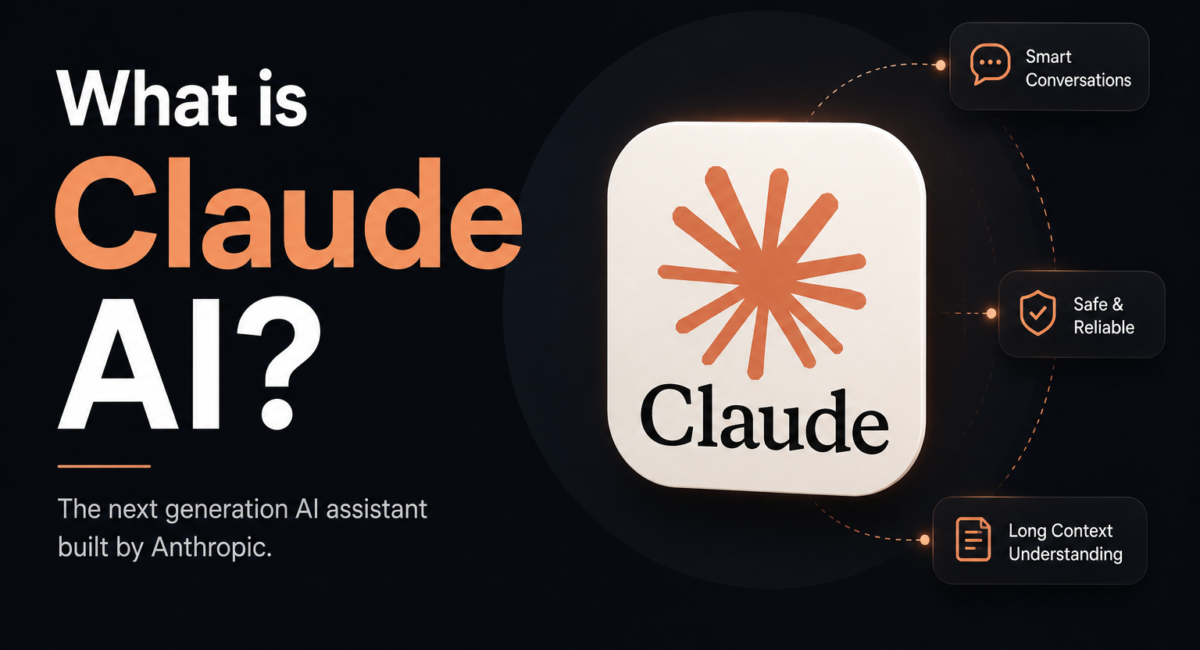
Claude is an advanced artificial intelligence assistant developed by Anthropic, designed to be helpful, harmless, and honest. Launched in 2023 and continuously improved through 2026, Claude represents one of the most capable large language models available, competing directly with OpenAI’s ChatGPT and Google’s Gemini.
Unlike many AI assistants that prioritize pure performance, Claude emphasizes safety, reliability, and nuanced understanding of complex instructions. The AI can engage in sophisticated conversations, analyze documents, write code, solve mathematical problems, and assist with creative projects while maintaining strong ethical guidelines and factual accuracy.
What is Claude best for? Claude excels at tasks requiring careful analysis, detailed explanations, coding assistance, document processing, and creative writing. Its large context window (200,000 tokens) enables processing of entire books or codebases in a single conversation, making it particularly valuable for researchers, developers, writers, and professionals handling complex information. Similar to how generative AI is transforming content creation, Claude is revolutionizing how professionals interact with AI for knowledge work.
📊 Claude processes over 100 million conversations monthly across web, mobile, and API integrations — [Anthropic Company Report 2026]
📊 Developer adoption grew 400% in 2025, with Claude API powering applications across healthcare, legal, education, and software development — [TechCrunch AI Survey]
This rapid adoption reflects Claude’s unique positioning as the AI assistant for users who prioritize quality, accuracy, and thoughtful responses over speed alone. Organizations from startups to Fortune 500 companies rely on Claude for mission-critical applications requiring high reliability and sophisticated reasoning.
1.1 Claude Model Family
Anthropic offers multiple Claude models optimized for different use cases, balancing performance, speed, and cost. Understanding these options helps you select the right model for specific tasks.
What is Claude Opus?
Claude Opus represents the most powerful and intelligent model in the Claude family, designed for complex tasks requiring maximum capabilities. Opus delivers superior performance on difficult problems, nuanced reasoning, specialized knowledge application, and creative work.
- Superior Intelligence: Handles the most complex analysis, research, and problem-solving tasks with highest accuracy
- Advanced Reasoning: Excels at multi-step logical reasoning, strategic planning, and sophisticated decision-making
- Specialized Expertise: Performs best on technical, academic, and professional tasks requiring deep domain knowledge
- Best Use Cases: Research analysis, complex coding projects, strategic planning, advanced writing, legal document review
- Performance: Highest quality outputs but slower response times and higher costs
- API Model String: claude-opus-4-20250514 (latest version)
What is Claude 3.5 Sonnet?
Claude 3.5 Sonnet strikes the optimal balance between intelligence and speed, making it the most popular choice for everyday use. This model delivers near-Opus quality at significantly faster speeds and lower costs.
- Balanced Performance: Near-Opus intelligence with 2x faster response times
- Versatile Capability: Handles wide range of tasks from coding to creative writing effectively
- Cost Effective: Best value proposition for most commercial applications
- Best Use Cases: Daily work tasks, content creation, coding assistance, customer service, general analysis
- Current Status: Most widely deployed Claude model for both consumer and business applications
- API Model String: claude-sonnet-3-5-20250219
What is Claude Haiku?
Claude Haiku prioritizes speed and efficiency, delivering rapid responses for straightforward tasks requiring quick turnaround. This model excels at high-volume, lower-complexity workloads.
- Maximum Speed: Fastest response times in Claude family, ideal for real-time applications
- Cost Optimized: Lowest pricing per token, enabling high-volume deployments
- Streamlined Intelligence: Handles routine tasks efficiently while maintaining quality
- Best Use Cases: Customer support chatbots, simple coding tasks, quick summaries, data extraction, real-time applications
- Performance Profile: Sacrifices some reasoning depth for speed and cost efficiency
- API Model String: claude-haiku-3-5-20250219
1.2 Claude Platform Options
Claude is accessible through multiple interfaces designed for different user needs, from casual users to enterprise developers.
What is Claude Desktop?
Claude Desktop is a native application for macOS and Windows that provides direct access to Claude without a browser. Launched in 2024, the desktop app offers enhanced features including local file processing, system integration, and offline capabilities.
- Native Performance: Faster, more responsive than web interface with optimized resource usage
- File System Integration: Direct access to local files and folders for analysis and processing
- MCP Support: Enables Model Context Protocol integrations for extended functionality
- Offline Capabilities: Some features available without internet connection (limited)
- Download: Available from Anthropic website for macOS 11+ and Windows 10+
- Best For: Developers, researchers, and power users requiring deep integration with local systems
What is MCP in Claude?
Model Context Protocol (MCP) is an open standard developed by Anthropic that allows Claude to securely connect to external data sources, tools, and services. What is Claude MCP? It’s the framework enabling Claude to access your files, databases, APIs, and applications while maintaining security and user control.
- Tool Integration: Connect Claude to development tools, databases, APIs, and business applications
- Data Access: Give Claude secure access to local files, cloud storage, and enterprise systems
- Custom Extensions: Developers can build MCP servers to extend Claude’s capabilities
- Security First: All connections require explicit user permission and operate with principle of least privilege
- Use Cases: Database queries, file analysis, API integrations, workflow automation
- Availability: Desktop app and API (web interface has limited MCP support)
Similar to how AI agents are transforming business operations, MCP enables Claude to become a powerful AI agent capable of interacting with your entire digital workspace.
Claude Web Interface
The standard web-based interface at claude.ai provides accessible AI assistance without installation, offering:
- Instant Access: No download required, works in any modern browser
- Conversation History: Automatic saving and organization of all chats
- Document Upload: Analyze PDFs, images, and text files directly in conversations
- Projects Feature: Organize related conversations and maintain context across sessions
- Mobile Responsive: Optimized experience on tablets and smartphones
- Best For: Casual users, teams collaborating on projects, quick access scenarios
Claude Mobile Apps
Native iOS and Android applications provide Claude access on smartphones and tablets with:
- Voice Input: Speak questions and receive voice responses
- Photo Analysis: Upload images for instant AI analysis and description
- Sync Across Devices: Seamless conversation continuity between mobile and desktop
- Offline Drafting: Compose prompts offline and send when connected
- Best For: On-the-go access, voice interactions, mobile productivity
1.3 Claude Projects and Artifacts
What is a Claude Project?
Claude Projects is a workspace feature that allows you to organize related conversations, maintain context across multiple chats, and provide Claude with custom knowledge and instructions specific to your work. Projects act as dedicated environments for ongoing work with persistent context.
- Persistent Context: Upload reference documents, style guides, and background information that Claude remembers across all project conversations
- Custom Instructions: Set project-specific guidelines for tone, format, and behavior
- Organization: Group related conversations by topic, client, or initiative
- Team Collaboration: Share projects with team members for coordinated AI assistance (Pro and Team plans)
- Knowledge Base: Add up to 200MB of reference materials per project (documentation, previous work, specifications)
- Use Cases: Long-term writing projects, software development, research initiatives, client work
What is a Claude Artifact?
Claude Artifacts are interactive, editable outputs that Claude creates and displays separately from conversation text. When Claude generates code, documents, or visual content, Artifacts provide a dedicated workspace for viewing, editing, and iterating on these creations.
- Supported Content Types: Code (React components, HTML, Python, JavaScript), documents (Markdown, structured text), SVG graphics, and more
- Interactive Editing: Modify artifacts directly and ask Claude to update specific sections
- Version Control: Track changes and revert to previous versions
- Export Options: Download or copy artifacts for use in external applications
- Real-time Preview: See rendered output instantly as Claude generates content
- Best Use Cases: Web development, data visualization, document creation, prototyping
Artifacts represent a significant advancement in AI interaction, moving beyond pure conversation to collaborative content creation. For developers building applications, this parallels innovations in AI-powered business tools that generate actionable outputs.
2. Claude Pricing and Plans
Understanding Claude’s pricing structure helps you select the appropriate plan and manage costs effectively.
2.1 Free Plan
- Cost: $0/month
- Model Access: Claude 3.5 Sonnet and Haiku
- Usage Limits: Varies by demand; typically 40-50 messages per 5-hour window
- Features: Web and mobile access, basic projects, conversation history
- What is Claude 5 hour limit?: The free plan implements a rolling 5-hour usage window that resets continuously. If you reach your message limit, you’ll regain access as earlier messages fall outside the 5-hour window. This dynamic limit prevents abuse while allowing reasonable free usage.
- Best For: Casual users, students, evaluating Claude for potential paid upgrade
2.2 Claude Pro ($20/month)
- Model Access: All models including Opus, Sonnet, and Haiku
- Usage: 5x higher message limits than free tier with priority access
- Features: Early access to new features, higher usage during peak times, expanded projects
- Additional Benefits: Faster response times, extended conversation context, premium support
- Best For: Power users, professionals relying on Claude daily, complex projects
2.3 Claude Team ($25-30/user/month)
- Minimum: 5 users minimum
- Shared Features: Centralized billing, team projects, shared conversation libraries
- Administration: User management, usage analytics, security controls
- Collaboration: Share projects, conversations, and custom instructions across team
- Best For: Small to medium businesses, agencies, research teams
2.4 Claude Enterprise (Custom Pricing)
- Minimum: Typically 50+ users
- Advanced Features: SSO, enhanced security, compliance certifications, dedicated support
- Custom Deployments: On-premises options, custom integration support
- Volume Pricing: Negotiated rates based on usage volume
- Best For: Large organizations, regulated industries, high-volume deployments
2.5 Claude API Pricing
What is MTok Claude?
MTok stands for “million tokens” and represents the pricing unit for Claude API usage. Token-based pricing enables precise cost control, charging only for actual AI processing rather than fixed subscriptions.
API Cost Structure (February 2026):
Claude Opus 4:
- Input: $15 per MTok (million input tokens)
- Output: $75 per MTok (million output tokens)
- Best For: Complex analysis, maximum quality requirements, specialized expertise tasks
Claude 3.5 Sonnet:
- Input: $3 per MTok
- Output: $15 per MTok
- Best For: General-purpose applications, balanced quality and cost
Claude Haiku:
- Input: $0.25 per MTok
- Output: $1.25 per MTok
- Best For: High-volume applications, simple tasks, cost-sensitive deployments
Context Window Pricing: All models include 200K token context window at standard rates with no premium charges for extended context.
Batch API Discounts: 50% discount available for non-urgent batch processing with 24-hour processing windows.
3. What is Claude Best At?
Claude demonstrates particular strengths across specific use cases where its design priorities—accuracy, nuance, and safety—provide clear advantages.
3.1 Writing and Content Creation
Claude excels at sophisticated writing tasks requiring tone control, structural coherence, and stylistic consistency. The AI understands context deeply and maintains voice across long documents.
- Long-form Content: Generate comprehensive articles, reports, and documentation with consistent structure and argumentation
- Creative Writing: Develop narratives, dialogue, and descriptive prose with nuanced character development and plot coherence
- Technical Writing: Produce clear documentation, API references, and user guides with appropriate technical depth
- Editing and Revision: Improve existing content for clarity, flow, grammar, and style while preserving author voice
- Style Adaptation: Match specific writing styles from formal academic to casual conversational tones
Implementation Example: Marketing agency uses Claude Sonnet to draft client blog posts, reducing content creation time from 6 hours to 90 minutes while maintaining brand voice consistency across 40+ clients.
3.2 Coding and Software Development
What is the best Claude model for coding? Claude 3.5 Sonnet and Opus both excel at programming tasks, with Sonnet offering the best balance of quality and speed for most coding work, while Opus handles the most complex architectural decisions.
- Code Generation: Write functional code in 20+ programming languages with proper structure, error handling, and best practices
- Debugging Assistance: Identify bugs, explain error messages, and suggest fixes with clear reasoning
- Code Review: Analyze code quality, identify security issues, suggest optimizations, and recommend improvements
- Documentation: Generate comprehensive code comments, API documentation, and technical specifications
- Refactoring: Restructure code for better maintainability, performance, and scalability
- Algorithm Development: Design efficient algorithms with complexity analysis and optimization strategies
Claude’s 200K context window enables processing entire codebases for comprehensive analysis and refactoring suggestions. Similar to specialized AI tools for business applications, Claude integrates into development workflows through API and IDE plugins.
Implementation Example: Software startup reduced code review time by 60% using Claude API integration in GitHub, automatically analyzing pull requests for security issues, code quality, and architectural concerns.
3.3 Research and Analysis
Claude processes complex information, synthesizes insights across multiple sources, and provides nuanced analysis with proper reasoning.
- Document Analysis: Extract insights from research papers, legal documents, financial reports, and technical specifications
- Data Synthesis: Combine information from multiple sources into coherent summaries with cited sources
- Comparative Analysis: Evaluate options, compare approaches, and provide structured decision support
- Literature Review: Analyze academic research, identify themes, and synthesize findings
- Strategic Planning: Develop frameworks, analyze scenarios, and provide reasoned recommendations
Implementation Example: Law firm uses Claude Opus for contract analysis, reducing document review time by 70% while maintaining 95%+ accuracy in identifying critical clauses and potential issues.
3.4 Customer Support and Communication
Claude handles customer inquiries with empathy, accuracy, and appropriate tone calibration for different situations.
- Query Response: Provide accurate answers with appropriate level of detail based on question complexity
- Issue Resolution: Guide customers through troubleshooting processes with clear, step-by-step instructions
- Tone Adaptation: Adjust communication style from formal to casual based on context and customer preference
- Escalation Recognition: Identify situations requiring human intervention and provide appropriate handoff
- Multi-language Support: Respond in 95+ languages with cultural context awareness
For organizations deploying AI in customer service, Claude’s capabilities complement AI phone call agents for comprehensive automated support.
3.5 Education and Tutoring
Claude excels at explaining complex concepts with patience, multiple explanation approaches, and adaptive difficulty levels.
- Concept Explanation: Break down difficult topics into understandable components with relevant examples
- Practice Problems: Generate customized exercises with solutions and explanations
- Homework Help: Guide students through problem-solving without directly providing answers
- Study Planning: Create personalized study schedules and learning strategies
- Subject Expertise: Provide accurate information across mathematics, sciences, humanities, and professional subjects
4. Using Claude Effectively
Maximizing Claude’s capabilities requires understanding prompt engineering, workflow integration, and best practices for different use cases.
4.1 Prompt Engineering Best Practices
Effective communication with Claude significantly impacts output quality and relevance. These techniques improve results across all use cases.
- Be Specific and Detailed: Provide comprehensive context, requirements, and constraints rather than vague instructions
- Use Examples: Show Claude desired output format and style through concrete examples
- Structure Complex Requests: Break multi-part tasks into clear steps with numbered sequences
- Specify Constraints: Define length limits, tone requirements, format specifications, and any restrictions
- Iterate and Refine: Build on previous responses, requesting modifications rather than starting over
- Leverage System Prompts: In API usage, use system messages to set persistent context and behavior
Example Effective Prompt:
Create a comprehensive blog post about sustainable agriculture practices.
Requirements:
- Length: 1,500-2,000 words
- Tone: Educational but accessible for general audience
- Include: 3-5 specific farming techniques with examples
- Structure: Introduction, technique sections with headers, conclusion
- SEO: Naturally incorporate keywords: "sustainable farming," "regenerative agriculture"
- Citations: Reference at least 3 recent studies or reports
4.2 Project Organization
Effective project management enhances Claude’s usefulness for ongoing work and team collaboration.
- Create Topic-Specific Projects: Organize projects by client, product, initiative, or research topic
- Upload Reference Materials: Add style guides, previous work examples, technical specifications
- Set Custom Instructions: Define project-specific tone, format preferences, and constraints
- Maintain Conversation Continuity: Use same project for related conversations to maintain context
- Share with Team Members: Collaborate on projects with shared knowledge and consistent AI behavior
Implementation Example: Content agency maintains separate projects for each client with brand guidelines, voice samples, and content calendars, ensuring consistent AI-generated drafts matching client requirements.
4.3 Document Processing Workflows
Claude’s large context window and document understanding capabilities enable sophisticated document workflows.
- Analysis: Upload documents for summary, key point extraction, and insight identification
- Comparison: Compare multiple documents side-by-side for differences, commonalities, and analysis
- Extraction: Pull specific information, data points, or sections from lengthy documents
- Transformation: Convert documents between formats, restructure content, or adapt for different audiences
- Verification: Cross-reference claims in documents against other sources or known information
Supported Formats: PDF, TXT, DOCX, images (via OCR), and pasted text up to 200K tokens combined
4.4 API Integration
For developers building applications with Claude, the API provides programmatic access with extensive customization.
- Multiple SDKs: Official libraries for Python, JavaScript/TypeScript, and more
- Streaming Responses: Receive tokens as generated for real-time user feedback
- System Messages: Set persistent behavior and context for all requests
- Tool Use: Enable Claude to call functions and interact with external systems
- Batch Processing: Submit large volumes of requests with deferred processing for cost savings
- Safety Controls: Implement content filtering, rate limiting, and usage monitoring
For comprehensive implementation strategies, explore our guide on how generative AI works to understand the underlying technology.
5. Claude vs. Competitors
Understanding how Claude compares to other AI assistants helps you select the right tool for specific needs.
5.1 Claude vs. ChatGPT
Claude Advantages:
- Longer context window (200K vs. 128K tokens)
- More nuanced understanding of complex instructions
- Better at maintaining consistent tone and style
- Stronger emphasis on safety and refusing inappropriate requests
- Superior performance on reasoning and analysis tasks
ChatGPT Advantages:
- Larger plugin ecosystem and third-party integrations
- More widely adopted with larger user community
- Better image generation (DALL-E 3 integration)
- More aggressive feature release cycle
- Lower API pricing for some models
Best Use Cases:
- Choose Claude: Legal analysis, academic research, complex coding, long document processing, nuanced writing
- Choose ChatGPT: Quick general questions, image generation needs, maximum plugin variety
5.2 Claude vs. Google Gemini
Claude Advantages:
- Superior performance on reasoning benchmarks
- Better at following complex instructions precisely
- More reliable factual accuracy in specialized domains
- Stronger privacy protections and data handling
Gemini Advantages:
- Native Google Workspace integration
- Real-time web search capabilities
- Multimodal input (text, image, audio, video)
- Free tier with more generous limits
Best Use Cases:
- Choose Claude: Complex analysis, software development, professional writing, research synthesis
- Choose Gemini: Google Workspace integration, current event queries, multimodal tasks
5.3 Model Selection Guide
When to Use Claude Opus:
- Mission-critical analysis requiring highest accuracy
- Complex strategic planning and decision-making
- Specialized domain expertise (legal, medical, technical)
- Advanced creative projects with nuanced requirements
- High-stakes content where errors have significant consequences
When to Use Claude 3.5 Sonnet:
- Daily professional work across diverse tasks
- Balanced requirements for quality and speed
- Content creation and editing projects
- Software development and code review
- General business applications and customer support
When to Use Claude Haiku:
- High-volume, straightforward tasks
- Real-time applications requiring immediate responses
- Cost-sensitive deployments with simple requirements
- Customer service chatbots handling routine inquiries
- Data extraction and simple analysis tasks
6. Advanced Features and Capabilities
Claude offers sophisticated capabilities extending beyond basic conversation to specialized functions for power users and developers.
6.1 Vision and Image Analysis
Claude processes images alongside text, enabling visual understanding and analysis across diverse applications.
- Document Scanning: Extract text, tables, and data from images of documents, receipts, and forms
- Diagram Analysis: Understand flowcharts, technical diagrams, architectural plans, and scientific visualizations
- Photo Description: Generate detailed descriptions of images for accessibility, cataloging, and content creation
- Visual Question Answering: Answer specific questions about image content with accurate interpretation
- Chart and Graph Analysis: Extract insights from data visualizations, identify trends, and explain findings
Limitations: Claude analyzes existing images but cannot generate images (unlike ChatGPT with DALL-E integration)
6.2 Code Execution and Interactive Development
Through Claude Desktop and API integrations, Claude can execute code and interact with development environments.
- Live Code Testing: Run code snippets and debug issues in real-time
- Environment Setup: Configure development environments with proper dependencies
- Database Interactions: Query databases and analyze results through MCP connections
- API Testing: Test API endpoints and analyze responses
- Build Automation: Execute build scripts and deployment processes
These capabilities position Claude as a powerful development assistant, similar to specialized AI agents for technical workflows.
6.3 Multi-Turn Reasoning
Claude excels at complex tasks requiring multiple reasoning steps, maintaining context and logic throughout extended problem-solving.
- Chain of Thought: Break complex problems into logical steps with explicit reasoning
- Hypothesis Testing: Propose solutions, test against requirements, and iterate based on feedback
- Scenario Analysis: Evaluate multiple scenarios with pros, cons, and outcome predictions
- Strategic Planning: Develop comprehensive plans with contingencies and success criteria
- Debugging Complex Issues: Systematically diagnose multi-faceted problems with root cause analysis
6.4 Language and Translation
Claude handles 95+ languages with varying proficiency levels, enabling global communication and content localization.
- Translation: Convert text between languages with cultural context awareness and idiomatic accuracy
- Localization: Adapt content for specific markets with appropriate cultural references and conventions
- Multilingual Analysis: Process documents in multiple languages and synthesize insights across languages
- Language Learning: Provide explanations, corrections, and practice exercises for language students
- Cross-Language Research: Analyze sources in different languages and synthesize findings in target language
7. Enterprise and Business Use Cases
Organizations across industries leverage Claude for competitive advantage, operational efficiency, and innovation.
7.1 Legal and Compliance
Law firms and legal departments use Claude for document analysis, research, and compliance monitoring.
- Contract Review: Analyze agreements for key terms, obligations, risks, and unusual provisions
- Legal Research: Synthesize case law, statutes, and regulations relevant to specific issues
- Compliance Monitoring: Review documents and communications for regulatory compliance
- Brief Drafting: Assist with legal writing, argument development, and citation organization
- Due Diligence: Process large document sets during M&A transactions and investigations
Implementation Example: Corporate legal team reduced contract review time from 3 hours to 45 minutes per contract using Claude Opus, enabling same-day turnaround on standard agreements.
7.2 Healthcare and Medical
Healthcare organizations use Claude for clinical documentation, research support, and patient communication (with appropriate oversight).
- Clinical Documentation: Assist with medical record creation, ensuring comprehensive and accurate notes
- Research Analysis: Synthesize medical literature, identify treatment protocols, and analyze clinical studies
- Patient Education: Generate clear explanations of medical conditions, treatments, and procedures
- Coding Support: Assist with medical coding and billing documentation
- Drug Information: Provide detailed information about medications, interactions, and usage guidelines
Critical Note: Claude provides information support but should never replace professional medical judgment. All clinical uses require human review and validation.
7.3 Financial Services
Financial institutions leverage Claude for analysis, reporting, and customer service while maintaining security and compliance.
- Financial Analysis: Analyze earnings reports, financial statements, and market research documents
- Risk Assessment: Evaluate investment risks, credit applications, and portfolio exposures
- Report Generation: Create investment reports, market summaries, and client communications
- Regulatory Reporting: Assist with compliance documentation and regulatory filing preparation
- Customer Support: Respond to account inquiries, explain financial products, and provide investment education
7.4 Software Development
Development teams integrate Claude into workflows for code generation, review, documentation, and architecture design.
- Feature Development: Generate implementation code from requirements and specifications
- Code Review Automation: Identify issues, suggest improvements, and ensure coding standards compliance
- Documentation Generation: Create comprehensive API docs, code comments, and user guides
- Test Case Generation: Develop unit tests, integration tests, and test data
- Architecture Planning: Design system architectures, database schemas, and API structures
For organizations implementing AI across development workflows, this complements broader AI integration strategies for business.
7.5 Marketing and Content
Marketing teams use Claude for content creation, campaign planning, and market research analysis.
- Content Production: Generate blog posts, social media content, email campaigns, and ad copy
- Market Research: Analyze competitor information, customer feedback, and market trends
- Campaign Planning: Develop marketing strategies, messaging frameworks, and content calendars
- SEO Optimization: Create search-optimized content with keyword integration and structure
- Brand Voice Development: Maintain consistent messaging across channels and content types
This connects directly to how businesses integrate generative AI into content creation workflows.
8. Security, Privacy, and Safety
Anthropic emphasizes responsible AI development with strong security and privacy protections built into Claude.
8.1 Data Privacy
Claude implements robust privacy protections for user data and conversations.
- No Training on User Data: Conversations and uploaded content are not used to train or improve Claude models (except where explicitly opted in)
- Data Retention: Enterprise customers can negotiate custom data retention policies including zero retention options
- Encryption: All data encrypted in transit and at rest using industry-standard protocols
- Access Controls: Strict internal access limitations with audit logging for all data access
- Compliance: SOC 2 Type II certified, GDPR compliant, HIPAA eligible for enterprise customers
8.2 Safety and Alignment
Claude incorporates Constitutional AI principles to ensure helpful, harmless, and honest behavior.
- Harmful Content Prevention: Refuses to generate illegal, dangerous, or explicitly harmful content
- Bias Mitigation: Trained to minimize demographic biases and treat all users fairly
- Factual Accuracy: Prioritizes truthful information and acknowledges uncertainty appropriately
- Transparency: Clearly indicates when unsure or when information may be outdated
- Ethical Guidelines: Follows clear ethical principles in ambiguous situations
8.3 Enterprise Security
Organizations deploying Claude at scale benefit from enterprise-grade security features.
- SSO Integration: Support for SAML, OAuth, and enterprise identity providers
- Role-Based Access: Granular permissions controlling feature access and data visibility
- Audit Logging: Comprehensive logs of all user actions and API requests
- Compliance Certifications: SOC 2, ISO 27001, and industry-specific certifications
- Custom Deployments: On-premises or private cloud options for highly regulated industries
- DLP Integration: Data loss prevention controls for sensitive information protection
9. Getting Started with Claude
Begin using Claude effectively with these practical steps for individuals and organizations.
9.1 Individual Users
Free Tier Getting Started:
- Create Account: Visit claude.ai and sign up with email or Google account
- Explore Interface: Familiarize yourself with conversation interface, document upload, and basic features
- Start Simple: Begin with straightforward tasks to understand Claude’s capabilities and style
- Learn Prompting: Experiment with different prompt styles to improve output quality
- Understand Limits: Be aware of the 5-hour rolling usage limit and plan accordingly
- Upgrade When Needed: Consider Pro subscription when hitting free tier limits regularly
Pro Subscription Benefits:
- Consider upgrading if you use Claude daily for professional work
- Upgrade when you frequently hit message limits
- Valuable for users requiring Opus model access
- Essential for power users managing multiple complex projects
9.2 Teams and Businesses
Team Implementation:
- Pilot Program: Start with small team (5-10 users) to evaluate effectiveness
- Define Use Cases: Identify specific workflows where Claude delivers immediate value
- Establish Guidelines: Create internal documentation for effective prompts and best practices
- Train Team Members: Provide training on prompt engineering and tool features
- Monitor Usage: Track adoption, measure productivity improvements, and identify issues
- Scale Gradually: Expand to additional teams based on pilot program success
Enterprise Deployment:
- Requirements Gathering: Document technical requirements, security needs, and integration points
- Contact Sales: Engage Anthropic enterprise team for custom deployment planning
- Security Review: Conduct security assessment and compliance verification
- Integration Planning: Plan API integrations, SSO setup, and workflow connections
- Pilot Deployment: Test with limited user group before organization-wide rollout
- Training Program: Develop comprehensive training for all users
- Governance Framework: Establish policies for appropriate use, data handling, and oversight
9.3 Developers
API Integration Steps:
- Get API Key: Sign up for API access at console.anthropic.com
- Review Documentation: Study API reference and best practices at docs.anthropic.com
- Choose SDK: Install official SDK for your programming language
- Start with Examples: Use provided code samples to understand basic patterns
- Implement Authentication: Securely store and use API keys in your application
- Test Thoroughly: Validate responses, handle errors, and test edge cases
- Monitor Usage: Track token consumption and costs through API console
- Optimize Prompts: Refine system messages and prompts for better results and efficiency
Example Python Integration:
import anthropic
client = anthropic.Anthropic(api_key="your-api-key")
response = client.messages.create(
model="claude-3-5-sonnet-20250219",
max_tokens=1024,
messages=[
{"role": "user", "content": "Explain quantum computing in simple terms"}
]
)
print(response.content[0].text)
10. Future Developments and Roadmap
Claude continues evolving with new capabilities, models, and features planned for 2026 and beyond.
10.1 Announced Features
Anthropic has confirmed several upcoming enhancements to Claude’s capabilities:
- Enhanced MCP Integration: Expanded Model Context Protocol support with more pre-built connectors
- Improved Multimodal: Better image understanding and potential video analysis capabilities
- Extended Context: Research into million-token context windows for even larger document processing
- Faster Response Times: Continued optimization reducing latency across all models
- Advanced Reasoning: Enhanced multi-step reasoning and planning capabilities
- Custom Models: Fine-tuning options for enterprise customers with specialized needs
10.2 Research Directions
Anthropic’s research team is exploring several frontier AI capabilities:
- Constitutional AI Advances: Further improvements in AI safety and alignment
- Factual Accuracy: Enhanced mechanisms for verifying and sourcing factual claims
- Interpretability: Tools helping users understand how Claude reaches conclusions
- Efficiency Improvements: Reducing computational costs while maintaining quality
- Cross-Modal Understanding: Better integration of text, image, and structured data reasoning
10.3 Industry Trends
The AI assistant market continues evolving rapidly with several key trends:
- Specialization: Domain-specific models optimized for healthcare, legal, finance, and other industries
- Agentic Capabilities: AI systems that can plan, execute, and monitor complex multi-step tasks
- Enterprise Focus: Increased emphasis on security, compliance, and integration for business use
- Responsible AI: Growing focus on safety, transparency, and ethical considerations
- Open Standards: Development of interoperability standards like MCP for ecosystem growth
For broader context on generative AI evolution, see our comprehensive guide on who created generative AI and its historical development.
11. FAQs About Claude
What is the difference between Claude Opus, Sonnet, and Haiku?
The three models represent different performance and cost trade-offs. Opus delivers maximum intelligence and reasoning for complex tasks but operates slower and costs more. Sonnet balances intelligence with speed and cost, making it ideal for most applications. Haiku prioritizes speed and efficiency for straightforward tasks requiring quick responses. Choose based on task complexity: Opus for critical analysis, Sonnet for everyday work, Haiku for high-volume simple tasks.
Can Claude access the internet and search for current information?
Claude’s training data has a knowledge cutoff (currently early 2025), and the base models cannot browse the internet. However, Claude can access web information through MCP integrations when using Claude Desktop or custom API implementations with tool use. For current events and real-time data, consider using Claude’s API with external search tools or choosing alternatives like Google Gemini with native search capabilities.
Is Claude suitable for business and enterprise use?
Yes, Claude is extensively used by businesses across industries including healthcare, legal, finance, technology, and consulting. Enterprise plans offer enhanced security, compliance certifications (SOC 2, HIPAA eligible), custom data retention policies, SSO integration, and dedicated support. Many Fortune 500 companies deploy Claude for document analysis, customer service, software development, and research applications.
How does Claude handle sensitive or confidential information?
Claude implements strong privacy protections including encryption in transit and at rest, no training on user conversations (unless explicitly opted in), and compliance with major privacy regulations (GDPR, CCPA). Enterprise customers can negotiate custom data retention policies including zero retention options. However, users should still follow their organization’s data handling policies and avoid sharing highly sensitive information through any AI assistant without proper security controls.
What programming languages does Claude support?
Claude can understand, write, and debug code in 20+ programming languages including Python, JavaScript, TypeScript, Java, C++, C#, Go, Rust, Ruby, PHP, Swift, Kotlin, Scala, R, SQL, and more. The AI handles both high-level languages and lower-level systems programming, with particularly strong performance on Python, JavaScript, and web development technologies.
Can I use Claude to generate content for my website or blog?
Yes, Claude excels at content generation including blog posts, articles, product descriptions, and marketing copy. However, best practices recommend using Claude for first drafts with human editing to ensure accuracy, brand voice consistency, and value-add beyond generic AI content. Google does not penalize AI-generated content specifically, but does penalize low-quality content regardless of creation method. Focus on creating genuinely helpful, accurate, and original content that serves your audience.
What is Claude Max and how does it differ from Pro?
What is Claude Max? “Claude Max” is not an official plan name—users sometimes confuse terminology between Claude Pro (the $20/month subscription) and Opus (the highest-capability model). The Pro subscription provides access to all models including Opus, increased usage limits, and priority access. If you’re seeing references to “Claude Max,” it likely refers to either the Pro plan or maximum usage tiers within that plan.
How accurate is Claude compared to other AI assistants?
Claude performs competitively with or exceeds other leading AI assistants on most benchmarks, particularly excelling in reasoning, coding, and nuanced understanding tasks. However, accuracy varies by use case and specific task. For factual information, always verify critical claims, especially for specialized domains or recent events. For coding tasks, test generated code thoroughly. For any mission-critical application, implement human review processes regardless of AI assistant choice.
12. Conclusion
Claude represents Anthropic’s vision of helpful, harmless, and honest artificial intelligence—an AI assistant designed not just for capability, but for reliability, safety, and thoughtful interaction. From casual users exploring AI possibilities to enterprises deploying sophisticated automation, Claude adapts to diverse needs while maintaining consistent emphasis on quality and responsibility.
What is Claude best for? The AI excels at tasks requiring nuanced understanding, careful reasoning, and sophisticated output: complex analysis, professional writing, software development, research synthesis, and strategic thinking. Its 200,000-token context window, multiple model options (Opus, Sonnet, Haiku), and strong privacy protections make it particularly valuable for professionals, researchers, and organizations handling complex information.
The platform’s evolution continues with desktop applications, Model Context Protocol integrations, advanced artifact capabilities, and ongoing improvements to intelligence and reasoning. Whether you’re an individual seeking a capable AI assistant, a developer building intelligent applications, or an enterprise deploying AI at scale, Claude offers tools and capabilities that prioritize both performance and responsible AI principles.
Success with Claude comes from understanding its strengths, mastering effective prompting, leveraging appropriate models for different tasks, and combining AI capabilities with human judgment and expertise. As the technology continues advancing, users who learn to collaborate effectively with AI assistants like Claude will gain significant productivity and capability advantages.
📊 Key Metrics:
200K Token Context: Process entire books or codebases in single conversation
3 Model Options: Opus (maximum intelligence), Sonnet (balanced), Haiku (speed)
95+ Languages: Multilingual understanding and generation capabilities
SOC 2 Certified: Enterprise-grade security and compliance
For more information on implementing AI solutions in your organization, explore our comprehensive guide on AI tools for business.
To understand how Claude and similar AI assistants fit into broader content creation strategies, see integrating generative AI into content creation.


4 Comments
Pingback: 15 Best Agentic AI Tools & Platforms for Autonomous Agents 2026
Pingback: Building Agentic AI Applications: Problem-First Approach 2026
Pingback: Best AI Agent: Ultimate Buyer's Guide [2026] - %sitenameBest AI Agent: Ultimate Buyer's Guide [2026]
Pingback: Top 20 Generative AI Tools for Content & Marketing [2026]