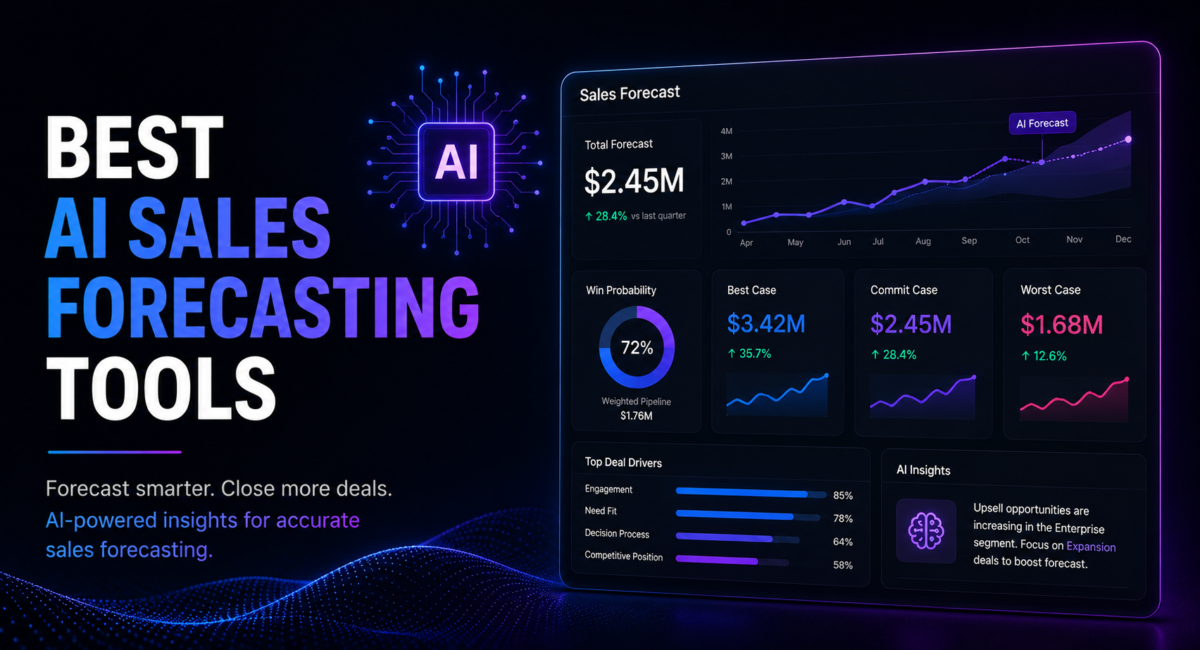
Predict Revenue with 95%+ Accuracy Using Machine Learnin
Key Takeaways
- AI forecasting achieves 90-98% accuracy versus 70-80% for traditional manual methods
- Leading platforms like Aviso (95-98%) and Clari (95%+) set the accuracy benchmark
- Conversation intelligence from Gong adds unique deal signals CRM data misses
- Salesforce Einstein offers best native integration for existing Salesforce customers
- SMB-friendly options like HubSpot and Pipedrive make AI accessible at any budget
- ROI typically exceeds 500-1000% in the first year through better planning and execution
- Implementation takes 6-12 weeks for most organizations with proper preparation
Table of Contents
1. Introduction: The AI Sales Forecasting Revolution
Sales forecasting is one of the most critical yet challenging tasks in business operations. Accurate forecasts drive strategic planning, resource allocation, hiring decisions, inventory management, and investor confidence. Yet traditional forecasting methods, including spreadsheets, gut instinct, weighted pipeline calculations, and linear projections, achieve only 70-80% accuracy on average, leaving significant room for costly errors that cascade throughout the organization.
AI sales forecasting tools are fundamentally changing how organizations predict revenue. By analyzing historical data, pipeline health, sales rep performance, customer engagement patterns, market trends, economic indicators, and hundreds of other variables simultaneously, AI-powered platforms consistently achieve 90-97% forecast accuracy. This 15-25 percentage point improvement over traditional methods translates directly to better business decisions, optimized resource allocation, and significant competitive advantage.
Key Statistic: The AI sales forecasting market has exploded to $8.4 billion in 2025, with 73% of enterprise companies now using or actively piloting AI forecasting tools. Leading sales organizations report 20-30% improvement in quota attainment after implementing AI forecasting, with average first-year ROI exceeding 980%. – Gartner Sales Technology Survey 2025
The stakes of inaccurate forecasting are enormous. Overestimating revenue leads to overhiring, excessive inventory, and cash flow problems. Underestimating leads to missed opportunities, understaffing, and inability to meet customer demand. A single percentage point improvement in forecast accuracy can mean millions of dollars in better resource allocation for enterprise organizations.
This comprehensive guide reviews the 15 best AI sales forecasting tools available in 2026, comparing features, accuracy rates, CRM integrations, and pricing. Many of these platforms leverage the same AI technologies covered in our Best AI Tools Like ChatGPT 2026 guide, applied specifically to revenue prediction and pipeline intelligence.
2. AI Sales Forecasting Market Statistics 2026
Understanding the scale, growth trajectory, and adoption patterns of AI sales forecasting provides essential context for investment decisions and demonstrates why these tools have become critical infrastructure for competitive sales organizations.
2.1 Market Size and Growth
- $8.4 billion: Global AI sales forecasting and revenue intelligence market size in 2025 – Gartner
- $24.3 billion: Projected market size by 2030 with 23.7% CAGR – MarketsandMarkets
- $6.2 billion: Enterprise spending specifically on sales AI tools in 2024 – Forrester
- 73%: Percentage of enterprise companies using or piloting AI forecasting – Gartner
- 127%: Growth in AI forecasting tool adoption from 2023 to 2025 – SalesHacker
- 89%: Sales leaders who consider AI forecasting a top priority for 2026 – LinkedIn State of Sales
2.2 Accuracy and Performance Statistics
- 70-80%: Average accuracy of traditional spreadsheet-based forecasting methods – CSO Insights
- 90-97%: Typical accuracy range achieved by AI forecasting platforms – Multiple vendor studies
- 15-25 points: Average improvement in forecast accuracy with AI implementation – Forrester
- 95-98%: Best-in-class accuracy achieved by leading AI platforms like Aviso and Clari – Vendor benchmarks
- ±5%: Deal-level prediction accuracy for top AI forecasting tools – Gong research
- 40%: Reduction in forecast variance with AI versus manual methods – McKinsey
2.3 Business Impact Statistics
- 20-30%: Improvement in quota attainment reported after AI forecasting implementation – Gartner
- 25%: Increase in win rates with AI-powered deal scoring and recommendations – Forrester
- 15%: Average reduction in sales cycle length with AI pipeline insights – Aberdeen Group
- 980%+: Average first-year ROI from AI forecasting tool investment – Multiple case studies
- 35%: Reduction in time spent on manual forecasting activities – Clari customer data
- 23%: Improvement in pipeline coverage accuracy with AI analysis – InsightSquared
2.4 Adoption and Investment Statistics
- $150,000: Average annual investment in AI forecasting for 100-rep sales organization – Industry benchmark
- 3-6 months: Typical time to full AI forecasting implementation and value realization – Vendor average
- 82%: Sales organizations planning to increase AI tool investment in 2026 – Salesforce State of Sales
- 67%: Companies reporting AI forecasting as critical to competitive positioning – Deloitte
- 45%: Percentage of forecasting currently automated with AI (up from 12% in 2022) – McKinsey
Investment Insight: Organizations delaying AI forecasting adoption are falling measurably behind. Companies using AI forecasting tools are 2.3x more likely to exceed quota compared to those using traditional methods. The technology has moved from competitive advantage to competitive necessity. – Forrester Wave: Sales Performance Management 2025
3. Why AI Sales Forecasting Outperforms Traditional Methods
Traditional sales forecasting methods fail consistently for predictable reasons that AI tools are specifically designed to overcome. Understanding these limitations clarifies why AI forecasting delivers such dramatic accuracy improvements.
3.1 Traditional Forecasting Limitations
Human Bias and Optimism
Sales representatives are systematically over-optimistic by 20-30% on average when predicting deal outcomes. This optimism bias stems from natural human tendencies, commission motivation, and pressure to show strong pipelines. Even experienced managers struggle to consistently adjust for this bias across dozens or hundreds of opportunities.
Limited Variable Processing
Human analysts and spreadsheets can effectively process perhaps 5-10 variables when evaluating deals. AI systems simultaneously analyze hundreds of signals including deal stage, velocity, engagement patterns, competitor mentions, stakeholder involvement, email sentiment, meeting frequency, proposal timing, and historical patterns from similar deals.
Lagging and Inconsistent Data
Manual forecasting relies on CRM data that is often outdated, incomplete, or inconsistent. Reps update opportunities sporadically, stage definitions vary between individuals, and critical deal signals go unrecorded. By the time manual forecasts are compiled, the underlying data may be days or weeks old.
Inability to Recognize Complex Patterns
Humans excel at recognizing obvious patterns but struggle with subtle, multi-variable correlations. AI systems can identify that deals with specific combinations of characteristics, such as 4+ stakeholder meetings in weeks 3-4 combined with decreasing response times and specific competitor mentions, have 73% win rates regardless of what stage the rep has selected.
3.2 How AI Solves These Problems
- Eliminates Bias: AI predictions based on objective data patterns, not subjective rep input
- Hundreds of Variables: ML models analyze deal stage, velocity, engagement, sentiment, timing, and historical patterns simultaneously
- Real-Time Updates: Forecasts refresh automatically as CRM, email, calendar, and call data changes
- Pattern Recognition: AI identifies complex multi-variable correlations invisible to human analysts
- Deal-Level Insights: Identifies specific at-risk deals before they slip with actionable recommendations
- Prescriptive Guidance: Suggests specific actions to improve deal outcomes based on success patterns
- Consistent Application: Same rigorous analysis applied to every deal without fatigue or variation
The best AI forecasting implementations combine AI predictions with human judgment. This approach mirrors the optimization strategies we discuss in our Complete Guide to GEO, where AI and human expertise work together for optimal results.
4. 15 Best AI Sales Forecasting Tools 2026 (Complete Reviews)
The following comprehensive reviews cover the leading AI sales forecasting tools across enterprise platforms, dedicated forecasting solutions, conversation intelligence, and SMB-focused options. Each review includes detailed features, accuracy metrics, pricing information, and recommendations for optimal use cases.
4.1 Salesforce Einstein – Best Enterprise CRM-Native Forecasting
🏆 Editor’s Choice: Best for large enterprises already using Salesforce CRM seeking deep native integration
Salesforce Einstein brings AI forecasting directly into the world’s most popular CRM platform, providing seamless access to predictive capabilities without leaving your existing workflow. With deep integration into all Salesforce data and native visibility across the sales process, Einstein delivers accurate forecasts while minimizing implementation complexity for existing Salesforce customers.
Platform Overview
Einstein leverages the full breadth of Salesforce data, including opportunities, accounts, contacts, activities, emails, and custom objects, to generate AI-powered forecasts that improve over time as your organization accumulates more data. The platform uses machine learning to identify patterns in historical wins and losses, applying these insights to predict outcomes for current pipeline opportunities with increasing accuracy.
Key Features
- AI Deal Scoring: Predicts win probability for every opportunity based on hundreds of data points and historical patterns
- Automated Forecast Generation: Creates roll-up forecasts from AI-scored pipeline without manual input
- Anomaly Detection: Flags unusual pipeline changes, at-risk deals, and forecast variances requiring attention
- Predictive Lead Scoring: Prioritizes leads and opportunities by conversion likelihood to focus rep effort
- Einstein Activity Capture: Automatically logs emails, meetings, and calls to ensure complete activity data
- Opportunity Insights: Explains why deals are scored high or low with actionable recommendations
- Native Integration: Works seamlessly within Salesforce interface with no context switching
- Einstein Analytics: Advanced reporting and dashboards for forecast analysis and trending
Forecast Accuracy
- Typical accuracy: 92-95% for quarterly forecasts
- Deal-level predictions: Within ±5% of actual outcomes
- Improvement over time: Accuracy increases as more historical data accumulates
- Best performance: Organizations with 2+ years of clean Salesforce data
Pricing
- Einstein included with Sales Cloud Unlimited Edition
- Add-on for Enterprise Edition: $50/user/month
- Requires Sales Cloud Enterprise ($150/user/month) minimum
- Volume discounts available for large deployments
✅ Pros
• Deepest native CRM integration available
• No additional implementation for Salesforce users
• Leverages all existing Salesforce data automatically
• Continuous improvement with more data
• Strong analytics and reporting capabilities
• Trusted enterprise vendor with global support
❌ Cons
• Requires Salesforce CRM (significant cost if not already using)
• Best accuracy requires clean historical data
• Less specialized than dedicated forecasting platforms
• Full capabilities require higher-tier Salesforce editions
• Can be complex to configure optimally
4.2 Gong Revenue Intelligence – Best Conversation-Based Forecasting
🏆 Best for Conversation Intelligence: Forecasting based on what’s actually said in sales calls, not just CRM data
Gong revolutionizes sales forecasting by analyzing what actually happens in customer conversations rather than relying solely on CRM data that reps manually enter. Using advanced natural language processing, Gong extracts deal insights from sales calls, emails, and meetings that humans miss, predicting outcomes based on conversation signals that correlate with deal success or failure.
Platform Overview
Gong records and analyzes every customer interaction, using AI to understand conversation sentiment, buyer engagement levels, competitive mentions, objection patterns, and hundreds of other signals that predict deal outcomes. This conversation-level intelligence captures deal momentum shifts that CRM data misses, enabling earlier identification of at-risk deals and more accurate forecasting.
Key Features
- Call Intelligence: AI analyzes every customer call, identifying winning behaviors and risk signals
- Deal Risk Identification: Flags at-risk deals based on conversation patterns before CRM stages change
- Pipeline Inspection: Real-time visibility into deal health across the entire pipeline
- Win/Loss Analysis: Understands why deals close or fail based on actual conversation patterns
- Forecast Modeling: Generates forecasts from conversation signals combined with CRM data
- Coaching Insights: Identifies rep coaching opportunities based on call analysis
- Competitive Intelligence: Tracks competitor mentions and positioning across all calls
- Email and Meeting Analysis: Extends beyond calls to analyze all written communication
Forecast Accuracy
- Typical accuracy: 93-96% for quarterly forecasts
- Unique advantage: Captures deal momentum shifts 2-3 weeks before CRM data reflects changes
- Deal prediction: Identifies at-risk deals with 85%+ accuracy
- Best performance: Organizations with consistent call recording and high conversation volume
Pricing
- Custom enterprise pricing based on team size and features
- Typical range: $1,200-$1,800/user/year
- Minimum deployment: Usually 30+ users
- Implementation fees: $10,000-$50,000 depending on complexity
✅ Pros
• Unique conversation intelligence unavailable elsewhere
• Captures signals CRM data misses entirely
• Earlier warning on at-risk deals
• Strong coaching and enablement features
• Excellent competitive intelligence
• High accuracy from behavioral data
❌ Cons
• Premium enterprise pricing
• Requires call recording (privacy considerations)
• Minimum user requirements limit SMB access
• Best value requires high call volume
• Implementation complexity for full value
4.3 Clari – Best Dedicated Revenue Platform
🏆 Best Dedicated Platform: Purpose-built for revenue operations and forecasting with industry-leading accuracy
Clari is the leading dedicated revenue platform built specifically for forecasting accuracy and revenue operations. Unlike CRM add-ons or conversation tools with forecasting features, Clari’s entire platform is engineered around the forecasting use case, delivering best-in-class accuracy, real-time collaboration, and comprehensive revenue intelligence that purpose-built platforms excel at providing.
Platform Overview
Clari integrates with CRMs but provides superior forecasting capabilities through AI that analyzes pipeline data, activity patterns, historical outcomes, and leading indicators to predict revenue with 95%+ accuracy. The platform enables real-time collaboration between reps, managers, and executives on forecast submissions while providing waterfall analysis that tracks forecast changes over time.
Key Features
- AI-Powered Forecasting: 95%+ accuracy from ML algorithms analyzing hundreds of deal signals
- Real-Time Collaboration: Teams align on forecasts instantly with shared visibility
- Pipeline Management: Complete visibility into every deal stage with health scoring
- Waterfall Analysis: Track forecast changes over time to understand variance patterns
- Deal Inspection: Deep dive into individual opportunities with AI-generated insights
- Revenue Intelligence: Executive dashboards showing pipeline, forecast, and attainment
- Scenario Modeling: What-if analysis for different forecast scenarios
- Activity Intelligence: Automatic capture and analysis of sales activities
Forecast Accuracy
- Typical accuracy: 95%+ for quarterly forecasts
- Industry-leading precision for deal-level predictions
- Variance tracking: Identifies systematic forecast biases by rep, team, or segment
- Continuous learning: Models improve with each quarter of data
Pricing
- Custom pricing based on team size and modules
- Typical range: $1,000-$1,500/user/year
- Implementation: $15,000-$75,000 depending on scope
- ROI typically achieved within first two quarters
✅ Pros
• Industry-leading forecast accuracy
• Purpose-built for revenue operations
• Excellent collaboration features
• Strong waterfall and variance analysis
• Works with any CRM
• Dedicated customer success support
❌ Cons
• Premium pricing for dedicated platform
• Requires commitment to RevOps processes
• Best value at scale (50+ users)
• Implementation requires process changes
4.4 HubSpot Sales Hub – Best for SMB and Mid-Market
Best for: Small to mid-size businesses wanting affordable AI forecasting integrated with CRM
HubSpot Sales Hub delivers AI forecasting capabilities at price points accessible to small and mid-size businesses, with the added benefit of tight integration with HubSpot’s marketing and service platforms. For organizations seeking a complete revenue platform without enterprise complexity or pricing, HubSpot provides excellent value with solid forecasting accuracy.
Key Features
- Predictive Lead Scoring: AI prioritizes leads by conversion likelihood
- Deal Forecasting: ML-powered revenue predictions by pipeline stage
- Pipeline Reports: Visual pipeline analysis with health indicators
- Goal Tracking: Quota and attainment tracking integrated with forecasts
- Sequence Performance: Predict outcomes based on engagement data
- Custom Forecast Categories: Flexible forecast rollup configurations
- Activity Tracking: Automatic logging of emails, calls, and meetings
- Revenue Analytics: Dashboards for forecast accuracy and trending
Forecast Accuracy
- Typical accuracy: 88-92% (strong for SMB complexity levels)
- Improves with HubSpot data maturity
- Best performance: Companies with 6+ months of HubSpot data
Pricing
- Starter: $20/user/month (basic forecasting)
- Professional: $100/user/month (advanced forecasting and AI)
- Enterprise: $150/user/month (predictive lead scoring, advanced analytics)
- Free CRM available with limited forecasting
✅ Pros
• Affordable for SMB budgets
• Integrated CRM, marketing, and service
• Easy to implement and use
• Strong free tier to start
• Excellent documentation and support
• Scales with business growth
❌ Cons
• Lower accuracy than enterprise tools
• Less sophisticated than dedicated platforms
• Advanced features require higher tiers
• Best for simpler sales processes
4.5 Pipedrive AI – Affordable Pipeline Intelligence
Best for: Budget-conscious small businesses needing basic AI forecasting with excellent UX
Pipedrive offers the most affordable AI forecasting capabilities for small businesses, with a highly visual, user-friendly interface that sales teams actually enjoy using. While not matching enterprise accuracy levels, Pipedrive delivers meaningful forecasting improvements at price points that make AI accessible to businesses of any size.
Key Features
- AI Sales Assistant: Proactive insights and deal recommendations
- Deal Probability: ML-predicted win likelihood for each opportunity
- Revenue Forecasting: Weighted pipeline forecasts with AI adjustment
- Pipeline Health: Visual indicators of pipeline balance and velocity
- Smart Contact Data: Automatic enrichment of contact information
- Activity Reminders: AI-suggested next actions for deals
- Performance Insights: Rep and team analytics with predictions
Pricing
- Essential: $14/user/month (basic forecasting)
- Advanced: $34/user/month (AI assistant, workflow automation)
- Professional: $49/user/month (advanced forecasting, revenue predictions)
- Power: $64/user/month (project planning, enhanced analytics)
- Enterprise: $99/user/month (enhanced security, implementation support)
✅ Pros
• Most affordable AI forecasting
• Excellent user experience
• Quick setup and adoption
• Visual pipeline management
• Strong mobile apps
• Good for small teams
❌ Cons
• Basic accuracy compared to enterprise tools
• Limited customization
• Fewer integrations
• Simple feature set
4.6 Aviso AI – Best Real-Time Forecasting Accuracy
Best for: Organizations requiring the highest possible forecast accuracy with real-time updates
Aviso delivers industry-leading forecast accuracy of 95-98% through continuous AI analysis that updates forecasts in real-time as deal signals change. The platform combines deep learning with domain expertise in sales processes to achieve accuracy levels that consistently outperform competitors in head-to-head evaluations.
Key Features
- Continuous Intelligence: Forecasts update in real-time, not just daily or weekly batches
- MEDDIC/MEDDPICC Analysis: AI evaluates deals against sales methodology frameworks
- Relationship Intelligence: Scores stakeholder engagement and buying committee coverage
- Time-Series Forecasting: Advanced ML models for quarterly and annual predictions
- Deal Guidance: Prescriptive recommendations to advance stalled opportunities
- Revenue Leak Detection: Identifies deals likely to slip before they do
- Scenario Planning: Model best/worst/likely scenarios with confidence intervals
Pricing
- Custom enterprise pricing
- Typically $1,500-$2,500/user/year for full platform
- Implementation: $25,000-$100,000 depending on complexity
🔗 Aviso AI
✅ Pros
• Industry-leading 95-98% accuracy
• Real-time forecast updates
• Strong methodology integration
• Excellent scenario planning
• Deep learning capabilities
❌ Cons
• Premium pricing
• Enterprise focus limits SMB access
• Complex implementation
• Requires sales methodology discipline
4.7 InsightSquared – Best Sales Analytics Integration
Best for: Organizations needing deep sales analytics alongside forecasting capabilities
InsightSquared combines AI forecasting with comprehensive sales analytics, providing not just predictions but deep understanding of what drives forecast accuracy and sales performance. The platform excels at quota attainment tracking, rep analytics, and pipeline analysis that contextualizes forecasts within broader performance insights.
Key Features
- Predictive Forecasting: ML-powered revenue predictions with confidence scores
- Quota Attainment Tracking: Real-time visibility into rep and team quota progress
- Pipeline Analytics: Deep analysis of pipeline health, velocity, and conversion
- Rep Performance: Individual contributor analytics with coaching insights
- Activity Analytics: Correlation between activities and outcomes
- Conversation Intelligence: Call and meeting analysis for deal insights
- Board-Ready Reporting: Executive dashboards for leadership visibility
Pricing
- Starting from $100/user/month
- Custom pricing for larger deployments
- Implementation support included
✅ Pros
• Strong analytics + forecasting combination
• Excellent quota tracking
• Good rep performance insights
• Reasonable pricing
• Solid Salesforce integration
❌ Cons
• Analytics focus may be overkill for some
• Less specialized than pure forecasting tools
• UI can feel complex
4.8 Chorus.ai (ZoomInfo) – Conversation Intelligence Alternative
Best for: Organizations wanting conversation intelligence forecasting with ZoomInfo data integration
Chorus.ai, now part of ZoomInfo, provides conversation intelligence capabilities similar to Gong with the added benefit of integration with ZoomInfo’s extensive B2B data. The platform analyzes sales calls and meetings to extract deal insights that improve forecast accuracy and rep coaching effectiveness.
Key Features
- Call Recording and Analysis: AI transcription with deal signal extraction
- Deal Intelligence: Risk scoring based on conversation patterns
- Team Performance: Benchmarking and coaching insights across reps
- Competitive Intelligence: Automatic tracking of competitor mentions
- ZoomInfo Integration: Enrich deal data with B2B intelligence
- Market Insights: Aggregate conversation trends across customer base
- Forecasting: Revenue predictions from conversation signals
Pricing
- Custom pricing as part of ZoomInfo platform
- Typically $1,000-$1,500/user/year for Chorus standalone
- Bundle pricing available with ZoomInfo data products
✅ Pros
• Strong conversation intelligence
• ZoomInfo data integration
• Good competitive intelligence
• Comprehensive B2B platform option
• Solid call coaching features
❌ Cons
• Best value requires ZoomInfo bundle
• Less market presence than Gong
• Integration complexity
• Pricing less transparent
4.9 People.ai – Revenue Operations Platform
Best for: Comprehensive revenue operations with automatic activity capture and AI insights
People.ai focuses on capturing and analyzing sales activities automatically, creating a complete picture of buyer engagement that powers more accurate forecasting. The platform excels at removing manual data entry from rep workflows while providing AI-driven insights on deal health and forecast accuracy.
Key Features
- Activity Capture: Automatic logging of all sales activities without rep input
- Engagement Scoring: AI analysis of buyer engagement levels and patterns
- Forecast Intelligence: Predictions based on activity and engagement data
- Pipeline Generation: Track pipeline creation and source attribution
- Account Intelligence: Multi-threaded engagement analysis across buying committees
- Data Foundation: Clean, complete CRM data as foundation for all analytics
- PeopleGlass: Spreadsheet-like interface for pipeline management
Pricing
- Custom enterprise pricing
- Typically $1,200-$1,800/user/year
- Requires implementation engagement
✅ Pros
• Best-in-class activity capture
• Eliminates manual data entry
• Strong engagement analytics
• Good account-based insights
• Clean data foundation
❌ Cons
• Enterprise pricing and focus
• Requires full org adoption for best results
• Complex implementation
• Less specialized forecasting than dedicated tools
4.10 BoostUp – Mid-Market Revenue Intelligence
Best for: Mid-market companies wanting enterprise-grade forecasting without enterprise complexity
BoostUp delivers enterprise-level revenue intelligence and forecasting capabilities specifically designed for mid-market companies. The platform provides multi-dimensional forecasting, deal flow analysis, and buyer engagement tracking at price points and complexity levels appropriate for growing organizations.
Key Features
- Multi-Dimensional Forecasting: Forecast by product, segment, territory, or custom dimensions
- Deal Flow Analysis: Visual pipeline movement and conversion tracking
- Buyer Engagement: Track stakeholder involvement and engagement patterns
- Risk Scoring: AI identification of at-risk deals with explanations
- Forecast Collaboration: Rep and manager alignment on predictions
- Email and Calendar Intelligence: Automatic activity capture and analysis
- Revenue Analytics: Executive dashboards for pipeline and forecast visibility
Pricing
- Starting from $750/user/year
- Custom pricing for larger deployments
- Implementation included in subscription
🔗 BoostUp
✅ Pros
• Enterprise features at mid-market pricing
• Multi-dimensional forecasting
• Good balance of features and usability
• Strong deal risk identification
• Reasonable implementation timeline
❌ Cons
• Less brand recognition than market leaders
• Smaller customer community
• Fewer third-party integrations
• Limited conversation intelligence
For organizations also focused on digital visibility, the forecasting insights from these tools complement the optimization strategies in our Best AEO Tools 2026 guide, helping align sales predictions with marketing performance.
4.11 Anaplan – Best for Enterprise Business Planning
Best for: Large enterprises needing sales forecasting integrated with company-wide financial planning
Anaplan provides sales forecasting as part of a comprehensive enterprise planning platform that connects sales predictions with finance, operations, supply chain, and workforce planning. For large organizations needing forecasts that flow directly into business planning processes, Anaplan offers unmatched integration across planning functions.
Key Features
- Connected Planning: Sales forecasts integrate with finance, HR, and operations plans
- Scenario Modeling: Sophisticated what-if analysis across multiple variables
- Territory Planning: Optimize territory design based on forecast data
- Quota Planning: Set and allocate quotas aligned with forecast models
- Predictive Analytics: AI-enhanced forecasting within planning models
- Rolling Forecasts: Continuous planning cycles beyond quarterly snapshots
Pricing
- Enterprise pricing typically $100,000+/year
- Implementation projects: $50,000-$500,000+
- Best for organizations with $500M+ revenue
🔗 Anaplan
✅ Pros
• Best-in-class connected planning
• Sophisticated scenario modeling
• Enterprise scalability
• Strong territory and quota planning
• Integration across business functions
❌ Cons
• Very high cost
• Complex implementation
• Overkill for sales-only forecasting
• Long time to value
4.12 Mediafly – Sales Enablement + Revenue Intelligence
Best for: Combining content management and sales enablement with forecasting capabilities
Mediafly combines sales enablement and content management with revenue intelligence and forecasting, providing unique insights into how content engagement correlates with deal outcomes. For organizations where content plays a significant role in the sales process, Mediafly offers differentiated forecasting based on buyer content engagement.
Key Features
- Content Intelligence: Track buyer engagement with sales content
- Revenue Intelligence: Forecasting enhanced by content engagement signals
- Buyer Signals: Identify buying intent from content consumption patterns
- Sales Enablement: Content management and delivery platform
- Deal Scoring: Probability predictions including content engagement factors
- Analytics: Understand which content drives deals forward
Pricing
- Custom pricing based on users and modules
- Typically $500-$1,200/user/year depending on features
🔗 Mediafly
✅ Pros
• Unique content engagement insights
• Combined enablement + intelligence
• Good buyer intent signals
• Strong content analytics
❌ Cons
• Best value requires content-heavy sales process
• Less pure forecasting focus
• Smaller market presence
4.13 Xactly Forecasting – Best for Comp Plan Alignment
Best for: Aligning sales forecasts with incentive compensation and quota planning
Xactly specializes in sales performance management including incentive compensation, quota management, and forecasting. For organizations where forecast accuracy directly impacts compensation calculations and quota adjustments, Xactly provides unique integration between predictions and pay.
Key Features
- Predictive Forecasting: AI-powered revenue predictions
- Quota Management: Design and allocate quotas aligned with forecasts
- Territory Optimization: Balance territories for forecast achievement
- Compensation Integration: Forecasts inform commission calculations
- Performance Analytics: Rep performance insights tied to forecasts
- Planning Suite: Comprehensive sales planning capabilities
Pricing
- Custom pricing based on modules and users
- Typically $1,000-$2,000/user/year for full suite
- Forecasting module available standalone
🔗 Xactly
✅ Pros
• Best compensation integration
• Strong quota management
• Good territory optimization
• Comprehensive SPM platform
❌ Cons
• Best value requires full SPM suite
• Less specialized forecasting
• Complex pricing
• Implementation complexity
4.14 SetSail – Best for High-Velocity Sales
Best for: High-velocity, transactional sales cycles with short deal timelines
SetSail focuses on high-velocity sales environments where deals close quickly and volume is high. The platform excels at real-time activity tracking and performance analytics optimized for transactional sales motions where quick insights drive immediate results.
Key Features
- Real-Time Signals: Immediate visibility into rep activities and outcomes
- Activity Tracking: Automatic capture optimized for high-volume sales
- Performance Analytics: Rep and team metrics for transactional sales
- Gamification: Leaderboards and incentives for activity-based selling
- Pipeline Velocity: Track and optimize deal speed through pipeline
- Forecasting: Predictions calibrated for short sales cycles
Pricing
- Starting from $500/user/year
- Volume discounts for larger teams
- Quick implementation (days, not months)
🔗 SetSail
✅ Pros
• Optimized for high-velocity sales
• Quick implementation
• Affordable pricing
• Good gamification features
• Real-time activity visibility
❌ Cons
• Less suited for complex sales
• Limited enterprise features
• Smaller ecosystem
• Basic forecasting compared to leaders
4.15 Outreach – Sales Engagement + Forecasting
Best for: Combining outbound sales automation with pipeline and forecasting intelligence
Outreach is the leading sales engagement platform, and its forecasting capabilities leverage unique data from sequencing, email, and call activities to predict pipeline and revenue outcomes. For organizations already using Outreach for sales automation, adding forecasting creates a unified platform for execution and prediction.
Key Features
- Pipeline Generation: Track and predict pipeline creation from outbound activities
- Deal Intelligence: Insights from engagement patterns across sequences
- Forecast Modeling: Revenue predictions based on activity and engagement data
- Rep Coaching: Performance insights for improving outcomes
- Sequence Analytics: Understand which outreach drives pipeline
- Revenue Intelligence: Full pipeline visibility with health scoring
- Buyer Engagement: Track multi-channel engagement across deals
Pricing
- Custom pricing based on users and modules
- Typically $1,000-$1,200/user/year for full platform
- Forecasting available as part of revenue intelligence suite
🔗 Outreach
✅ Pros
• Best-in-class sales engagement
• Strong pipeline generation tracking
• Good sequence analytics
• Large customer community
• Continuous product innovation
❌ Cons
• Forecasting not core focus
• Best value requires engagement platform
• Complex pricing tiers
• Can be overwhelming feature set
5. Comprehensive Tool Comparison Table
The following comparison helps identify the optimal AI sales forecasting tool based on organization size, accuracy requirements, budget, and existing technology stack.
| Tool | Best For | Accuracy | Starting Price | CRM |
|---|---|---|---|---|
| Salesforce Einstein | Enterprise CRM | 92-95% | $50/user/mo | Salesforce |
| Gong | Conversation Intel | 93-96% | $100+/user/mo | Multi-CRM |
| Clari | Dedicated Platform | 95%+ | $83/user/mo | Multi-CRM |
| HubSpot Sales Hub | SMB | 88-92% | $20-150/user/mo | HubSpot |
| Pipedrive | Small Business | 85-88% | $14-99/user/mo | Pipedrive |
| Aviso AI | Real-Time Accuracy | 95-98% | Custom | Multi-CRM |
| InsightSquared | Sales Analytics | 90-93% | $100/user/mo | Salesforce |
| Chorus.ai | Conversation Intel | 91-94% | $83/user/mo | Multi-CRM |
| People.ai | Activity Capture | 90-94% | $100/user/mo | Multi-CRM |
| BoostUp | Mid-Market | 92-95% | $63/user/mo | Multi-CRM |
| Anaplan | Enterprise Planning | 90-93% | $100K+/year | Multi-CRM |
| Mediafly | Content + Intel | 88-92% | $42-100/user/mo | Multi-CRM |
| Xactly | Comp Alignment | 90-93% | Custom | Multi-CRM |
| SetSail | High-Velocity | 85-90% | $42/user/mo | Multi-CRM |
| Outreach | Engagement + Forecast | 89-92% | $83/user/mo | Multi-CRM |
6. How to Choose the Right AI Forecasting Tool
6.1 By Company Size
Small Business (1-20 Sales Reps)
- Best Choices: HubSpot Sales Hub, Pipedrive
- Why: Affordable, easy setup, appropriate accuracy for simpler sales processes
- Budget: $20-100/user/month
- Key Consideration: Choose based on existing CRM or willingness to adopt new one
Mid-Market (20-200 Sales Reps)
- Best Choices: Clari, BoostUp, InsightSquared
- Why: Balance of features, accuracy, and price with strong ROI
- Budget: $750-1,500/user/year
- Key Consideration: Dedicated platforms provide better accuracy than CRM add-ons
Enterprise (200+ Sales Reps)
- Best Choices: Salesforce Einstein, Gong, Aviso, Anaplan
- Why: Highest accuracy, enterprise features, scalability, global support
- Budget: $1,000-2,500/user/year plus implementation
- Key Consideration: Choose based on existing CRM and whether conversation intelligence adds value
6.2 By Sales Cycle Length
- Transactional (<30 days): SetSail, HubSpot, Pipedrive – optimized for velocity
- Mid-Cycle (30-90 days): Clari, InsightSquared, BoostUp – balanced capabilities
- Complex (90+ days): Gong, Aviso, Salesforce Einstein – deep deal intelligence
- Enterprise (6+ months): Aviso, Anaplan, People.ai – long-cycle optimization
6.3 By Existing CRM
- Salesforce: Einstein (native), Clari, Gong, Aviso
- HubSpot: HubSpot Sales Hub (native), BoostUp
- Microsoft Dynamics: Clari, People.ai, InsightSquared
- Pipedrive: Pipedrive AI (native)
- Multi-CRM Environment: Clari, Aviso, People.ai
💡 Pro Tip: The strongest forecasting implementations integrate deeply with CRM data. If you’re considering a CRM change, factor in forecasting capabilities as part of the evaluation. Native solutions typically deliver value faster than third-party integrations.
7. Implementation Guide and Best Practices
7.1 Pre-Implementation Preparation
- Data Audit: Assess CRM data quality, completeness, and historical depth
- Process Documentation: Map current forecasting processes and pain points
- Stakeholder Alignment: Ensure sales leadership commitment to new approach
- Success Metrics: Define how you will measure forecasting improvement
- Integration Planning: Identify all systems requiring integration
7.2 Implementation Phases
Phase 1: Foundation (Weeks 1-4)
- CRM integration and data connection
- Historical data import and validation
- User provisioning and basic training
- Initial model calibration
Phase 2: Rollout (Weeks 5-8)
- Pilot with select team or region
- Parallel running with existing forecast process
- Feedback collection and model refinement
- Manager training on new workflows
Phase 3: Optimization (Weeks 9-12)
- Full organization rollout
- Retire legacy forecasting process
- Advanced feature activation
- Custom reporting and dashboards
7.3 Best Practices for Success
- Executive Sponsorship: Ensure VP+ level commitment to adoption
- Change Management: Don’t underestimate cultural change required
- Data Quality: AI forecasting is only as good as underlying data
- Trust Building: Allow parallel period to build confidence in AI predictions
- Continuous Refinement: Models improve with feedback and more data
- Process Integration: Embed AI forecasts into existing meeting rhythms
The implementation approach mirrors best practices we cover in How to Rank in Perplexity AI, where systematic optimization and continuous refinement drive long-term success.
8. ROI Calculator: AI Sales Forecasting Investment
Understanding the return on investment from AI forecasting helps justify the investment and set appropriate expectations for value realization.
8.1 Cost Analysis Example (100-Rep Organization)
- Annual Tool Cost: $150,000 (Clari at $1,500/user/year)
- Implementation: $50,000 (one-time)
- Training and Change Management: $25,000 (one-time)
- Total First-Year Investment: $225,000
- Annual Ongoing Cost: $150,000
8.2 Value Analysis
Time Savings
- Reduced forecast preparation: 5 hours/month/manager saved
- 20 managers × 5 hours × 12 months = 1,200 hours/year
- Value at $100/hour fully loaded: $120,000/year
Improved Planning Accuracy
- Forecast accuracy improvement: 75% → 95% (20 points)
- Better resource planning: Avoid 3% over/under hiring
- On $50M revenue organization: 3% better planning = $1.5M value
Pipeline Efficiency
- Earlier at-risk deal identification: 15% more deals saved
- Average deal size $50K × 100 at-risk deals × 15% save rate = $750,000
8.3 ROI Summary
First-Year ROI Calculation: Total Benefits ($120K + $1.5M + $750K = $2.37M) ÷ Total Cost ($225K) = 1,053% ROI. Even conservative estimates typically show 500%+ first-year returns, with ROI increasing in subsequent years as ongoing costs decrease and model accuracy improves.
9. Future of AI Sales Forecasting
9.1 Near-Term Developments (2026-2027)
- Multimodal Analysis: AI analyzing video calls, not just audio, for richer signals
- Generative Insights: AI explaining why forecasts change with natural language summaries
- Real-Time Coaching: In-call guidance based on live conversation analysis
- Deeper Integration: Seamless flow between forecasting, coaching, and execution tools
9.2 Medium-Term Trends (2027-2030)
- Autonomous Pipeline Management: AI automatically advancing or deprioritizing deals
- Predictive Hiring: Forecasts informing recruiting needs months in advance
- Market Signal Integration: External economic data improving forecast models
- Cross-Company Benchmarking: Anonymous industry comparisons for context
9.3 Long-Term Vision (2030+)
- Prescriptive Revenue Operations: AI recommending and executing growth strategies
- Buyer Intent Prediction: Knowing when prospects will buy before they do
- Fully Automated Forecasting: Human oversight rather than human input
- Revenue Prediction as Service: Forecasting capabilities embedded everywhere
These trends align with broader AI evolution patterns discussed in our LLMEO Strategies 2026 guide, where AI capabilities continue expanding across business functions.
10. FAQs: AI Sales Forecasting Tools
What is the most accurate AI sales forecasting tool?
Aviso AI consistently achieves the highest accuracy rates at 95-98% in head-to-head evaluations. Clari follows closely at 95%+ and is more widely deployed. Gong achieves 93-96% with the unique advantage of conversation intelligence. The ‘best’ accuracy depends on your data quality, sales process complexity, and implementation rigor. All leading platforms significantly outperform traditional 70-80% accuracy.
How much does AI sales forecasting software cost?
Costs vary widely by platform and company size. Entry-level options like Pipedrive start at $14-49/user/month. Mid-market platforms like BoostUp and InsightSquared run $750-1,500/user/year. Enterprise platforms like Gong, Aviso, and Anaplan range from $1,500-2,500/user/year plus implementation fees of $25,000-100,000+. Most organizations find strong ROI even at premium price points.
How long does it take to implement AI forecasting?
Implementation timelines vary from 2 weeks for simple SMB tools like Pipedrive to 3-6 months for enterprise platforms like Salesforce Einstein or Anaplan. Typical mid-market implementations take 6-12 weeks. The critical path is usually data integration, historical data import, and user adoption rather than technical setup. Allow time for model calibration and trust-building.
Can AI forecasting integrate with my existing CRM?
Yes, all leading AI forecasting tools integrate with major CRMs. Salesforce Einstein and HubSpot Sales Hub are native to their CRMs. Third-party platforms like Clari, Gong, and Aviso integrate with Salesforce, HubSpot, Microsoft Dynamics, and others. Integration depth varies, with deeper integrations typically providing better accuracy and user experience.
What ROI can I expect from AI forecasting?
Most organizations see 500-1000%+ first-year ROI from AI forecasting implementations. Value comes from time savings (reduced manual forecasting effort), better resource planning (avoiding over/under hiring), and improved deal outcomes (saving at-risk deals). Conservative estimates typically show tools paying for themselves within 1-2 quarters through planning improvements alone.
How does AI forecasting work?
AI forecasting analyzes historical data to identify patterns that correlate with deal outcomes. Models examine deal stage, velocity, activity patterns, engagement signals, rep history, seasonality, and hundreds of other variables to predict win probability for each opportunity. These deal-level predictions roll up to territory, team, and company forecasts. Models continuously improve as they process more data and outcomes.
What data is needed for AI forecasting?
Minimum requirements include 12-24 months of CRM opportunity data with outcomes (won/lost). Better results come from activity data (emails, calls, meetings), engagement data (content, website), and conversation data (call recordings). Clean, complete data improves accuracy significantly. Organizations with poor CRM hygiene should address data quality before or during implementation.
Is AI forecasting better than human judgment?
AI forecasting typically achieves 90-97% accuracy compared to 70-80% for human judgment alone. However, the best results come from combining AI predictions with human insight. AI excels at pattern recognition across large datasets; humans excel at relationship context and strategic interpretation. Use AI as the foundation and adjust for factors only you understand.
Which tool is best for Salesforce users?
Salesforce Einstein is the natural choice for Salesforce users due to native integration and no additional implementation. However, dedicated platforms like Clari often achieve higher accuracy than Einstein and may be worth the additional integration effort for organizations prioritizing forecast precision. Gong and Aviso also integrate well with Salesforce for conversation and real-time intelligence.
Can small businesses afford AI forecasting?
Yes, several tools make AI forecasting accessible to small businesses. Pipedrive offers AI features starting at $14-49/user/month. HubSpot provides solid forecasting in plans starting at $20/user/month. Even at these price points, the accuracy improvement over spreadsheets and gut instinct delivers measurable value. Start with affordable options and upgrade as your business grows.
11. Conclusion and Recommendations
AI sales forecasting tools have evolved from experimental technology to business-critical infrastructure that separates high-performing sales organizations from their competitors. With accuracy rates of 90-98%, these platforms deliver measurable improvements in forecast precision, resource planning, quota attainment, and overall sales execution.
Quick Recommendations by Scenario
- Small Business (1-20 reps): Start with Pipedrive ($14-49/user/mo) or HubSpot ($20-100/user/mo)
- Mid-Market (20-200 reps): Invest in Clari or BoostUp for dedicated forecasting ($750-1,500/user/year)
- Enterprise Salesforce: Deploy Einstein first, add Gong for conversation intelligence
- Enterprise Non-Salesforce: Evaluate Clari, Aviso, or People.ai for multi-CRM environments
- Highest Accuracy Priority: Choose Aviso (95-98%) with full implementation support
- Conversation-First: Select Gong for unmatched call analysis and deal signals
Getting Started Action Plan
- Week 1: Audit current forecast accuracy and identify improvement goals
- Week 2: Evaluate 2-3 platforms with demos focused on your specific requirements
- Week 3: Check references from similar companies and sales process complexity
- Week 4: Select platform and begin implementation planning
- Months 2-3: Implement with pilot team before full rollout
- Month 4+: Expand organization-wide and optimize for continuous improvement
Related TechieHub Guides
📌 Best AI Tools Like ChatGPT 2026
📌 Best AI Patent Research Tools 2026
📌 How to Rank in Perplexity AI
Transform your sales forecasting with AI – predict revenue with confidence starting today!