Close Menu

    Subscribe to Updates

    Get the latest creative news from FooBar about art, design and business.

    What's Hot

    Best AI Search Monitoring Tools 2026

    May 10, 2026

    Best AI APIs: Complete Developer Guide 2026

    April 29, 2026

    What Are AI Hallucinations? Complete Guide 2026

    April 27, 2026
    Facebook X (Twitter) Instagram
    Facebook X (Twitter) Instagram
    TechiehubTechiehub
    • Home
    • Featured
    • Latest Posts
    • Latest in Tech
    TechiehubTechiehub
    Home - Latest in Tech - LLMEO: Large Language Model Engine Optimization — Complete Guide 2026
    Latest in Tech

    LLMEO: Large Language Model Engine Optimization — Complete Guide 2026

    TechieHubBy TechieHubUpdated:May 11, 20268 Comments29 Mins Read
    Facebook Twitter Pinterest LinkedIn Tumblr Email
    LLMEO
    Share
    Facebook Twitter LinkedIn Pinterest Email

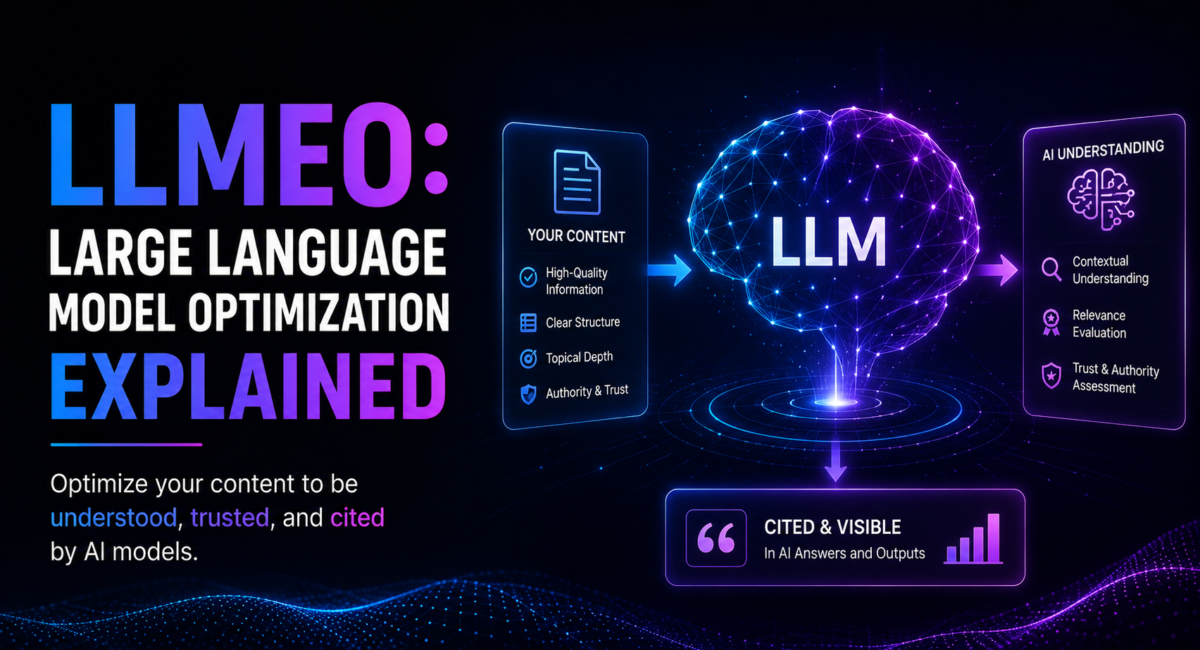
    The definitive guide to LLMEO — how to optimize your content so ChatGPT, Claude, Gemini, and Perplexity discover, cite, and recommend your brand to 987 million AI users.

    🚀 LLMEO by the Numbers — April 2026

    987MPeople Influenced by LLMs Daily800MChatGPT Weekly Active Users2.5–3BPrompts Processed Daily by ChatGPT4.4xHigher Conversion from AI vs Organic35%Sources Shared Between ChatGPT & Google

    Table of Contents

    1. What Is LLMEO?
    2. LLMEO vs GEO vs SEO vs AEO — The Full Picture
    3. How LLMs Retrieve and Cite Content
      1. The Two Retrieval Mechanisms
      2. Vector Embeddings and Semantic Similarity
      3. Chunking and Content Structure
      4. Content Freshness and Recency Weighting
    4. LLMEO by Platform — ChatGPT, Claude, Perplexity, Gemini
      1. ChatGPT — Authority and Structural Clarity
      2. Perplexity — Freshness and Community Validation
      3. Claude — Nuance, Evidence, and Depth
      4. Google AI Overviews and Gemini — E-E-A-T Plus SEO
    5. The Core LLMEO Content Strategies
      1. Question-First Content Architecture
      2. Semantic Topic Coverage — Beyond Keywords
      3. The TLDR-First Content Structure
      4. Unique Value Proposition and Original Data
      5. Community Presence and Social Proof
      6. Hub-and-Spoke Topical Architecture
    6. Technical LLMEO — llms.txt, Schema, and Site Structure
      1. The llms.txt Protocol
      2. AI Crawler Permissions
      3. Schema Markup for LLM Parsing
      4. Page Speed and Core Web Vitals
      5. Content Freshness Signals
    7. LLMEO Authority Building — Off-Page Signals
      1. Third-Party Brand Mentions and Citations
      2. Wikipedia and Knowledge Graph Presence
      3. Academic and Research Citations
      4. Cross-Platform Brand Consistency
    8. Measuring LLMEO Performance
      1. Manual Citation Audit — The Core LLMEO Test
      2. Analytics Signals for AI Traffic
      3. Tools for LLMEO Tracking
    9. Frequently Asked Questions
      1. What is LLMEO and how is it different from GEO?
      2. Why do only 35% of ChatGPT and Google sources overlap?
      3. What is a llms.txt file and do I need one?
      4. How do I get my brand cited in Perplexity?
      5. Does Reddit really matter for LLMEO?
      6. How long does LLMEO take to show results?
      7. Is LLMEO relevant for small businesses?
      8. How does LLMEO relate to the AI search tools guide on techiehub.blog?
    10. Conclusion
    11. Quick Recommendations
    12. 🚀 Getting Started Action Plan

    1. What Is LLMEO?

    LLMEO — Large Language Model Engine Optimization — is the practice of optimizing digital content to be discovered, cited, and recommended by AI language models including ChatGPT, Claude, Gemini, Perplexity, and Microsoft Copilot. While the world has focused on traditional SEO and the newer Generative Engine Optimization (GEO), LLMEO represents the most technically precise layer of this discipline — optimizing specifically for how large language models discover, process, and prioritize information during retrieval and generation.

    You may also see this discipline called LLMO (Large Language Model Optimization), LLM SEO, or AI Search Optimization. These terms are largely interchangeable in 2026, though LLMEO and GEO are the most commonly used in professional and academic contexts. The core goal is identical across all naming conventions: make your content the source that AI systems choose to cite when answering questions in your domain.

    The opportunity is massive and time-sensitive. ChatGPT now has 800 million weekly active users processing 2.5–3 billion prompts daily. Google Gemini has reached 450 million monthly active users. Claude’s enterprise market share has grown from 18% to 29% year-over-year. Together, these LLMs influence how over 987 million people worldwide find information. And critically, only 35% of sources cited by ChatGPT are shared with Google — which means LLMEO and traditional SEO are optimizing for fundamentally different citation pools.

    💡 Pro TipLLMEO is not just GEO with a different name. GEO focuses primarily on citation optimization strategies — adding statistics, citing sources, structuring content for extraction. LLMEO goes deeper into the technical retrieval mechanisms: vector embeddings, semantic similarity scoring, chunking optimization, llms.txt protocol, and platform-specific behavioral differences. The most effective 2026 strategy implements both layers simultaneously.

    2. LLMEO vs GEO vs SEO vs AEO — The Full Picture

    Understanding how LLMEO fits within the broader optimization landscape prevents strategy fragmentation and resource waste. These are not competing disciplines — they are complementary layers that build on each other.

    DimensionTraditional SEOAEOGEOLLMEO
    TargetGoogle/Bing SERPsFeatured snippetsAI-generated answersLLM retrieval & citation
    MetricKeyword rankingsSnippet capture rateAI citation shareShare of Model (SOM)
    Key SignalsBacklinks, E-E-A-TSchema, direct answersStats, quotes, sourcesSemantic depth, embeddings
    Content FormatKeyword-rich pagesShort Q&A formatSynthesis-friendlySemantically dense, structured
    Technical LayerCrawlability, Core Web VitalsFAQPage schemaArticle schema, RAG-readyllms.txt, chunk optimization
    PlatformsGoogle, BingGoogle AI Overviews, voiceAll generative enginesChatGPT, Claude, Perplexity, Gemini
    Traffic TypeDirect organic clicksZero-click exposureAI referral (4.4x CVR)Branded AI recommendations
    Status 2026Declining but essentialMerged into GEOFast-growing priorityCutting-edge, early-mover advantage

    The correct implementation order is: build strong technical SEO foundations first (crawlability, Core Web Vitals, E-E-A-T), then add AEO signals (schema markup, direct answer formatting), then layer GEO strategies (statistics, citations, expert quotes), then implement LLMEO technical optimizations (llms.txt, semantic depth, chunk-aware content structure, platform-specific tuning). Each layer amplifies the one beneath it. Skipping the foundation and jumping straight to LLMEO tactics produces minimal results.

    💡 Pro TipChatGPT and Google share only 35% of cited sources, according to research comparing citation patterns across platforms. This means a brand that ranks well in traditional SEO is not automatically visible in LLM answers — and vice versa. A brand that optimizes only for Google is invisible to 65% of the citation pool that ChatGPT draws from. LLMEO closes this gap.

    3. How LLMs Retrieve and Cite Content

    Figure 2: How LLMs retrieve and cite content — RAG pipeline, semantic embeddings, and training data signals

    3.1 The Two Retrieval Mechanisms

    Large language models cite content through two distinct mechanisms that require different optimization approaches. Understanding both is essential for a complete LLMEO strategy.

    Mechanism 1 — Training Data: The model’s base knowledge comes from its pre-training corpus — trillions of tokens of web content, books, and other data sources processed before deployment. Content that was indexed and widely referenced during training is embedded in the model’s weights and can be recalled without live retrieval. This mechanism is more relevant for brand establishment and definitional authority than for current information.

    Mechanism 2 — Retrieval-Augmented Generation (RAG): For real-time queries, most AI search engines use RAG — a two-stage process where the system first retrieves relevant documents from a live index, then generates a response based on those retrieved documents. Perplexity, Google AI Overviews, and ChatGPT’s browsing feature all use RAG. This mechanism is where active LLMEO optimization produces the most immediate and measurable results.

    3.2 Vector Embeddings and Semantic Similarity

    In RAG systems, content relevance is determined not by keyword matching but by semantic similarity scoring using vector embeddings. Your content is converted into a numerical vector (an embedding) that represents its meaning in a high-dimensional semantic space. The query is also converted to a vector. The system retrieves documents whose vectors are closest in semantic distance to the query vector — meaning content that is topically and conceptually relevant, not just lexically matching.

    This has a profound implication for LLMEO: keyword stuffing does not work. Content that uses diverse, rich semantic vocabulary around a topic — covering related concepts, analogies, edge cases, and applications — produces richer embeddings and scores higher for semantic similarity. This is why comprehensive, contextually deep content consistently outperforms thin keyword-targeted pages in LLM citation.

    3.3 Chunking and Content Structure

    RAG systems process documents in chunks — typically 256 to 1,024 tokens per chunk — and retrieve the most relevant chunks rather than entire documents. This means your content needs to be optimized at the chunk level, not just the page level. Each section of your article should be self-contained and independently meaningful, because the LLM may only retrieve a single chunk from your 3,000-word guide rather than the entire piece.

    Chunk-optimized content structure means: each H2 section opens with a clear topic sentence that defines what the section covers, every paragraph can stand alone without requiring context from surrounding paragraphs, key claims are stated explicitly within the same paragraph rather than implied from earlier content, and definitions are repeated in context rather than forcing the reader back to a glossary. This structure serves both human readers and AI retrieval systems equally well.

    3.4 Content Freshness and Recency Weighting

    LLM-powered search engines weight recency heavily for time-sensitive queries. Perplexity prioritizes fresh content and community validation. ChatGPT’s browsing feature can pull from your site in real-time, even if content is not in the training data. Google AI Overviews blend traditional SEO with recency signals. A guide published in 2024 with no updates will consistently lose ground to a 2026 article on the same topic. Content freshness is not just about new articles — it is about maintaining and updating existing cornerstone content with visible timestamps and current data.

    4. LLMEO by Platform — ChatGPT, Claude, Perplexity, Gemini

    Figure 3: LLMEO by platform — each LLM has different retrieval behaviors, optimize for all four

    PlatformUsers (2026)Retrieval MethodTop Citation SignalsUnique Behavior
    ChatGPT800M weeklyTraining + live browsingAuthority, directness, structure35% source overlap with Google
    Google AI Overviews60% of searchesRAG + traditional indexE-E-A-T, schema, SEO rankBlends SEO + LLMEO signals
    Perplexity780M monthly queriesLive RAG, real-timeFreshness, community, RedditReddit = 6.6% of all citations
    Claude29% enterprise shareTraining + toolsNuance, evidence, depthEmphasizes accuracy over brevity
    Microsoft CopilotIntegrated in WindowsBing index + RAGBing SEO signals + freshnessBenefits from traditional Bing SEO
    Gemini450M monthlyGoogle index + RAGGoogle E-E-A-T + multimodalBenefits from Google Search ranking

    4.1 ChatGPT — Authority and Structural Clarity

    ChatGPT has 800 million weekly active users processing 2.5–3 billion prompts daily, making it the highest-priority LLMEO platform. ChatGPT’s browsing feature retrieves from the live web in real time, but only 35% of its citations overlap with Google — meaning strong Google rankings alone do not guarantee ChatGPT visibility. ChatGPT favors content that is direct, authoritative, and structurally clear. Opening sentences that directly define the topic, numbered lists for processes, and specific statistics with clear attribution all perform strongly. ChatGPT also responds well to content that has established brand presence across multiple platforms — social profiles, Wikipedia mentions, and industry publication features all increase citation likelihood.

    4.2 Perplexity — Freshness and Community Validation

    Perplexity processes 780 million monthly queries and is the search-native AI engine — its entire product is AI-generated answers with citations. Perplexity’s top cited source is Reddit at 6.6% of all citations, which reveals an important behavioral pattern: Perplexity heavily weights community validation alongside formal content authority. For LLMEO on Perplexity, publishing fresh content (within days or weeks of a query peak), having your brand mentioned in relevant Reddit and Quora discussions, and earning citations from news publications are the highest-leverage activities. Perplexity also indexes directly from your site if it is crawlable — ensure your robots.txt allows PerplexityBot.

    4.3 Claude — Nuance, Evidence, and Depth

    Claude’s enterprise market share has grown from 18% to 29% year-over-year, making it the fastest-growing professional AI platform. Claude emphasizes nuance and evidence over simple answers — it favors content that acknowledges complexity, presents multiple perspectives where they exist, and supports claims with specific evidence rather than assertion. For LLMEO targeting Claude, academic-style content structure (claim, evidence, implication) performs better than headline-driven listicles. Claude also has strong safety training that makes it unlikely to cite sources it cannot verify — factual accuracy and source transparency are more important for Claude optimization than for any other major LLM.

    4.4 Google AI Overviews and Gemini — E-E-A-T Plus SEO

    Google AI Overviews appear in up to 60% of searches and blend traditional SEO signals with LLMEO principles. Because Google controls both the search index and the AI layer, traditional SEO rank remains a significant citation signal for AI Overviews — pages in positions 1–10 are dramatically more likely to be cited than pages outside the top 10. Gemini has reached 450 million monthly active users and draws from the same Google index. For these platforms, LLMEO and SEO are more tightly intertwined than on other platforms. E-E-A-T signals, schema markup, and Core Web Vitals that boost traditional rankings also directly improve AI Overview citation rates.

    5. The Core LLMEO Content Strategies

    LLMEO content optimization goes beyond the GEO baseline of statistics and citations. These strategies are specific to how LLMs retrieve, process, and rank content during generation.

    5.1 Question-First Content Architecture

    LLMs are optimized to answer questions, not to interpret keyword intent. Traditional SEO optimizes for keyword phrases — ‘best project management software.’ LLMEO optimizes for natural language questions — ‘What is the best project management software for a remote team of ten people?’ This behavioral shift is fundamental: when someone opens Perplexity or ChatGPT, they type a full question or describe a situation, and the AI looks for sources that answer that question completely, directly, and credibly.

    Implementation: Before writing any article, identify the five most specific questions a real user would ask about this topic. Use each question verbatim (or close variant) as a subheading within the article. Write a direct, complete answer to each question in the first 2–3 sentences under that heading. This structure maps precisely to how LLMs retrieve and extract content, and earns dramatically higher citation rates than keyword-matched paragraphs.

    5.2 Semantic Topic Coverage — Beyond Keywords

    Because LLMs use vector embeddings for relevance scoring, content that covers a topic with semantic depth — addressing related concepts, common misconceptions, edge cases, and practical applications — produces richer embeddings and scores higher for semantic similarity across a broader range of query variations. This is the conceptual opposite of keyword stuffing: instead of repeating the target phrase, you deepen the topical coverage around it.

    Implementation: For every primary topic, map the semantic field around it — related terms, subtopics, prerequisite concepts, common objections, and downstream applications. Include all of these naturally in your content. For a topic like ‘LLMEO,’ the semantic field includes: LLM retrieval, RAG, vector embeddings, semantic similarity, citation optimization, Share of Model, llms.txt, AI search, prompt testing, and platform-specific behaviors. Content that covers this full semantic field ranks higher across more query variations than content that only optimizes for the primary keyword.

    5.3 The TLDR-First Content Structure

    AI search systems consistently favor content that answers the primary query in the first 200 words. LLMEO content structure should mirror the academic abstract model: a clear summary statement, then the evidence and detail. This is called the TLDR-first structure — you state the most important conclusion at the top, then support it throughout the article.

    Implementation: Open every article with a 100-word TL;DR block that directly answers the primary query with specific, citable statements. Format it as a clearly labeled section (‘TL;DR’ or ‘Key Answer’). This block will be retrieved by AI systems for queries that match your topic — even if the rest of the article is not retrieved. The remaining article then provides the depth and evidence that earns ongoing citation authority for more complex queries.

    5.4 Unique Value Proposition and Original Data

    LLMs have a strong preference for citing content that contains information they cannot find elsewhere. Original research, proprietary datasets, unique benchmarks, and first-hand case studies are the highest-citation content types because they represent exclusive sources. A strong Unique Value Proposition — a specific claim, insight, or data point that only your brand can make — gives LLMs a reason to cite you over dozens of lookalike alternatives covering the same topic.

    Even simple original data qualifies. A B2B SaaS company that analyzed its internal customer data and published ‘Based on analysis of 10,000 customer accounts, our clients using AI tools save an average of 4.2 hours per week’ has a citable original claim no other source can reproduce. A marketing agency that surveyed 200 clients on AI adoption has original survey data. Publish what you know from your own experience and data — it is the most defensible citation magnet.

    5.5 Community Presence and Social Proof

    Perplexity’s citation of Reddit at 6.6% of all citations reveals a critical insight: LLMs weight community validation alongside formal content authority. A brand mentioned in relevant Reddit discussions about its category is more likely to be cited when users ask AI engines for recommendations in that category. These community mentions function as distributed social proof signals that influence LLM training data and live retrieval simultaneously.

    Implementation: Identify the top 10 subreddits and Quora spaces where your target audience asks questions related to your domain. Participate genuinely in these communities with helpful answers — not promotional content. When appropriate, link to your original research or guides. A productivity tool mentioned in r/productivity threads about the ‘best apps for remote teams’ will appear more often in ChatGPT answers to those exact questions. Community presence compounds over months — start now.

    5.6 Hub-and-Spoke Topical Architecture

    LLMs favor brands that demonstrate comprehensive topical authority rather than isolated individual articles. The hub-and-spoke architecture — a comprehensive pillar page (hub) supported by a network of interconnected spoke articles on related subtopics — signals semantic authority across an entire domain rather than a single keyword. This architecture creates multiple entry points for LLM retrieval while also signaling the breadth of expertise that makes a source citation-worthy.

    Implementation: Build content clusters where one hub page covers the main topic comprehensively and 5–10 spoke articles cover specific subtopics in depth. Interlink all spokes to the hub and to each other where topically natural. For techiehub.blog’s AI search pillar, the GEO guide, this LLMEO guide, the AEO guide, the AI search monitoring tools guide, and the AI model comparison guide form a cluster that collectively signals topical authority on AI search optimization. See our Generative Engine Optimization guide on techiehub.blog for the hub-and-spoke implementation framework.

    💡 Pro TipA B2B SaaS company tracked which content pieces became citations in ChatGPT, Gemini, and Perplexity. Traffic from AI platforms converted at approximately 30% — six to seven times higher than typical organic conversion rates. The pages earning these citations all shared three characteristics: question-first headings, original data points, and comprehensive semantic coverage of the topic domain. These three elements are the non-negotiable foundation of LLMEO content.

    6. Technical LLMEO — llms.txt, Schema, and Site Structure

    Technical LLMEO ensures that AI systems can discover, crawl, and process your content efficiently. The technical layer is the prerequisite that determines whether your content reaches the retrieval stage at all.

    6.1 The llms.txt Protocol

    The llms.txt file is emerging as the AI-era equivalent of robots.txt — a machine-readable file that tells AI crawlers who you are, what you know, and where to find your most authoritative content. Located at yourdomain.com/llms.txt, this file provides structured metadata that helps LLM indexing systems understand your content hierarchy without needing to crawl and interpret every page.

    A well-structured llms.txt includes: your organization name and description, a brief statement of your core areas of expertise, links to your most authoritative content pages organized by topic cluster, and any information about data freshness or update schedules. Every credible website in 2026 should have an llms.txt file. It is a direct handshake with the AI web — stating clearly to AI crawlers: here is who we are, here is what we know, here is where to find it.

    6.2 AI Crawler Permissions

    Many sites that have never explicitly thought about AI crawlers are inadvertently blocking them via aggressive robots.txt configurations. The major AI crawlers have specific user agent strings: GPTBot (OpenAI), PerplexityBot (Perplexity), Google-Extended (Google AI training), Anthropic-AI (Anthropic), and ClaudeBot. If your robots.txt disallows these crawlers, your content is invisible to those AI systems regardless of quality. Review your robots.txt file and explicitly allow AI crawlers for the content you want cited, while maintaining appropriate restrictions for sensitive or duplicate content areas.

    6.3 Schema Markup for LLM Parsing

    Structured data (JSON-LD schema) communicates content meaning to both search engines and AI systems in an unambiguous machine-readable format. For LLMEO, the highest-priority schema types are: Article with complete author markup (name, credentials, URL), FAQPage for question-answer content, HowTo for process guides, Organization for brand entity establishment, and BreadcrumbList for content hierarchy. Research shows content with proper schema markup receives 30–40% higher AI visibility. Each schema type tells the AI system exactly what type of content it is processing — dramatically improving retrieval accuracy and citation likelihood.

    6.4 Page Speed and Core Web Vitals

    AI crawlers prioritize sites with fast load times and clean architecture because they can index more content per crawl budget. Poor Core Web Vitals do not directly penalize AI citation, but they reduce crawl frequency and index coverage. Target: Largest Contentful Paint under 2.5 seconds, Cumulative Layout Shift below 0.1, and First Input Delay below 100ms. Use Google PageSpeed Insights to identify and fix performance bottlenecks on your most important LLMEO target pages first.

    6.5 Content Freshness Signals

    AI engines use multiple signals to assess content recency: the last-modified HTTP header, visible ‘Last updated’ timestamps in the article body, publication dates in structured data markup, and update frequency in the sitemap. Implement all four layers for maximum freshness signaling. Update your XML sitemap lastmod dates whenever you refresh content. Add visible ‘Last updated: April 2026’ timestamps above the fold on all evergreen content. A 2024 article with a visible 2026 update date and a refreshed sitemap entry will consistently outperform an unmodified 2024 article for time-sensitive queries.

    7. LLMEO Authority Building — Off-Page Signals

    LLMs assess source credibility through a combination of on-page content quality and off-page authority signals. Building external citation authority requires a different approach than traditional link building.

    7.1 Third-Party Brand Mentions and Citations

    LLMs use unlinked brand mentions across the web as authority signals in addition to traditional linked citations. A brand mentioned in industry publications, news articles, research papers, and community forums builds semantic authority in the LLM’s understanding of your domain — even without a hyperlink. This is why digital PR (earning media coverage and expert mentions) is a core LLMEO discipline, not just a nice-to-have.

    Target publications in your niche for guest contributions, expert commentary, and original research coverage. HARO (Help A Reporter Out) and similar journalist query platforms let you respond to journalist requests for expert sources — each media placement is a citable authority signal. Track unlinked brand mentions using Ahrefs or Semrush and reach out to request links where appropriate, converting authority signals into full citations.

    7.2 Wikipedia and Knowledge Graph Presence

    Wikipedia is one of the highest-authority sources in LLM training data — it is heavily weighted in pre-training corpora and serves as a ground-truth reference for entity recognition. A Wikipedia entry for your brand or key products significantly increases the likelihood of LLM recall in training-data-based responses. For brands that do not yet qualify for a Wikipedia article, contributing to relevant Wikipedia pages as a cited source (adding references to your original research) achieves the same authority signal at a lower bar.

    7.3 Academic and Research Citations

    LLMs have strong preference for academic and institutional sources in their training data. Publishing original research that gets cited in academic or industry publications creates the highest-quality authority signal available. Even informal research — a survey of 200 customers, an analysis of 1,000 data points — published with clear methodology and publicly accessible data can earn academic-style citations from bloggers, journalists, and researchers, which in turn builds LLM citation authority over time.

    7.4 Cross-Platform Brand Consistency

    LLMs build entity models of brands and people across the web. Consistent brand name, description, and positioning across your website, LinkedIn company page, Google Business Profile, social media profiles, and industry directories strengthens your entity model and makes it more likely that AI systems accurately identify and cite your brand when relevant. Inconsistent naming (e.g., ‘TechieHub’ vs ‘Techie Hub’ vs ‘TechieHub.blog’) creates entity resolution problems that reduce citation accuracy.

    8. Measuring LLMEO Performance

    LLMEO measurement requires a new set of metrics and tools beyond traditional analytics dashboards. The following framework covers the core KPIs and measurement approaches for 2026.

    KPIDefinitionHow to Measure2026 Benchmark
    Share of Model (SOM)% of AI citations in your topic vs competitorsManual prompt testing or GEO toolTarget 10–20% within 6 months
    AI Citation RateTimes brand cited per 100 target queriesManual query audit across 4 platformsTrack monthly, aim for consistent growth
    AI Referral TrafficSessions from ChatGPT, Perplexity, GeminiGA4 referral source filterGrowing % of total sessions
    AI CVR vs OrganicConversion rate: AI visitors vs organicGA4 segment comparison4.4x average — track your baseline
    Crawl Coverage% of LLMEO target pages indexed by AI botsLog file analysis for AI crawler visits100% of priority pages crawled
    Brand Sentiment in AIPositive vs negative framing in AI citationsManual review of AI-generated answersTrack language used to describe brand

    8.1 Manual Citation Audit — The Core LLMEO Test

    The most important LLMEO measurement is also the simplest: regularly query your target questions in ChatGPT, Perplexity, Gemini, and Copilot and record whether your brand is cited. Build a spreadsheet of your top 30–50 target questions. Query each platform monthly. Record: Is the brand cited? What position in the response? What language is used? Which competitors are cited alongside or instead?

    This manual audit, done consistently over 3–6 months, reveals more actionable insight than any automated tool: which platforms favor you, which content pieces earn citations, which competitors are beating you on specific query types, and whether your citation rate is growing. It takes 2–3 hours per month and is the non-negotiable foundation of any serious LLMEO program.

    8.2 Analytics Signals for AI Traffic

    Set up dedicated GA4 filters for AI platform referrals: chat.openai.com, chatgpt.com, perplexity.ai, gemini.google.com, copilot.microsoft.com, and claude.ai. Create a custom GA4 channel group called ‘AI Referral’ that captures all of these sources. Track sessions, conversion rate, and revenue from this channel group separately from organic search. Survey forms should include ‘How did you find us?’ with ‘ChatGPT or AI assistant’ as an explicit option — direct survey data captures AI-referred users who arrive via branded search after an AI recommendation, which analytics cannot attribute to AI platforms.

    8.3 Tools for LLMEO Tracking

    • Geoptie — AI citation analytics and competitor benchmarking across ChatGPT, Perplexity, Gemini, and Copilot
    • GenOptima — Automated Share of Model tracking and content optimization recommendations
    • Wellows — Tracks citations, sentiment, and competitive gaps across major AI platforms
    • Mention / Ahrefs Alerts — Unlinked brand mention tracking across web, forums, and social platforms
    • Google Search Console — AI Overview impression data and click-through rates for Google AI citations
    • Server log analysis — Direct verification of AI crawler visits (GPTBot, PerplexityBot, Google-Extended)

    9. Frequently Asked Questions

    What is LLMEO and how is it different from GEO?

    LLMEO (Large Language Model Engine Optimization) is the practice of optimizing content specifically for how large language models retrieve, process, and cite information through mechanisms like RAG systems, vector embeddings, and training data. GEO (Generative Engine Optimization) is a broader discipline focused on citation optimization strategies — adding statistics, citing sources, structuring content for extraction. LLMEO goes deeper into the technical retrieval layer: vector embedding optimization, chunking structure, llms.txt protocol, semantic depth, and platform-specific behavioral differences. In 2026, many practitioners use the terms interchangeably, but LLMEO is the more technically precise term for advanced optimization.

    Why do only 35% of ChatGPT and Google sources overlap?

    ChatGPT and Google draw from fundamentally different information sources. Google’s search index prioritizes pages based on PageRank, backlink authority, and traditional SEO signals. ChatGPT’s citation pool includes its pre-training corpus (which includes many sources not well-indexed by Google), live web browsing that uses different relevance scoring, and community content from Reddit, forums, and platforms that rank lower in Google but carry strong authority signals for LLMs. This 65% non-overlap means brands optimizing only for Google are invisible to the majority of ChatGPT’s citation sources — which is the core business case for LLMEO as a distinct discipline.

    What is a llms.txt file and do I need one?

    The llms.txt file is a plain-text file located at yourdomain.com/llms.txt that provides structured metadata for AI crawlers — your organization name and description, core expertise areas, links to authoritative content pages, and update frequency information. It is the AI-era equivalent of robots.txt, providing a machine-readable handshake with AI indexing systems. In 2026, llms.txt is not yet a universal standard but is being rapidly adopted by forward-thinking publishers and increasingly indexed by major AI systems. Every website with a serious LLMEO strategy should implement one. It takes under an hour to create and has no cost.

    How do I get my brand cited in Perplexity?

    Perplexity favors fresh content (published or updated recently), community validation (Reddit at 6.6% of all citations), and direct answer formatting. To improve Perplexity citation: publish and update content frequently with visible timestamps, build genuine presence in relevant Reddit communities and Quora spaces, structure content with question-first headings and direct answers in the first paragraph, earn mentions in news publications (Perplexity heavily indexes news sources), and ensure PerplexityBot is allowed in your robots.txt. Unlike Google, Perplexity’s index is more volatile — freshness and community signals matter more than domain authority alone.

    Does Reddit really matter for LLMEO?

    Yes, significantly. Perplexity cites Reddit as its top source at 6.6% of all citations — higher than any individual news organization or domain. ChatGPT’s training data includes large amounts of Reddit content, meaning brands organically mentioned in Reddit discussions have higher base-rate citation likelihood in training-data recall. The implication is not to spam Reddit — that backfires immediately and permanently. The implication is to participate genuinely in relevant communities where your target audience asks questions, build real reputation over time, and have your brand’s name appear naturally in discussions that LLMs will index as community validation signals.

    How long does LLMEO take to show results?

    Technical implementations (llms.txt, schema markup, AI crawler permissions, content structure improvements) can show measurable results in 2–4 weeks as AI crawlers re-index your updated content. Content strategy changes (question-first headings, original data, semantic depth) typically show citation improvements in 30–60 days. Authority building (third-party mentions, community presence, original research citations) takes 3–6 months to accumulate meaningfully. Plan for a 90-day initial implementation sprint followed by a 6-month measurement period before evaluating strategic ROI. Brands that restructure their top 15–20 pages and implement technical foundations see the most consistent early results.

    Is LLMEO relevant for small businesses?

    Yes. LLMEO is particularly valuable for small businesses because it levels the playing field with larger competitors. A small local business with highly specific, accurate, community-validated content about a narrow topic can earn higher citation rates than a large brand with generic coverage of the same area. The citation that matters is the one that appears when someone asks ‘best accountant in [city]’ or ‘top yoga studio in [neighborhood]’ — and AI engines are increasingly answering those hyper-local queries by citing specific businesses with strong community presence and accurate location-specific content. Google Business Profile optimization, local review building, and location-specific FAQ content are the highest-ROI LLMEO tactics for local businesses.

    How does LLMEO relate to the AI search tools guide on techiehub.blog?

    LLMEO is the optimization discipline; AI search monitoring tools are the measurement layer that tells you whether your LLMEO strategy is working. Tools like Geoptie, GenOptima, and Wellows track your Share of Model, citation frequency, and competitive positioning across ChatGPT, Perplexity, Gemini, and Copilot. Without measurement, LLMEO strategy is guesswork. See our Best AI Models Compared guide on techiehub.blog for how the specific LLM architectures affect retrieval behavior, and our Generative Engine Optimization guide for the full GEO strategy layer that sits alongside LLMEO.

    10. Conclusion

    LLMEO in 2026 is where SEO was in 2005 — a discipline whose fundamentals are understood, whose practitioners are few, and whose early movers are building compounding advantages that will be very hard to overcome later. The 987 million people now influenced by LLMs daily are not going back to scrolling ten blue links. The 35% source overlap between ChatGPT and Google means two-thirds of LLM citation authority is invisible to traditional SEO measurement. And the 4.4x conversion rate of AI-referred traffic means every citation earned by LLMEO delivers higher business value than the equivalent organic search click.

    The technical foundation — llms.txt, AI crawler permissions, schema markup, chunk-aware content structure — can be implemented this week. The content strategy layer — question-first architecture, semantic depth, original data, community presence — can be started this month. The authority layer — third-party citations, Wikipedia presence, digital PR — compounds over the next six months. Start with the technical layer, build the content layer consistently, and measure monthly with a simple citation audit. The brands doing this now will own the AI citation share in their domains for years.

    Key Takeaways

    • LLMEO optimizes for LLM retrieval mechanisms — RAG, vector embeddings, and training data — beyond GEO’s citation tactics
    • 987 million people are influenced by LLMs daily in 2026 — ChatGPT alone processes 2.5–3 billion prompts per day
    • Only 35% of ChatGPT citations overlap with Google — LLMEO closes visibility gaps that SEO cannot address
    • Each LLM has different retrieval behaviors — ChatGPT (authority), Perplexity (freshness + Reddit), Claude (evidence), Gemini (SEO + E-E-A-T)
    • Vector embeddings score semantic depth, not keyword density — rich topical coverage outperforms keyword stuffing
    • Chunk-aware content structure: each paragraph must be independently meaningful for RAG retrieval
    • llms.txt is the AI-era robots.txt — implement it to give AI crawlers a direct map of your authority content
    • Perplexity cites Reddit at 6.6% of all citations — genuine community presence is a measurable citation signal
    • AI referral traffic converts at 4.4x organic rates — every LLMEO citation earned delivers outsized business value
    • Measure with Share of Model, monthly citation audits across 4 platforms, and GA4 AI referral segments

    Quick Recommendations

    This week (technical foundation):

    • Create your llms.txt file at yourdomain.com/llms.txt — takes under an hour, zero cost
    • Audit robots.txt for blocked AI crawlers — allow GPTBot, PerplexityBot, Google-Extended, ClaudeBot
    • Add FAQPage and Article schema to your top 5 pages

    This month (content layer):

    • Restructure your top 5 articles with question-first H2/H3 headings and direct answers in opening paragraphs
    • Add a TL;DR summary block above the fold on each cornerstone article
    • Identify and add at least 3 original data points per article — even simple internal analysis qualifies
    • Add visible ‘Last updated: April 2026’ timestamps and refresh statistics on top content

    This quarter (authority layer):

    • Build genuine presence in 3–5 relevant Reddit communities and Quora spaces
    • Earn 5 third-party media mentions via HARO or direct journalist outreach
    • Publish one original research piece with shareable data and clear methodology
    • Run monthly citation audits across ChatGPT, Perplexity, Gemini, and Copilot

    🚀 Getting Started Action Plan

    1. TODAY: Create llms.txt at your domain root and audit robots.txt for blocked AI crawlers
    2. DAY 2: Run your LLMEO baseline — query 20 target questions across ChatGPT, Perplexity, Gemini, and Copilot
    3. WEEK 1: Restructure your top 3 articles with question-first headings, TL;DR blocks, and direct answer paragraphs
    4. WEEK 2: Add FAQPage and Article schema to your top 10 pages; verify with Google’s Rich Results Test
    5. MONTH 1: Publish one original research piece and begin genuine participation in relevant Reddit/Quora communities
    6. ONGOING: Run monthly citation audits, track GA4 AI referral traffic, follow techiehub.blog for LLMEO updates

    987 million people are now influenced by LLMs every day. The brands they never encounter in AI-generated answers are becoming invisible to a generation of users who will never open a search results page. LLMEO is how you stay visible. Start with your llms.txt. Restructure one article. Run one citation audit. The compounding begins from your very first optimization. 🚀

    Share. Facebook Twitter Pinterest LinkedIn Tumblr Email
    Previous ArticleGenerative Engine Optimization (GEO): Complete Guide 2026
    Next Article Best Answer Engine Optimization Tools 2026
    TechieHub

      Related Posts

      Best AI Tools for YouTube Automation: Complete Guide 2026

      February 28, 2026

      Best Agentic AI Tools: Complete Guide 2026

      February 25, 2026

      What is Claude: Complete Guide 2026

      February 24, 2026
      View 8 Comments

      8 Comments

      1. Pingback: Perplexity SEO: Complete Optimization Guide 2026

      2. Pingback: 15 Best AI Sales Forecasting Tools 2026: Complete Guide

      3. Pingback: 12 Best AI Tools for Academic Research 2026: Complete Guide

      4. Pingback: Gong vs Chorus.ai 2026: Complete Comparison Guide

      5. Pingback: 15 Best Answer Engine Optimization Tools 2026 Complete Guide

      6. Pingback: LLMEO Strategies 2026: Complete Guide to LLM Optimization

      7. Pingback: Best AI Chatbot for WordPress 2026 Tested

      8. Pingback: Best Open Source AI Models 2026: DeepSeek vs Llama 4

      Leave A Reply Cancel Reply

      Editors Picks

      Best AI Search Monitoring Tools 2026

      May 10, 2026

      Best AI APIs: Complete Developer Guide 2026

      April 29, 2026

      What Are AI Hallucinations? Complete Guide 2026

      April 27, 2026

      What is Prompt Engineering? Complete Guide 2026

      April 27, 2026
      Techiehub
      • Home
      • Featured
      • Latest Posts
      • Latest in Tech
      • Privacy Policy
      • Terms and Conditions
      Copyright © 2026 Tchiehub. All Right Reserved.

      Type above and press Enter to search. Press Esc to cancel.

      We use cookies to ensure that we give you the best experience on our website. If you continue to use this site we will assume that you are happy with it.