


Affiliate disclosure: TechieHub may earn a commission from some developer-tool and hosting links on this page. Commissions never influence which standards, protocols or products we recommend.
For most of the generative-AI era, the hard part of shipping something useful was never the model. It was the wiring. Every assistant that needed to read a repository, query a warehouse or file a support ticket required a bespoke connector, written against one vendor’s function-calling format and thrown away the moment the team switched models. The Model Context Protocol ended that pattern, and on 28 July 2026 it shipped the largest revision in its history. This guide explains the standard, how it works, what just changed, and where it sits alongside the other protocols in the agent stack.

| Quick answer: MCP (Model Context Protocol) is an open standard, released by Anthropic in November 2024 and now governed by the Linux Foundation, that lets any AI model connect to any external tool or data source through one interface. You build one MCP server per system, and every MCP-compatible client can use it. |
Table of Contents
What Is MCP, and Why Does It Matter Now?
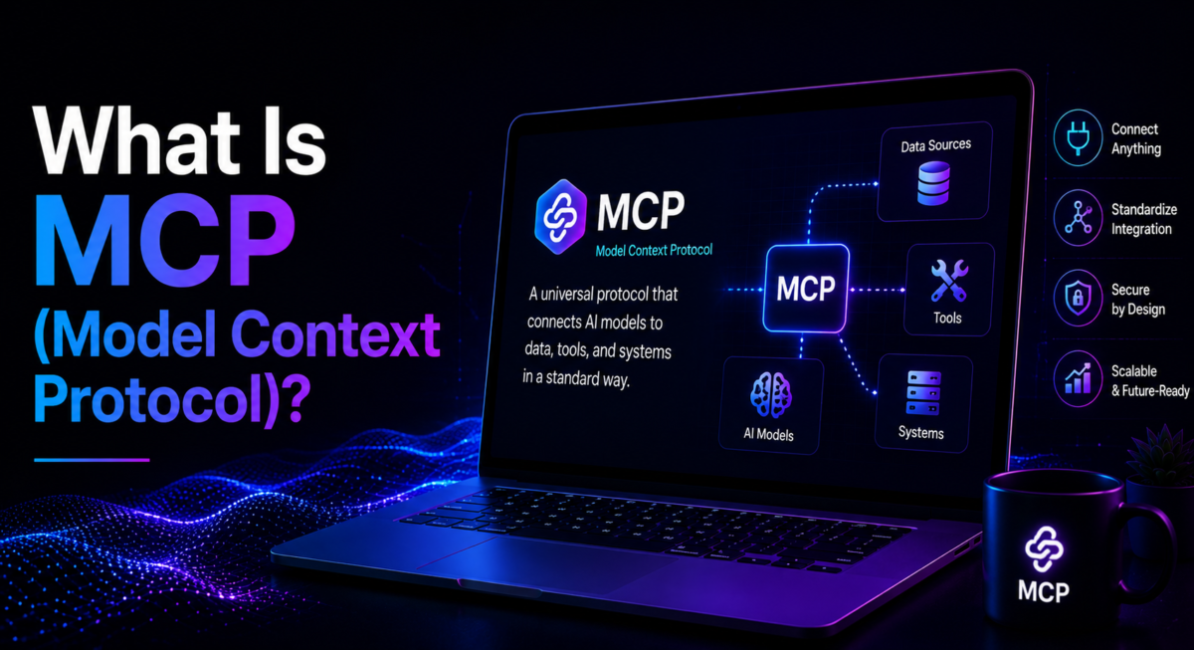
The Model Context Protocol is an open standard that defines how AI applications discover and call external tools, data sources and services. Anthropic published it in November 2024 and open-sourced it on day one. The shorthand that stuck is “USB-C for AI”: one connector shape replacing a drawer full of proprietary cables.
What makes the protocol worth understanding in 2026 is that it is no longer one vendor’s proposal. In December 2025 Anthropic donated it to the newly formed Agentic AI Foundation, a directed fund under the Linux Foundation co-founded with Block and OpenAI and supported by Google, Microsoft, AWS, Cloudflare and Bloomberg, announced alongside the goose and AGENTS.md projects. Anthropic’s figures at that point were more than 97 million monthly SDK downloads and over 10,000 active public servers. A standard with that footprint and neutral governance is not a trend. It is infrastructure.
How we compare: every claim on this page is checked against the published specification, the official changelog and primary announcements from Anthropic and the Linux Foundation. Where widely repeated figures could not be traced to a primary source, including the throughput and latency benchmarks that circulate in MCP explainers, we left them out rather than pass them along.
Why Did AI Integration Need a Standard?
Connecting N AI applications to M tools without a shared protocol is an N×M problem. Each pairing carries its own authentication scheme, request format and error semantics. Want a Claude-based assistant to read your Postgres database? Write an Anthropic-specific connector. Want ChatGPT to read the same table? Write a second one. Want Gemini to join in? A third. Maintenance cost grows quadratically while delivering nothing new.
The protocol collapses that matrix to N+M. Each client implements it once, each system implements it once, and any client can reach any server. That linear arithmetic is the entire reason adoption moved as fast as it did. The second benefit matters just as much: capabilities are discoverable at runtime, so an agent can ask a server what it offers and adapt instead of being reprogrammed. Anyone learning how to build an AI agent from scratch hits this distinction within the first afternoon.
How Does the Model Context Protocol Actually Work?
The architecture has three participants. The host is the AI application a person actually uses, such as a desktop assistant or an IDE. The client is the connector living inside that host, maintaining a link to exactly one server. The server is a lightweight program that exposes one system’s capabilities. Messages travel as JSON-RPC 2.0 over either standard input/output for local servers or Streamable HTTP for remote ones.
Servers expose three primitives. Tools are actions the agent can invoke, such as running a query or creating a file. Resources are structured context objects, referenced by URI and pulled into the model’s context window on demand. Prompts are reusable templates that walk an agent through a multi-step workflow the server already knows how to handle. Official SDKs cover TypeScript, Python, Go, C# and Java, with a Rust SDK in beta.

What Changed in the July 2026 Specification?
Version 2026-07-28 published as final on 28 July 2026 after a ten-week release-candidate window, replacing 2025-11-25. The maintainers describe it as the largest revision since launch, and it contains deliberate backward-incompatible changes. Four shifts matter most, and all are documented in the official changelog.
The protocol became stateless. The initialize handshake and the Mcp-Session-Id header are gone. Every request now carries its protocol version and client capabilities in metadata, and a new server/discover RPC advertises what a server supports. The practical payoff is that servers deploy behind ordinary round-robin load balancers with no shared session store.
Extensions became formal. Tasks moved out of the experimental core into a governed extension namespace, joining MCP Apps and Enterprise Managed Authorization. Core stays small; ambitious features ship on a separate track.
Server-initiated requests were replaced. A pattern called Multi Round-Trip Requests supersedes calls like sampling/createMessage: a server returns an interim result asking for what it needs, and the client retries the original request with the answers attached. Roots, Sampling and Logging are now formally deprecated, as is the legacy HTTP+SSE transport.
Authorization hardened. Issuer validation under RFC 9207 is now required to block authorization-server mix-up attacks, client credentials are bound to the server that issued them, and Dynamic Client Registration is deprecated in favour of Client ID Metadata Documents. Alongside this, the project adopted a feature lifecycle policy with a twelve-month minimum deprecation window, so future breakage becomes something teams can schedule rather than absorb.
How Does It Compare to APIs, Function Calling and A2A?
A traditional API lets two applications exchange data, but the caller must already know what to ask for and how to shape the request. MCP adds discovery and intent on top, so an agent can enumerate a server’s capabilities at runtime. It does not replace function calling either; function calling remains the mechanism by which a model emits a tool invocation, and MCP standardises what sits on the other side of that invocation.
| Mechanism | Connects | Defining trait |
| Traditional API | App to app | Fixed contract; caller must know the request |
| Function calling | Model to tool | Vendor-specific invocation mechanism |
| MCP | AI client to tools and data | Universal, discoverable, vendor-neutral |
| A2A | Agent to agent | Delegation and cross-agent collaboration |
The cleanest rule of thumb: if your agent needs a database, file system or API, reach for MCP; if it needs another agent to own a subtask, reach for A2A. Our explainer on the A2A agent-to-agent protocol covers that second half in depth. Most production systems run both, and both now sit under Agentic AI Foundation governance.
What Does a Rollout Look Like in Practice?
Consider a composite scenario drawn from the pattern we see most often. Priya, a staff platform engineer at a mid-sized logistics company, is asked to give the support team’s internal assistant read access to shipment data currently scattered across a warehouse, a ticketing system and an in-house transport management platform.
The old approach meant three connectors per model provider and a rewrite whenever the company changed models. Instead she configures two existing public servers for the warehouse and the ticketing system, then writes one small server for the proprietary platform, exposing three read-only tools and one resource template. Total build time is under a week, most of it spent on access scoping rather than protocol plumbing.
Configuring a server is a few lines in the client, not an integration project — one entry per system, either a local process the client launches or a remote endpoint it calls:
{
  "mcpServers": {
    "warehouse": {
      "command": "npx",
      "args": ["-y", "@acme/mcp-warehouse"],
      "env": { "WAREHOUSE_API_KEY": "..." }
    },
    "shipments": {
      "url": "https://mcp.internal.example.com/shipments"
    }
  }
}
The outcome that convinced her leadership was not the initial launch. It was the following quarter, when the team swapped the underlying model, most recently to Anthropic’s Claude Opus 5, released on 24 July 2026 at $5 per million input tokens and $25 per million output tokens. Nothing on the integration side changed. That portability is the payoff, and it is the same reason MCP support has become a purchasing checkbox across the leading AI coding tools and agent platforms.
What Security Controls Does the Protocol Demand?
MCP gives agents the ability to take real actions, which makes the security posture non-optional. Treat third-party servers as zero-trust until you have reviewed what they expose. Run anything untrusted inside a container or sandbox. Log every tool invocation with a timestamp and sanitised arguments, because audit trails are increasingly a compliance requirement rather than a nice-to-have. The official MCP Inspector lets you exercise a server before wiring it into production systems.
Scope matters as much as isolation. A server that exposes a single read-only query tool is a far smaller blast radius than one wrapping an entire admin API, and the 2026 authorization changes exist precisely because token handling was the weakest link in early deployments. Teams building on Anthropic’s own tooling should read our guide to the Claude Agent SDK and its permission model alongside this one.
Frequently Asked Questions
What does MCP stand for?
MCP stands for Model Context Protocol. It is an open standard, introduced by Anthropic in November 2024, that defines how AI applications connect to external tools, data sources and services through a single universal interface rather than through custom per-vendor connectors.
Is MCP only for Claude?
No. MCP is model-agnostic and vendor-neutral. OpenAI adopted it across its Agents SDK and ChatGPT in March 2025, Google, Microsoft and AWS followed, and Anthropic donated the protocol to the Linux Foundation in December 2025 to guarantee that neutrality permanently.
What are the three MCP primitives?
Servers expose tools, resources and prompts. Tools are actions an agent can invoke, such as querying a database. Resources are structured context objects referenced by URI. Prompts are reusable templates for multi-step workflows. Together they let an agent discover what exists and how to use it.
Is MCP the same as an API?
Not quite. A traditional API exchanges data between applications, but the caller must know exactly what to request. MCP layers discovery and intent on top, so an agent can enumerate a server’s capabilities at runtime. It standardises function calling rather than replacing it.
Do I need to build my own MCP server?
Usually not. With more than 10,000 active public servers covering common developer and business tools, configuring an existing one is the fastest path. Build a custom server only when exposing a proprietary internal system, which the official SDKs make a matter of hours rather than weeks.
Does the 2026 specification break existing servers?
Yes, deliberately. Version 2026-07-28 removes protocol-level sessions and the initialize handshake, and it deprecates Roots, Sampling, Logging and the legacy HTTP+SSE transport. A newly adopted twelve-month minimum deprecation window means future breaking changes should be schedulable well in advance rather than abrupt.
Conclusion
MCP is the unglamorous layer that decides whether an AI agent is a demo or a system of record. It turned an N×M integration mess into a single open standard, earned adoption from every major lab, and then handed itself to neutral governance so no one vendor could pull the ladder up. The July 2026 specification signals the next phase: statelessness for scale, formal extensions for ambition, and a deprecation policy that treats production deployments as something worth protecting. Learn the three primitives, understand where A2A takes over, apply the security guardrails, and the rest of the agent landscape starts to make sense.
