


Disclosure: TechieHub is reader-supported. Some links are affiliate links and we may earn a commission at no extra cost to you. Our research and recommendations stay independent.
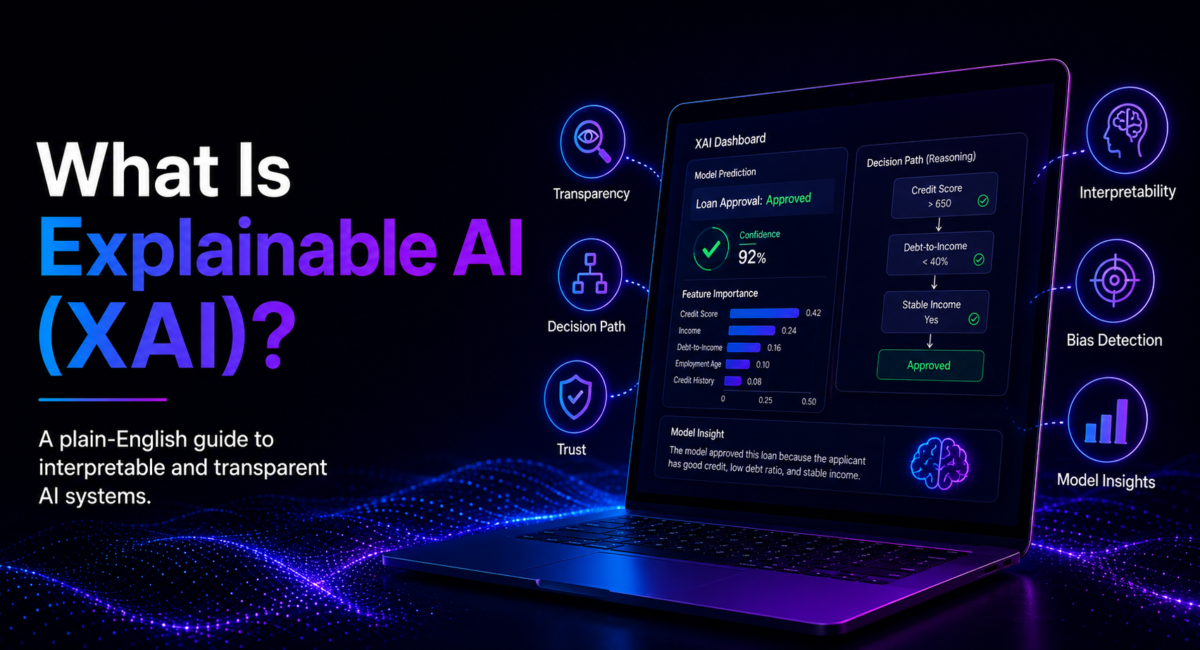
Every time an AI system denies a loan, flags a scan or ranks a job application, someone eventually asks the same one-word question: why? Explainable AI (XAI) is the set of methods and techniques that make an AI system’s decisions understandable to humans — answering not just what a model predicted, but why it predicted it.
That question stopped being academic in 2026. The Stanford Institute for Human-Centered AI reported the average Foundation Model Transparency Index score falling from 58 to 40, with the widest gaps in training data, compute and post-deployment disclosure: models got more capable and less legible at once. Meanwhile the EU AI Act gives people a legal right to an explanation of certain automated decisions from 2 August 2026. Explainability is a product requirement now, not a research paper.
| Quick answer: Explainable AI (XAI) is a set of methods that make an AI system’s decisions understandable to humans, showing why a model produced an output, not just what it produced. It solves the “black box” problem and matters most in healthcare, finance and hiring, where decisions must be trusted, audited or legally justified. |

Table of Contents
What is explainable AI, and why does the field exist?
Explainable AI is the practice of producing human-understandable accounts of how and why a machine learning model reached a specific output. The field has a concrete origin: the US Defense Advanced Research Projects Agency formulated its Explainable AI program in 2015 to let end users understand, appropriately trust and effectively manage AI systems, seeding much of today’s toolkit.
Two words travel together here. Interpretability describes how inherently readable a model is — a shallow decision tree, whose logic you trace by eye. Explainability describes generating an account of a model that is not readable on its own. The distinction matters when choosing a solution: you either build a model you can read, or bolt an explanation layer onto one you cannot.
Explainability is not accuracy. A model can be right for reasons you would reject if you could see them — a hiring model quietly keying on postcode. That failure mode is tied to how large language models generate text from statistical patterns rather than stored facts: fluent output is a poor proxy for sound reasoning.
What exactly is the black box problem?
The black box problem is that many high-performing models — deep neural networks with billions of parameters — reach outputs through computations no human can trace end to end, including the engineers who trained them. Input goes in, output comes out, and the reasoning between is written down nowhere a person can read.
The cost of that opacity scales with the stakes. An unexplained music recommendation costs nothing. An unexplained mortgage denial costs the applicant a house and the lender a defence it cannot mount before a regulator. Explainability converts an opaque verdict into a decision someone can question, appeal or sign off on.
How do XAI methods actually explain a model?
XAI methods fall into a few families. The practical choice comes down to whether you need to explain one prediction or the whole model, and whether you can retrain.
Feature importance ranks which inputs moved the output most. LIME (Local Interpretable Model-agnostic Explanations) approximates a complex model around a single case with a simple one. SHAP (SHapley Additive exPlanations) borrows from game theory to assign each feature a consistent contribution. Counterfactuals answer the question people actually ask — what would have had to change for a different outcome. Saliency maps highlight the image regions or text tokens the model leaned on. Interpretable models sidestep the problem by being readable from the start.
| Method | Question it answers | Scope | Model-agnostic? |
| Feature importance | Which inputs matter overall? | Global | Partly |
| LIME | Why this one prediction? | Local | Yes |
| SHAP | How much did each feature contribute? | Local and global | Yes (kernel form) |
| Counterfactuals | What would change the outcome? | Local | Yes |
| Saliency maps | Where in the input did the model look? | Local | No (needs gradients) |
| Interpretable models | What is the full decision logic? | Global | Not applicable |

The other axis is access. Model-agnostic tools learn only from inputs and outputs, so they work on almost anything, including a vendor API. Model-specific tools exploit internal structure — network gradients, tree branches — buying precision at the cost of portability.
Can the explanation itself be wrong?
Yes, and this is the most important caveat in the field. A post-hoc method does not read the model’s reasoning — it builds a second, simpler model of the first one’s behaviour and reports that. The output is an approximation, and approximations can be confidently wrong. The danger is specific: a plausible-looking explanation is more trusted than no explanation at all, so an unfaithful one can launder a bad decision rather than catch it.
Two failure modes are worth knowing by name. Instability: LIME builds its local approximation from randomly perturbed samples, so running it twice on the same prediction can return different top features — if the explanation moves and the prediction does not, the explanation is telling you about the sampling, not the model. Unfaithfulness: an explanation can be perfectly stable and still fail to reflect the mechanism, because correlated inputs let a method attribute importance to a proxy rather than the feature the model actually keyed on.
The practical response is not to abandon these tools but to stop treating a single explanation as evidence. Run the method more than once and check the account is stable, cross-check with a second method that answers the same question a different way, and test explanations against cases where you already know the answer. Where the stakes are highest, an interpretable model you can read directly beats a black box with a persuasive explanation attached.
How we compared these explainability methods
We score each method on four criteria verifiable from published documentation and hands-on use: the question it answers, whether the explanation is local or global, whether it needs model internals, and its inference-time compute cost. We publish no single “best” score, because the right choice is set by your constraints — a lender justifying individual decisions needs different tooling from a team auditing overall behaviour. Where sources disagree we cite primary documentation, not vendor summaries.
Why does explainable AI matter more in 2026 than in 2020?
Five drivers keep XAI on roadmaps: trust, because people act on AI output when they can see the reasoning; fairness, because explanations expose proxies for protected attributes; accountability, because a human must own consequential decisions; compliance, because transparency duties now carry fines; and debugging, because explanations are how engineers find confidently wrong outputs.
That last driver has grown teeth. The 2026 Stanford AI Index found that on a benchmark separating knowledge from mere belief, hallucination rates across 26 leading models ranged from 22% to 94%. When error rates vary that wildly and stated confidence does not, you cannot triage failures from the output alone — the ground covered in our guide to why AI hallucinations happen and how to catch them.
The US National Institute of Standards and Technology set the bar for a good explanation in NISTIR 8312: a system should deliver an explanation, make it meaningful to its audience, keep it accurate to the actual process, and operate only within its designed knowledge limits. Teams skip that fourth principle most often.
Is explainable AI required by law?
In the EU, yes, in specific circumstances. Article 86 of the EU AI Act gives a person subject to a high-risk automated decision producing legal effects the right to clear and meaningful explanations of the AI system’s role in it. Under the text of Article 86, that right applies from 2 August 2026.
The wider timetable shifted this year. Under the Digital Omnibus agreement reached in 2026, obligations for stand-alone high-risk systems in Annex III moved to 2 December 2027, and high-risk AI embedded in regulated products to 2 August 2028. The Article 50 transparency duties — disclosing chatbots, labelling AI-generated content and deepfakes — were not deferred. Our breakdown of how the EU AI Act classifies AI systems by risk tier tracks the current dates. This is general information, not legal advice.
Can explainability keep up with large language models?
Only partly, and this is the live frontier. LIME and SHAP were designed for tidy tabular features; they say little about the transformer architecture behind modern LLMs. The response has been mechanistic interpretability — reverse-engineering a network’s internal circuits rather than approximating it from outside. MIT Technology Review named it one of its 10 Breakthrough Technologies of 2026.
The tooling is genuinely new. Sparse autoencoders decompose a model’s activations into features a human can name, and attribution graphs trace the path from prompt to response. Anthropic used both as investigative tools in the alignment assessment published with the Claude Opus 5 system card in July 2026. The caveat matters: these techniques still rely on approximations and heavy manual interpretation, so they are an investigative aid, not a compliance artefact you can hand an auditor.

What does XAI look like in a real deployment?
Consider Dr. Anneke Smit, a consultant radiologist at a 400-bed regional hospital — a composite of deployment patterns we reviewed, not one named institution. Her department adopted a deep learning model flagging suspected pulmonary nodules on chest CT scans. Validation accuracy was excellent. Uptake was near zero.
The reason was mundane: the model returned a probability and nothing else, and Anneke would not sign a report she could not defend. The team added saliency overlays showing which voxels drove each flag, plus a SHAP-style summary of the tabular inputs that moved the score.
Two outcomes followed. Radiologists began reviewing flagged scans, because they could check the model’s attention in seconds. And the overlays caught a real defect: on scans from one older scanner, the model was partly keying on an imaging artefact near the chest wall rather than tissue — invisible in the accuracy metrics, obvious in the explanation. The fix was a retrain on rebalanced data. Explanations pay for themselves first as a debugging tool, second as a trust tool.
Frequently Asked Questions
How would you explain XAI to a non-technical colleague?
Explainable AI means an AI system can show its working. Instead of returning only an answer, it also surfaces the factors that drove that answer — which inputs mattered, how much, and what would have changed the result. It turns an unaccountable verdict into a decision a person can check and challenge.
What is the difference between interpretability and explainability?
Interpretability means a model is inherently readable, like a decision tree whose logic you can follow directly. Explainability means generating an account of a model that is not readable on its own, usually after it has made a prediction. Both aim at the same goal: letting a human understand why an AI produced its output.
What are LIME and SHAP?
LIME and SHAP are the two most widely used explanation techniques. LIME approximates a complex model around one specific case with a simple, readable model. SHAP uses cooperative game theory to assign each input feature a consistent numeric contribution to the output. Both explain individual predictions without needing model internals.
Does explainability reduce model accuracy?
Not necessarily. Choosing an inherently interpretable model can cost accuracy on complex data, but post-hoc methods like SHAP and LIME explain an existing model without changing or retraining it, so accuracy is untouched. The real costs are extra compute at inference time and engineering effort, not predictive performance.
Can large language models explain their own answers?
Not reliably. A model can produce fluent reasoning text that does not reflect the computation that actually generated its answer, a mismatch researchers call unfaithful reasoning. That is why mechanistic interpretability inspects internal activations directly rather than trusting self-reported explanations, and why chain-of-thought output is not an audit trail.
How do you start adding explainability to an existing model?
Start from the decision, not the toolkit. Write down who will ask “why did it do that?” — a customer, a regulator, an internal reviewer, an engineer debugging a failure — because each needs a different kind of answer, and picking a library before you know the audience is how teams end up with dashboards nobody reads.
From there the sequence is practical. Check whether an interpretable model performs acceptably on your problem, because on structured tabular data the gap is often smaller than assumed and it removes the faithfulness question entirely. If you need the black box, add SHAP for feature attribution and counterfactuals for the “what would change this?” question, since those two cover most real requests between them. Then log the explanations alongside the predictions — the explanation you cannot reproduce six months later is worth very little when a decision is contested.
Conclusion
Explainable AI is no longer a nicety layered on a working system — it is part of what makes a system deployable. The methods split cleanly: interpretable models where you can use them, post-hoc tools like SHAP, LIME and counterfactuals where you cannot, and mechanistic interpretability when the model is a frontier LLM. Choose by the question you need answered, not by popularity.
The 2026 direction of travel is unambiguous: transparency scores are falling while legal explanation rights switch on, and that gap is where compliance risk lives. If your AI decides something affecting someone’s money, health or job, build the explanation layer alongside the model. Retrofitting it after the first contested decision costs far more.
