


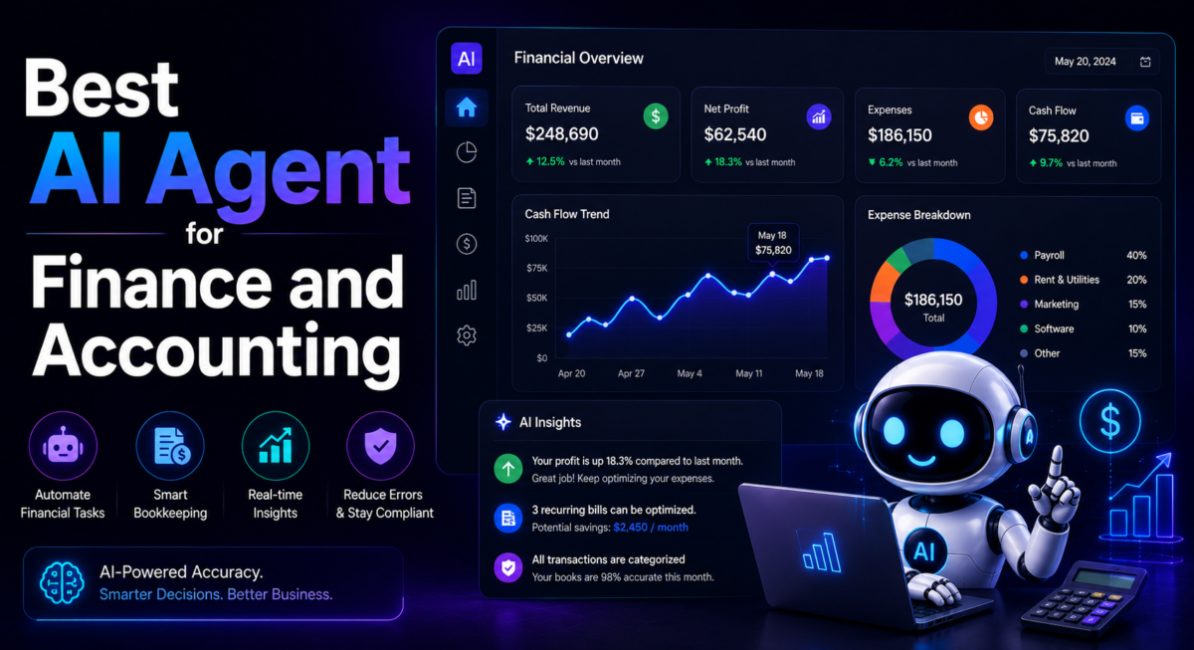
| Quick answer: The best AI agent for finance and accounting depends on your bottleneck. In 2026 the leaders are Ramp (spend plus an Accounting Agent that auto-codes transactions), Vic.ai (autonomous accounts payable), Docyt, Truewind and Digits (bookkeeping and close), and Datarails (FP&A and forecasting). Start with your slowest manual task, prove payback, then expand. |
How we compare: we weigh each tool on function fit, native accounting integrations, automation depth, security posture and published pricing, then map tools to the workflow they automate best rather than crowning one winner. Affiliate disclosure: some outbound links may earn TechieHub a commission at no cost to you; it never changes which tools we recommend.

An AI agent for finance and accounting is software that monitors financial workflows, takes actions on its own – coding transactions, processing invoices, reconciling accounts, forecasting cash flow – and adapts to context instead of following fixed rules. That autonomy is what separates it from an assistant; if the distinction matters to your evaluation, our guide on the difference between an AI agent and an AI assistant lays it out clearly.
Table of Contents
What makes the best AI agent for finance and accounting?
There is no single platform that owns every corner of the finance stack, and the buyers who chase one usually end up with a generalist that does everything adequately and nothing well. The best AI agent for finance and accounting is the specialist that erases your biggest time drain, syncs cleanly with your general ledger, and can prove it is secure. Three qualities separate the leaders from the demos:
- Genuine autonomy – it drafts the coding, matching or forecast without a human keystroke, then routes only the exceptions for review. This agentic behavior is the same pattern reshaping other back-office functions, covered in our overview of real-world agentic AI applications.
- Deep, native integrations – first-class support for QuickBooks, NetSuite, Xero or Sage Intacct so data flows both ways without brittle exports.
- Verifiable trust – SOC 2 Type II attestation, full audit trails, and a design that flags low-confidence items instead of guessing.
Adoption is nearly universal, but value is not. Gartner’s November 2025 survey found close to 60% of finance teams are piloting or implementing AI, yet only about 7% of CFOs report a strong impact from that spend (Gartner). The gap is almost always a targeting problem – the winners point one capable agent at one painful workflow.
How do finance AI agents actually work?
Modern finance agents combine document AI, large language models and workflow automation. Instead of the pattern-matching optical character recognition of the last decade, they interpret accounting context. Vic.ai, for example, is built on deep-learning models trained on more than one billion invoices, letting it read data across formats and code the general ledger without a template (Vic.ai). The result is straight-through processing: the invoice arrives, the agent extracts, classifies, matches the purchase order and routes for approval, and a person only steps in on the outliers. The same shift underpins the broader move to autonomous software explained in what agentic AI means.
Which finance AI agents lead each function in 2026?
The category splits cleanly by function. Here are the standouts, each strongest in a different lane.
| Function | Leading tools | Reported result | Pricing |
|---|---|---|---|
| Spend management | Ramp | Auto-codes on posting; clean books ~3x faster, 40+ hours saved a month | Free tier plus paid plans |
| Accounts payable | Vic.ai | Straight-through rates above 90%, around 99% extraction accuracy | Quote |
| Bookkeeping and close | Docyt, Truewind, Digits, Puzzle | Truewind reports 75% less categorisation time and close four days faster | Docyt from about $299/mo |
| FP&A and forecasting | Datarails, Cube, Mosaic | Datarails connects 600+ ERP, accounting and HRIS systems | Quote |
| Receivables | AR agents | Automated chasing and collections workflows | Varies |
Ramp – spend management with an Accounting Agent
Ramp pairs corporate cards, expense management and bill pay with an Accounting Agent it launched in February 2026 that auto-codes every transaction the moment it posts – GL account, department, class, location and custom fields, down to invoice line items – and surfaces only what needs a human. Ramp reports teams deliver clean books roughly three times faster and save 40+ hours a month, and it offers a free tier alongside paid plans (Ramp launch announcement). Best for teams that want spend and coding handled together.
Vic.ai – autonomous accounts payable
Vic.ai remains the AP leader. Its Autopilot handles data extraction, GL coding and approvals with published straight-through rates above 90% and around 99% extraction accuracy, and its Victoria agent adds conversational triage and exception resolution – giving high-volume teams up to 5x more capacity without new headcount. Best for enterprise AP.
Docyt, Truewind, Digits and Puzzle – bookkeeping and close
Docyt runs AI bookkeeping through a chat interface and only commits a category when fully confident, with tiered pricing from about $299/month; Truewind learns your transaction patterns and reports it cuts categorization time by 75% and closes books four days faster; Digits offers continuous bookkeeping whose Agentic Close covers roughly 80% of use cases; and Puzzle handles autonomous bookkeeping that asks clarifying questions. Best for startups, SMBs and CPA firms.
Datarails, Cube and Mosaic – FP&A and forecasting
Datarails brings AI to Excel-native planning, connecting to 600+ ERP, accounting and HRIS systems and layering on a Planning Agent for ad-hoc forecasts and scenario analysis (Datarails). Cube and Mosaic add driver-based modeling and rolling forecasts; Anaplan and Workday Adaptive Planning cover connected planning at enterprise scale. Because these agents surface trends and anomalies automatically, they let a small FP&A team run more scenarios in an afternoon than a spreadsheet-bound one could in a week.
AR agents – receivables and collections
The final lane is accounts receivable, where agents act as a tireless coworker – sending payment reminders, prioritizing at-risk accounts and forecasting incoming cash so collections scale without new hires. Pairing an AR agent with the AP and bookkeeping layers closes the loop on both sides of the cash cycle, which is what lets lean teams operate like much larger ones.

Where does AI pay back fastest in finance?
Follow the payback. Bank reconciliation and accounts payable automation consistently return the fastest – typically 3–9 months. Reconciliation drops a 5–8 hour monthly task to 15–30 minutes, and AP automation cuts per-invoice processing cost by up to 85% while freeing several hours a week. That is why Gartner found AP automation (37%) and anomaly detection (34%) among the top live use cases in finance teams. These are high-volume, repetitive tasks with clean, measurable savings – the ideal proving ground before you expand into forecasting or receivables.

AI finance agents in practice: a startup controller’s month-end
Consider Rosalind, a solo controller at a 40-person SaaS company running QuickBooks and juggling two entities. Before automating, her month-end close took nine working days, most of it spent categorizing card spend and chasing invoice approvals over Slack. She started with the single worst task – transaction coding – by moving company cards to a spend platform whose Accounting Agent auto-codes each purchase at the point of sale, then layered an AP agent to extract and route vendor invoices.
The change was sequencing, not magic. With coding drafted automatically, Rosalind shifted from data entry to reviewing exceptions the agent flagged as low-confidence. Her close now finishes in about two days, and the hours she reclaimed go into cash-flow scenarios and board reporting – the higher-value work that turns a finance team into a strategic partner. Her illustrative takeaway mirrors the industry pattern: automate the slowest manual task first, keep a human on the exceptions, and reinvest the saved time.
How do you choose the right finance AI agent?
Match the tool to your biggest bottleneck first. If invoice processing eats your week, evaluate Vic.ai or Stampli. If planning and forecasting are the constraint, look at Datarails, Cube or Mosaic. If spend and expenses are the drain, Ramp or Brex lead. If bookkeeping and close lag, Docyt, Truewind or Digits fit, and if receivables are the gap, AR agents close it. Then check the practical fit:
- Integrations – confirm native, two-way sync with your accounting system before anything else.
- Team size and stack – SMBs are well served by Puzzle, Truewind or Ramp’s free tier; enterprises need Vic.ai’s volume handling or connected planning platforms.
- Pricing versus value – offerings range from free (Ramp) through per-transaction bookkeeping tiers to six-figure enterprise FP&A licenses. Map cost against the hours and errors saved in your one target workflow.
What are the security and oversight essentials?
Finance is high-stakes and these agents can move money, so treat security as a gate, not a checkbox. Require SOC 2 Type II attestation, strong encryption and enterprise-grade data governance, and review each vendor’s compliance documentation before sharing records. Keep accountants in the loop – the best tools deliberately auto-commit only when confident and flag the rest – and use the audit trail every agent maintains to stay ready for review. AI handles the grunt work; a qualified professional owns the judgment calls and your compliance obligations. For the wider toolkit that surrounds these agents, see our pillar guide to the best AI agent tools.
Frequently Asked Questions
What is the best AI agent for finance and accounting?
It depends on your biggest bottleneck. Ramp leads spend and auto-coding, Vic.ai leads accounts payable, Docyt, Truewind and Digits handle bookkeeping and close, and Datarails leads FP&A. Identify your slowest manual task, prove ROI there, then expand rather than deploying one tool everywhere.
Can AI replace an accountant?
No. AI agents excel at repetitive, high-volume work like categorization, invoice processing and reconciliation, but accounting needs professional judgment, compliance expertise and oversight. The best tools flag uncertain items for human review. AI handles the grunt work so accountants focus on analysis, advisory and the judgment calls.
Where does AI deliver the fastest ROI in finance?
Bank reconciliation and accounts payable automation pay back fastest, usually in 3 to 9 months. Reconciliation drops a 5 to 8 hour monthly task to under 30 minutes, and AP automation cuts per-invoice cost by up to 85%. Start with whichever is your team’s biggest time drain.
Are AI finance tools secure?
The reputable ones are, but you must verify. Require SOC 2 Type II attestation, strong encryption and enterprise-grade governance, and review each vendor’s compliance documentation before sharing records. Leaders maintain full audit trails. Never share financial data with a tool that cannot demonstrate proper security certifications and access controls.
How much do AI accounting tools cost?
Pricing spans a wide range. Ramp offers a free tier, dedicated bookkeeping tools like Docyt start around $299/month and scale by transaction volume, and enterprise FP&A platforms can run six figures annually. Map the price against the hours and errors saved in your one target workflow before expanding.
Should I use one finance platform or several tools?
Usually several, targeted by function. Spend, AP, bookkeeping, FP&A and receivables each have leading specialists that outperform a generalist stretched across all of them. Solve your biggest bottleneck first with the best tool for it, prove the impact, then layer in adjacent agents as you grow.
How does an AI agent affect your audit trail?
Auditors do not object to AI coding entries — they object to entries nobody can explain. What they need is traceability: the source document, the values extracted from it, the coding decision, the confidence level, and who approved it. Any tool worth buying keeps that as an immutable log, and it is worth checking the export format before you commit rather than at year end.
Two things sit with you rather than the vendor. Set an explicit review threshold — which entries post automatically and which require a human — and make sure the threshold itself is documented, because “the AI decided” is not a control. And remember that a vendor’s SOC 2 report covers their controls, not your process; you still own the control environment your auditor tests. Teams that define the threshold up front generally find AI-assisted coding is easier to audit than manual entry, because the reasoning is logged rather than living in someone’s head.
Conclusion
The best AI agent for finance and accounting isn’t the platform that claims to do everything – it’s the specialist that erases your biggest time drain, integrates with your books and proves it’s secure. Start with reconciliation or AP where payback lands in 3–9 months, keep accountants reviewing the output, and let the reclaimed hours flow into analysis that actually moves the business.
Lending across jurisdictions? See our guide to AI agents for cross-border loan servicing, covering providers, EU AI Act duties and multi-state compliance.
