


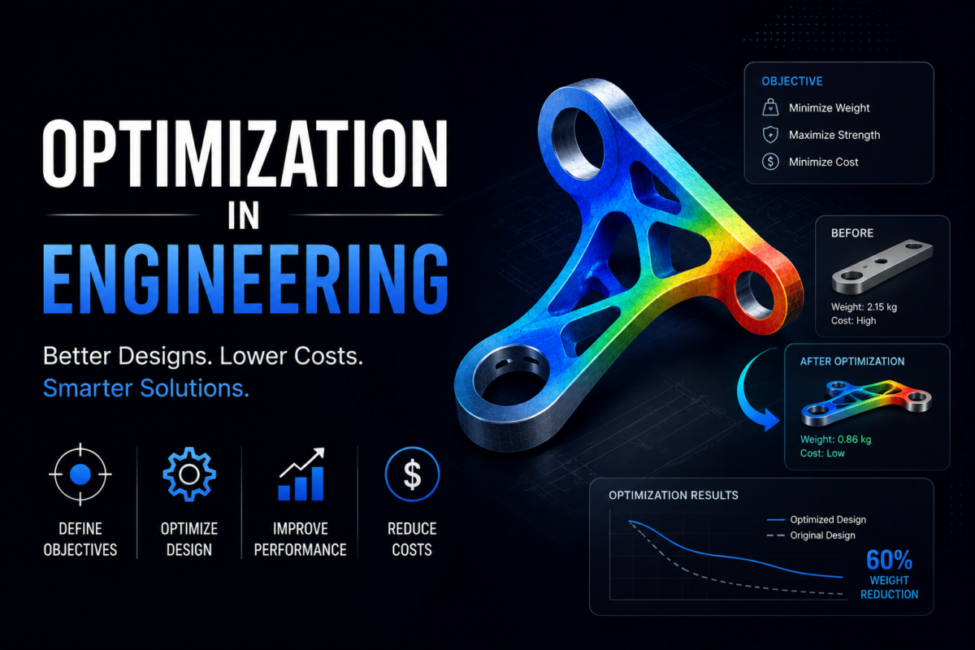
Every engineering team eventually hits the same wall: the design works, but nobody can prove it is the best design available. Optimization is the discipline that settles that question with mathematics instead of intuition, and it has quietly become one of the highest-leverage skills in modern engineering. Part of that is solver maturity. The larger part is that machine learning collapsed the cost of evaluating candidate designs, so studies that once needed a supercomputer allocation now run on a workstation. This guide covers the core ideas, the method families worth knowing, what actually changed in 2026, and the mistake that wastes the most engineering time.
| Quick answer: Optimization in engineering is the systematic search for the design that performs best under real constraints. Every problem combines an objective function to minimize or maximize, design variables you can change, and constraints the answer must respect. Engineers solve them with gradient methods, metaheuristics, topology optimization, and machine-learning surrogates. |

Table of Contents
What is optimization in engineering?
Optimization in engineering is the process of finding the best possible design within a set of constraints by minimizing or maximizing a measurable objective. That single sentence hides a real shift in how engineering work is organized. Without it, design is a loop of proposing something plausible, simulating it, and adjusting by feel. With it, the design space itself becomes the object of study and the algorithm does the proposing.
The distinction matters because “it passes” and “it is the best” are different standards. A bracket that survives its load case is acceptable. A bracket that survives the same load case at thirty percent less mass is worth money on every unit shipped, for the life of the product. Optimization is how you find the second one deliberately rather than by luck.
The mathematics is field-agnostic. Structural engineers use it to place material, aerospace teams use it to shape wings, chemical engineers use it to set operating conditions, and power-systems engineers use it to schedule generation. Only the objective, the variables, and the physics behind the constraints change.
What are the three ingredients of every optimization problem?
Every optimization problem, from a two-variable beam to a thousand-variable airframe, is assembled from the same three parts.
The objective function is the quantity being minimized or maximized: mass, cost, drag, stress, energy use, cycle time. The design variables are the parameters you are free to change: dimensions, thicknesses, material choices, angles, set points. The constraints are the rules the answer must obey: allowable stress, a budget ceiling, a minimum wall thickness the shop can machine, conservation laws.
Together, the constraints define the feasible design space — the set of designs that are actually permitted — and the optimizer’s job is to find the point inside that space that scores best on the objective. Getting these three right is the highest-value hour of the entire project. An elegantly solved problem with the wrong objective produces a precise answer to a question nobody asked.

Which optimization method should you use?
There is no universal algorithm. The right family follows from the shape of the problem: whether the objective is smooth, how expensive one evaluation is, and whether you are chasing a single goal or several at once.
| Method family | Best suited to | Evaluations needed | What it returns |
| Gradient-based | Smooth, differentiable objectives | Low | One local optimum |
| Metaheuristics (GA, PSO, simulated annealing) | Rugged, discrete or black-box problems | High | A strong but unguaranteed answer |
| Topology and shape optimization | Where material should sit in a volume | Moderate | Load-path-driven geometry |
| Multi-objective search | Competing goals such as mass and cost | High | A Pareto front of trade-offs |
| Convex and linear programming | Provably convex formulations | Very low | Guaranteed global optimum |
| Surrogate-assisted search | Expensive simulation loops | Low after training | Fast approximate rankings |
How we compare: we rank method families on three axes an engineer actually feels — evaluations required per useful answer, tolerance for non-smooth or black-box objectives, and whether the output is one design or a trade-off set. We weight published benchmark behaviour over vendor claims, and treat guaranteed global optimality as decisive only where the problem is genuinely convex.
Open-source tooling to start with
Open-source tooling covers most of this ground before you commit budget. The SciPy optimization reference documents gradient-based, derivative-free, global, and constrained solvers behind one consistent API, which makes it a sensible first stop.
How is AI changing engineering optimization in 2026?
The bottleneck was never the algorithm. It was the cost of a single evaluation. One finite-element or computational-fluid-dynamics run can take minutes to days, and a serious search needs thousands of them.
Surrogate models — cutting the cost per evaluation
Machine-learning surrogate models attack exactly that. Trained on a batch of high-fidelity simulations, a surrogate predicts the outcome of an unseen design almost instantly. Neural-field surrogates for aerodynamic flow fields have reported inference speedups of up to five orders of magnitude over high-fidelity solvers, according to research published in Scientific Reports. That converts “evaluate ten designs overnight” into “evaluate ten thousand before lunch,” which changes what questions are worth asking.
Generative design — two different things
The second shift is generative design, which now means two different things worth keeping apart. Optimization-driven generative design derives geometry from loads and constraints, usually via topology optimization. Generative AI for CAD uses models trained on engineering data to produce or edit geometry from prompts and sketches; a 2025 review in JMST Advances maps eight distinct application scenarios for that second category. The honest summary is that it accelerates ideation while still demanding physics-based validation.
Conversational querying of design data
A third shift is quieter: engineers increasingly query design data conversationally. If the mechanics are new to you, our explainer on how large language models actually work is the right starting point, while our guides to AI tools for data analysis and big data and AI cover the pipeline that feeds simulation output back into the design loop.

Why do mathematically optimal designs sometimes fail?
Three failure modes account for most of the disappointment.
Local optima. Most real problems are non-convex. A gradient method converges confidently on a good answer that is not the best one, and nothing in the output announces this. Multiple starting points, or a metaheuristic sweep before refinement, is the standard defence.
Missing constraints. An optimizer will happily return a shape no supplier can make, because manufacturability was never encoded. If it is not written as a constraint, it does not exist.
Unvalidated approximations. Surrogates carry error and generative models are bounded by their training data. Both must be checked against the real solver or a physical test before anything is committed. Topology optimization is a proven route to lighter aircraft components, but the published results that count are the ones that survived validation. Language-model assistants can draft an optimization setup quickly, and the caveat in our large language model primer applies directly: they generate plausible text, not verified physics.
Use case: lightweighting a drone motor arm
Consider a structures engineer at a mid-size industrial-drone manufacturer — an illustrative case, not a named company. The task is narrow and typical: cut mass from the aluminium bracket joining each motor arm to the fuselage, without losing stiffness or leaving the existing machining envelope.
She framed the problem before touching a solver. Objective: minimize bracket mass. Variables: material distribution inside the original bounding volume. Constraints: peak von Mises stress under the worst-case landing load, a three-millimetre minimum wall thickness for the three-axis mill, and unchanged bolt-hole positions.
A topology optimization run produced the expected organic geometry. Because the machining limit sat in the problem from the start, the result needed light manual cleanup rather than a redesign. She rebuilt the shape as parametric CAD, ran a confirmation analysis at full fidelity, and printed a test article for the drop rig.
Outcome: twenty-six percent mass reduction per bracket, peak stress eight percent below the original, and no tooling change. Across four arms and a five-figure annual build volume, that is a real payload and endurance gain — earned from one well-posed problem, not a cleverer algorithm.
Disclosure: some links in this article may be affiliate links. If you buy through them, TechieHub may earn a small commission at no extra cost to you. It never changes which methods or tools we recommend.
This example is a composite of the lightweighting studies we see most often, not a single client account; the figures are typical rather than measured from one engagement.
Frequently Asked Questions
What is the difference between optimization and simulation?
Simulation evaluates one design and tells you how it performs. Optimization wraps a search around simulation, generating and scoring many candidate designs to find the best feasible one. Simulation answers “how good is this?” while optimization answers “which design is best?” Most optimization workflows call a simulation solver thousands of times.
Is topology optimization the same as generative design?
No. Topology optimization is one specific method that finds the best distribution of material inside a design volume. Generative design is the broader workflow of automatically producing design candidates, and topology optimization is frequently the engine inside it. Newer generative AI for CAD creates geometry from prompts instead, which is a different technique.
Can optimization guarantee the single best design?
Only for convex problems, where the global optimum is provable. Most engineering problems are non-convex, so an algorithm may settle on a strong local optimum instead. Problems with competing objectives have no single winner at all; they produce a Pareto front of trade-offs that an engineer must choose between.
How much data does a surrogate model need?
It depends on dimensionality and how nonlinear the response is. A low-dimensional problem may need only dozens of high-fidelity runs, while a complex flow field can need thousands. A practical approach is a space-filling design of experiments, then adaptive sampling that adds runs where the surrogate is least confident.
Do you need advanced mathematics to start?
Not to begin. Modern libraries and CAD-integrated tools handle the algorithmic detail, so the skill that matters most is problem formulation: choosing a meaningful objective, identifying the real variables, and writing down every constraint. Deeper mathematics helps when diagnosing convergence problems or building custom formulations.
What software is used for engineering optimization?
Three tiers cover most practice. Inside CAE suites, the optimisation modules bundled with Ansys, Abaqus, COMSOL and Siemens NX handle structural, thermal and fluid problems against a solver you already own — the default choice when the physics is already modelled there. Standalone frameworks such as modeFRONTIER and Dakota coordinate multi-objective studies across several solvers, which is what multidisciplinary work needs. For custom and research problems, open-source Python libraries — SciPy optimize, pymoo for multi-objective work, OpenMDAO for coupled systems — give full control at the cost of building the problem definition yourself.
What does optimization mean in engineering, in simple terms?
It means finding the best possible design when you cannot have everything. Every real design pulls in competing directions: lighter usually means weaker, faster usually means hotter, cheaper usually means shorter-lived. Optimisation is the systematic version of the trade-off an engineer would otherwise make by intuition — you state precisely what “best” means as an objective, list what you are allowed to change, write down the limits you must not breach, and let a method search the space far more thoroughly than manual iteration allows.
What are the main types of optimization in engineering?
Four families cover almost all engineering practice. Gradient-based methods are fastest when the objective is smooth and derivatives are available. Gradient-free methods — Nelder-Mead, pattern search — handle noisy or non-differentiable objectives at the cost of more evaluations. Evolutionary and population-based methods such as genetic algorithms explore rugged, multi-modal spaces and suit multi-objective work. Bayesian optimization is the choice when each evaluation is expensive, because it decides where to sample next rather than sampling blindly. Structural work adds topology optimization as a specialised case. The shape of your problem picks the family, not preference.
Conclusion
Optimization turns engineering design from an educated guess into a search with a defined target. The three ingredients — objective, variables, constraints — decide the quality of the answer far more than the choice of algorithm does, and the method family should follow the shape of the problem rather than habit. AI has genuinely changed the economics by making expensive evaluations cheap, which widens the search rather than replacing the physics. Frame the problem carefully, encode what manufacturing actually demands, validate every optimum against reality, and the mathematics will sharpen your judgement instead of substituting for it.
