


| Quick answer |
|---|
| Microsoft Defender for Office 365 at $2 to $5 per user a month is the cheapest credible starting point for AI-powered email impersonation detection, and Abnormal AI is the strongest behavioural option. Add EasyDMARC, from $35.99 a month on annual billing, to stop your own domain being spoofed. |
| How we compare |
|---|
| Tools are separated by which direction of impersonation they defend, then by whether a price is published at all. Prices were re-read from vendor pages in September 2026 and marked quote-only where none exists. Every price was re-checked against the vendor’s own pricing page in September 2026, and figures available only from third-party trackers are marked as reported. No vendor paid for placement. We did not run a head-to-head detection test, and we reproduce no vendor effectiveness claim as if it were an independent result. |
Table of Contents
There are two impersonation problems, not one
Almost every buyer’s guide in this space blurs a distinction that decides what you should buy. Inbound impersonation is someone pretending to be your CFO or a supplier, in a message arriving at your staff. Outbound impersonation is someone sending mail as your domain to your customers, which you never see because it never touches your servers.
Different tools solve each. Inbound needs behavioural email security that knows who normally emails whom. Outbound needs DMARC enforcement, which is authentication policy rather than phishing detection at all. Buy only the first and your customers still get invoices signed with your brand. For inbox, calendar and meeting admin, see our guide to AI tools for executive assistants.
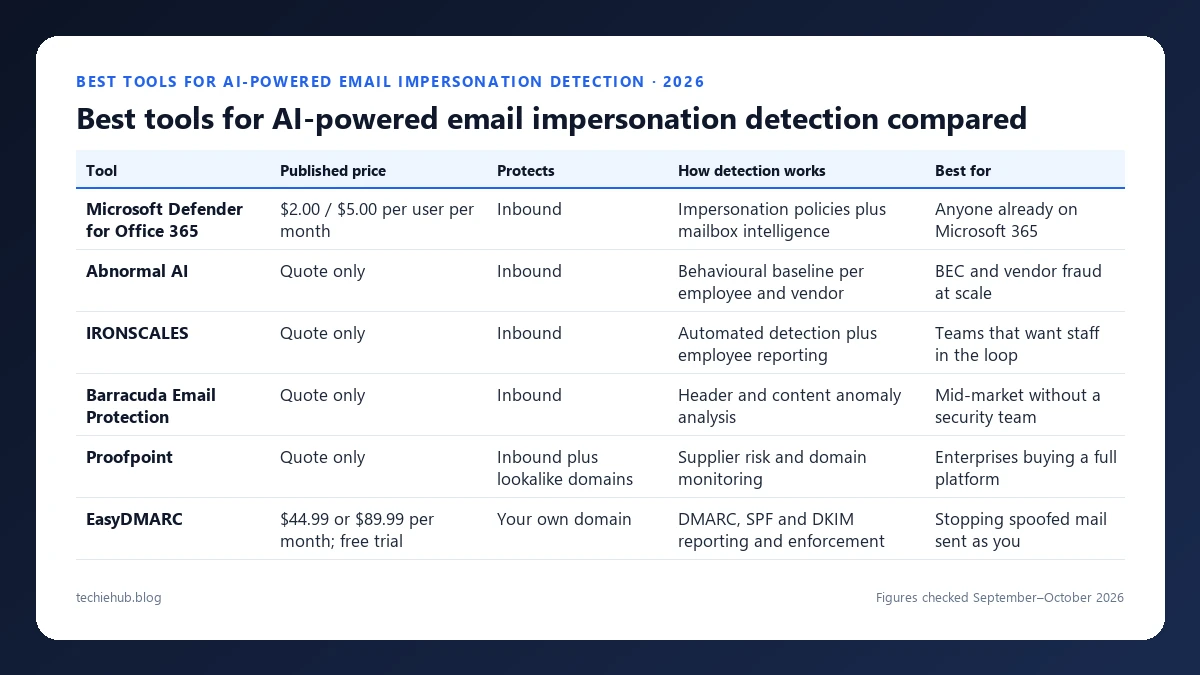
Best tools for AI-powered email impersonation detection compared
| Tool | Published price | Protects | How detection works | Best for |
|---|---|---|---|---|
| Microsoft Defender for Office 365 | $2.00 / $5.00 per user per month | Inbound | Impersonation policies plus mailbox intelligence | Anyone already on Microsoft 365 |
| Abnormal AI | Quote only | Inbound | Behavioural baseline per employee and vendor | BEC and vendor fraud at scale |
| IRONSCALES | Quote only | Inbound | Automated detection plus employee reporting | Teams that want staff in the loop |
| Barracuda Email Protection | Quote only | Inbound | Header and content anomaly analysis | Mid-market without a security team |
| Proofpoint | Quote only | Inbound plus lookalike domains | Supplier risk and domain monitoring | Enterprises buying a full platform |
| EasyDMARC | $44.99 or $89.99 per month; free trial | Your own domain | DMARC, SPF and DKIM reporting and enforcement | Stopping spoofed mail sent as you |


The tools in detail
Microsoft Defender for Office 365
Microsoft Defender for Office 365 is the only major option with published per-user pricing: Plan 1 is $2.00 and Plan 2 is $5.00 per user per month, paid yearly. Check your licence first: Plan 2 comes with E5, and Plan 1 is reported to join Business Standard from 1 July 2026. Its anti-phishing policies carry impersonation settings for named users and protected domains, plus mailbox intelligence that learns who each person normally corresponds with.
Abnormal AI
Abnormal AI — renamed from Abnormal Security in April 2025 — is an API-connected platform that models normal communication patterns per employee and flags deviations, which is the approach best suited to business email compromise and vendor fraud where there is no malicious link or attachment to scan. Quote-only.
IRONSCALES
IRONSCALES combines automated detection with employee reporting, sharing the signal from one customer’s reported message across its wider community. Plans are Protect, Email Protect and Complete Protect; the pricing page publishes no figures and routes to a quote request.
Barracuda Email Protection
Barracuda Email Protection sells Advanced, Premium and Premium Plus tiers, with phishing and business email compromise protection listed as available on all three. Detection works from header and content anomalies rather than static rules. No published per-user pricing.
Proofpoint
Proofpoint is enterprise email security with mature supplier-risk and lookalike-domain capabilities, typically bought as part of a wider platform rather than as a point solution. Quote-only, and normally sold on multi-year terms.
EasyDMARC
EasyDMARC handles the other half of the problem: stopping other people sending mail as you. Its pricing page, read on 11 October 2026, no longer lists a free plan: Plus is $44.99 a month for two domains and Premium $89.99 for four, with 20 percent off annual billing, a free trial of both, and free checker tools for one-off lookups.
What the AI is actually doing
The useful work is behavioural baselining, not content classification. A convincing impersonation contains no malware, no suspicious link and no misspelling — it is a plausible message from a plausible sender asking for a plausible change of bank details. Signature-based phishing detection has nothing to match on. CISA’s guidance on social engineering makes the same point from the defender’s side: the giveaway is the request, not the file attached to it.
- Relationship graphs. The model learns who each employee actually corresponds with, so a first-time sender using the CEO’s display name scores badly regardless of how clean the text is.
- Tone and request modelling. Urgency, secrecy and payment-detail changes are weighted against the sender’s own history rather than a generic rulebook.
- Lookalike domain matching. Catching the character swap a person reads straight past at eight in the morning.
- Where it fails: a genuinely compromised internal account. The messages come from the real mailbox, over the real relationship, so the baseline endorses them. That is an account-takeover and MFA problem, not a detection one.
The published-price floor, and why it is your best negotiating number
Four of the six vendors here will not publish a price, which leaves buyers with nothing to hold a quote against. So build the number yourself. Two vendors do publish, and their rates give you a defensible floor for what impersonation defence costs per mailbox. Worked at 100 mailboxes and one sending domain, using the September 2026 published rates:
| What you buy | Published rate | Arithmetic | Per month | Per mailbox |
|---|---|---|---|---|
| Defender for Office 365 Plan 1 | $2.00 per user per month | 2.00 × 100 | $200.00 | $2.00 |
| EasyDMARC free checker tools (no monitoring plan) | $0 | — | $0.00 | $0.00 |
| Published-price floor | — | 200.00 + 0 | $200.00 | $2.00 |
| Same, with EasyDMARC Plus for two domains | $44.99 per month | 200.00 + 44.99 | $244.99 | 244.99 ÷ 100 = $2.45 |
| Defender Plan 2 + EasyDMARC Premium | $5.00 per user, $89.99 | 500.00 + 89.99 | $589.99 | $5.90 |
That gives you $2.45 per mailbox per month as a realistic published-price benchmark, and $5.90 as the top of the transparent range. When Abnormal AI, IRONSCALES, Barracuda or Proofpoint send a quote, divide the annual figure by your seat count and then by twelve, and compare it with those two numbers. A behavioural platform costing four or five times the floor may still be the right buy, but you will be arguing about a multiple rather than about a number only one side of the table can see.
One smaller saving the same arithmetic exposes: EasyDMARC lists Plus at $35.99 a month on annual billing, or $431.88 a year instead of 44.99 × 12 = $539.88 — a $108.00 difference for a decision you have already made. Finance teams are the usual target of the invoice fraud these tools exist to stop, which is why the controls belong beside the rest of the AI tooling accounting teams run rather than only in the security budget.
Do the authentication work first
Before spending on detection, publish SPF, DKIM and DMARC, start at p=none, read the reports for a month, authorise every legitimate sending platform, then move to quarantine and reject. It costs nothing beyond attention, it is now expected of bulk senders by the major mailbox providers, and it removes an entire class of impersonation that no inbound tool can see. Our guides to AI agents for email and AI tools for marketers cover the sending side, and AI agents for security questionnaires covers the paperwork that follows a security purchase. For where email defence sits in a wider stack, see our breakdown of the AI tools businesses deploy by function.
Frequently Asked Questions
What are the best tools for AI-powered email impersonation detection?
Microsoft Defender for Office 365 is the cheapest credible option at $2 to $5 per user per month, and Abnormal AI is the strongest behavioural detector. IRONSCALES adds crowdsourced employee reporting and Barracuda covers the mid-market. Pair any of them with a DMARC platform such as EasyDMARC, which starts at $44.99 a month after a free trial.
What measurable results do email impersonation detection tools actually produce?
Independently audited effectiveness figures do not exist in this category — every published number is a vendor case study. Measure it yourself with four metrics you already own: business email compromise messages found after delivery, mean time from user report to remediation, the percentage of staff who report rather than click, and your DMARC pass rate. Baseline all four for 30 days before the pilot, or you will have nothing to compare against.
Do these tools integrate with your email and sending platforms?
Inbound detection tools connect to Microsoft 365 or Google Workspace by API, so they sit alongside your marketing stack rather than in front of it. The real integration work is outbound: every platform that sends mail as your domain — your ESP, CRM, helpdesk, invoicing tool — has to be authorised in SPF and signed with DKIM before you can enforce DMARC. Skip that audit and enforcement will silently kill your marketing campaigns.
Are there free tiers of email impersonation detection tools worth using?
Yes, on the domain-protection side. Publishing a DMARC record at p=none costs nothing, and EasyDMARC’s free checker tools will confirm it is valid. Its free monitoring plan is gone, though: the pricing page read on 11 October 2026 offers a free trial of the paid plans instead. Google Postmaster Tools is free and shows your authentication and spam rates at Gmail. Since Google and Yahoo began requiring authentication from bulk senders, this is table stakes rather than an upgrade. Inbound detection has no meaningful free tier.
How much do email impersonation detection tools cost?
Only two vendors here publish prices. Microsoft Defender for Office 365 is $2.00 per user per month on Plan 1 and $5.00 on Plan 2, paid yearly. EasyDMARC is $44.99 a month for Plus and $89.99 for Premium, with a free trial but no free plan. Abnormal AI, IRONSCALES, Barracuda and Proofpoint are all quote-only, so budget for a sales cycle and ask for the per-mailbox figure at your seat count.
What is the difference between DMARC and impersonation detection?
DMARC stops other people sending mail as your domain; impersonation detection stops convincing mail reaching your staff. DMARC protects your customers from spoofed mail signed with your brand; behavioural detection judges whether inbound mail fits the sender’s normal pattern. You need both, and DMARC costs almost nothing to start.
Conclusion
If you are on Microsoft 365, the sensible sequence is Defender for Office 365 Plan 1 at $2 per user, EasyDMARC’s Plus plan at $44.99 for domain reporting, and a 30-day baseline of the four metrics above. That combination costs about $245 a month for a hundred-person company and will tell you whether you need a behavioural platform on top.
If the baseline shows business email compromise attempts reaching inboxes, that is when Abnormal or IRONSCALES earns a quote. Buy the escalation on evidence you collected, not on a vendor’s case study — in a category where nobody publishes prices, evidence is the only leverage you have.
