


Disclosure: TechieHub is reader-supported. Some links to AI tools may be affiliate links that earn us a commission at no extra cost to you; our recommendations remain independent.
The gap between a disappointing AI answer and a genuinely useful one is almost never the model. It is the request. Most people type one vague sentence, get generic filler back, and conclude the tool is overrated – when the same model, handed a properly specified brief, would have produced something publishable on the first attempt.
What changed in 2026 is which fixes still matter. Models now reason internally, accept million-token contexts, and expose explicit effort controls that used to be simulated with clever phrasing. The techniques below are the ones that survived.
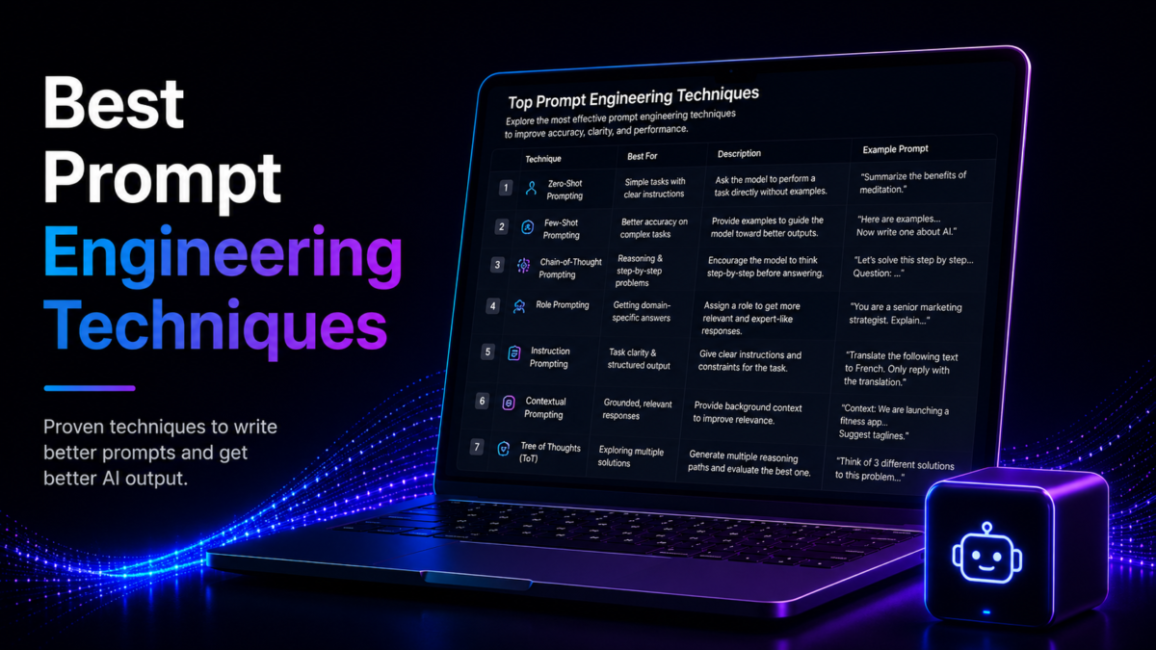
| Quick answer: The best prompt engineering techniques in 2026 are specificity, role and context framing, few-shot examples, structured output formats, task decomposition, and iteration. Explicit chain-of-thought matters less now that reasoning models think internally. No technique eliminates hallucination, so verify anything consequential before you act on it. |

Table of Contents
What is prompt engineering?
Prompt engineering is the practice of designing the input you send to a large language model so that it reliably produces the output you intended. That is the whole discipline in one sentence, and it is closer to briefing a competent freelancer than to casting a spell.
The field is larger than most people assume. The Prompt Report, a systematic academic survey of prompting literature, catalogues 58 distinct text-only prompting techniques and 33 vocabulary terms used to describe them. Almost nobody needs 58. Six cover the overwhelming majority of everyday work.
Techniques matter because the model has no access to your intent – it sees tokens. Everything you leave out, it guesses, and its guess defaults to the blandest option available. Understanding how a large language model processes your input makes that failure mode obvious, and our explainer on what prompt engineering is covers the foundations.
What are the best prompt engineering techniques in 2026?
Six techniques do the heavy lifting. They are not mutually exclusive – a strong prompt usually combines four or five at once.
| Technique | What it does | Best used when | Cost |
| Specificity | Removes ambiguity from the request | Every prompt, without exception | None |
| Role and context | Sets perspective and supplies background | Expert tone, document-grounded work | Context tokens |
| Few-shot examples | Shows the pattern instead of describing it | Format, tone and style control | Context tokens |
| Structured output | Fixes the shape of the response | Parseable or reusable results | None |
| Decomposition | Splits a job into ordered sub-prompts | Long or multi-stage deliverables | Your attention |
| Iteration | Closes the gap between ask and output | Any prompt you will reuse | Time |
The ordering is by frequency of use, not sophistication. Specificity is unglamorous and it also fixes the most broken prompts. Every technique carries a cost worth weighing against the task.
Structured output — fix the shape, not just the content
Name the format before the model picks one. Asking for “three bullet points, each under 20 words” or “a JSON object with keys risk, likelihood, mitigation” removes an entire class of rework, because you stop editing the shape and only judge the substance. It costs nothing in tokens and it is the technique most often skipped.
Decomposition — split the job into ordered steps
One prompt that asks for research, analysis and a written deliverable will do all three shallowly. Splitting them — gather, then assess, then write, each taking the previous output as input — produces better work at every stage and gives you a checkpoint where errors are still cheap to catch. The cost is your attention, which is why it earns its place only on longer jobs.
The six techniques in a single prompt
Most advice stops at describing techniques. Here is what the difference actually looks like. A prompt that will disappoint you:
Write a blog post about our new pricing.And the same request with the techniques applied:
You are a B2B product marketer writing for existing customers.

Task: draft an announcement post about our pricing change.

Context:
- Old: $49 per seat, flat. New: $29 base + $12 per active seat.
- Teams under 20 seats pay less; teams over 40 pay more.
- Effective 1 March. Existing contracts keep old pricing until renewal.

Produce, in this order:
1. A 40-word summary a customer can forward to their manager.
2. The three most likely objections, each with a two-sentence reply.
3. A table of team size (5, 20, 50) against old cost and new cost.

Constraints: no marketing superlatives. If a number is not in the
context above, write [CHECK] rather than estimating it.
That single prompt applies five of the six techniques: role in the first line, context in the block that supplies the actual numbers, decomposition in the ordered deliverables, structured output in the specified formats, and specificity throughout. The last line is the one people leave out and shouldn’t — instructing the model to flag gaps rather than fill them is the cheapest hallucination control available, because it converts a confident invention into a visible [CHECK].

How do you write a prompt that lands first try?
Specificity is mostly a matter of naming five things: the task, the audience, the length, the tone, and anything that must appear. “Write something about marketing” produces filler. “Write a 200-word product description for a stainless-steel water bottle, aimed at weekend hikers, in a plain and concrete tone, mentioning the lifetime warranty” produces a draft you can edit.
Role prompting – opening with “you are an experienced financial analyst” – aligns vocabulary, depth and default assumptions with the task. It is cheap and it still works, though the gain is smaller than it was three years ago.
Context is the part people skip and then blame the model for. Paste the source document, the previous draft, the error log. A model reasoning over material you supplied is categorically more reliable than one reasoning from memory.
Constraints finish the job. Telling the model what to avoid removes the generic register that unguided output drifts toward. Both major providers make the same point: Anthropic’s prompt engineering documentation and OpenAI’s prompt engineering guide both lead with clarity, structure and examples rather than tricks.
When do examples beat written instructions?
Few-shot prompting means including two to five examples of the input and the output you want, so the model matches a pattern instead of interpreting a description. For anything with a recognisable shape – a summary format, a tone, an extraction schema, a label set – examples outperform paragraphs of instruction.
Research on in-context learning explains why. In a widely cited study, randomly replacing the labels in the demonstrations barely hurt performance across twelve different models; what mattered was the label space, the distribution of the input text, and the format of the sequence. The practical reading: cover the range of cases and get the shape right rather than agonising over each example.
Structured output belongs to the same family. Requesting JSON against a named schema, a three-column table, or fixed section headings makes results consistent and machine-readable. Current APIs go further and enforce a schema during decoding. If your output feeds another system, specify the format: it turns a formatting problem into a validation problem.
Does chain-of-thought still work on reasoning models?
Chain-of-thought prompting asks the model to work through a problem step by step before answering. On standard models it measurably improves accuracy on maths, logic and multi-step analysis.
The 2026 caveat is that frontier reasoning models already do this internally, and the API now gives you a dial instead of a phrase. Claude Opus 5.5, at $4 per million input tokens and $20 per million output tokens, exposes adaptive thinking plus a graded effort setting. Rival frontier models expose equivalent reasoning-effort controls. Where a dial exists, use the dial – it is more predictable than phrasing and keeps your instructions uncluttered. Our roundup of the best AI models available today covers which ones expose these controls.

Explicit chain-of-thought still earns its place in three situations: you are on a smaller model with no reasoning mode, you need the reasoning visible for review, or you want a specific procedure followed rather than one the model chooses. Otherwise a disciplined middle ground works best – ask for internal reasoning, then a concise answer in a fixed format.
How do you fix a prompt that keeps missing?
Strong prompts are built, not written. The loop is draft, test, diagnose, refine – and diagnosis is the step people skip. When output misses, name the gap precisely: wrong length, wrong audience, invented facts, missing section, wrong register. Each has a different fix, and “write a longer prompt” is almost never it.
Task decomposition handles jobs a single prompt cannot. Instead of requesting a full research report in one shot, run outline, then section drafts, then a consistency pass. Errors surface at the stage that caused them instead of compounding invisibly.
Meta-prompting is cheap and effective: ask the model to critique its own draft against your criteria, then revise. Then keep whatever worked. A personal library of proven, parameterised prompts compounds faster than any individual trick.
What does this look like in real work?
Lotte Verbeek runs content for a mid-sized outdoor gear retailer. Her task in June 2026 was to rewrite 340 product pages that all read like the same manufacturer boilerplate.
Her first attempt – “rewrite this product description to be more engaging” – returned 340 variations of the same enthusiastic mush. The rebuild used four techniques at once. Role and context: a system prompt describing the brand voice, the customer profile, and three things the brand never says. Few-shot: five hand-written descriptions covering a tent, a stove, a jacket, a boot and an accessory, so the model saw the full range. Structured output: a fixed schema of headline, 90-word body, three spec bullets and one warranty line. Decomposition: a separate second pass checking every claim against the spec sheet.
The outcome after two weeks was 340 rewritten pages, roughly 60 needing meaningful human edits rather than all of them, and 11 fabricated product claims caught before publication. That last number is the important one. The prompt did not stop the model inventing details; the verification pass did.
This example is a composite of the prompting workflows we see most often, not a single client account; the figures are typical rather than measured from one engagement.
What can prompt engineering not fix?
Prompting improves quality and reduces error rates. It does not eliminate hallucination. Models still invent statistics, citations and specifications with complete confidence, so verification has to be a step in your workflow rather than an afterthought.
Techniques are also perishable. Guidance written for 2023 models is actively misleading now, so re-test whenever you switch models. And the stakes set the ceiling: for legal, medical or financial work, treat output as a draft for a qualified human. Getting real value from generative AI tools means pairing good prompts with a review process you actually run.
Frequently Asked Questions
What are the best prompt engineering techniques for beginners?
Start with three. State the task, audience, length and tone explicitly. Give the model the source material it needs instead of relying on its memory. Specify the output format you want. Those three fix most failing prompts before any advanced technique is needed.
Is prompt engineering still a useful skill in 2026?
Yes, though it has shifted. Modern models need fewer tricks and follow instructions closely, so the skill is now clear specification rather than magic phrasing. Well-specified prompts still produce noticeably better output than vague ones on every model currently available.
How many examples should a few-shot prompt include?
Two to five is the usual range. Prioritise covering the variety of cases you expect over polishing any single example, because research shows the format and input distribution of demonstrations matter more than perfectly correct labels. Add more only when outputs stay inconsistent.
Should I still write “think step by step” in my prompts?
Only on models without a built-in reasoning mode, or when you need the reasoning visible for review. Frontier models in 2026 reason internally and expose effort controls in the API, which are more predictable than prompt phrasing and keep your instructions uncluttered.
What is the difference between zero-shot and few-shot prompting?
Zero-shot gives the model a task with no examples and relies on its training. Few-shot includes a small set of input-output pairs. Zero-shot is faster and adequate for simple requests, while few-shot gives far tighter control over format, tone and structure.
Can better prompts stop an AI from making things up?
No. Prompting reduces error rates and can push a model to cite sources or flag uncertainty, but it cannot eliminate hallucination. Any output containing facts, figures, quotations or citations needs checking against a primary source before you publish or act on it.
Do prompts transfer between different AI models?
The structure transfers; the tuning does not. Specificity, supplied context, ordered deliverables and a named output format work on every model, which is why those techniques are worth learning rather than memorising provider tricks. What breaks on transfer is the fine detail — how verbose a model is by default, how literally it follows formatting, how it handles an instruction to refuse. Reasoning models in particular ignore or actively suffer from step-by-step scaffolding that helps older models. Expect to re-test rather than re-write: move the prompt across, run your real inputs through it, and adjust tone and format instructions. If a prompt only works on one model, it was probably relying on that model’s habits rather than being well specified.
Conclusion
Six techniques carry almost all the weight: specificity, role and context, few-shot examples, structured output, decomposition, and iteration. Learn those properly and you will get more out of any model than most people ever do.
The meta-lesson is that prompting is specification, not incantation. Every technique here is a different way of removing ambiguity – telling the model what you want, showing it, or breaking the job into pieces small enough that ambiguity cannot hide. Keep a library of the prompts that worked, re-test when you change models, and never skip verification.
