

How we compare: we test each tool on live research tasks and rate the output against the original sources, not the marketing. Pricing is checked against each vendor’s official page. Some links may be affiliate links; they never change our recommendations.
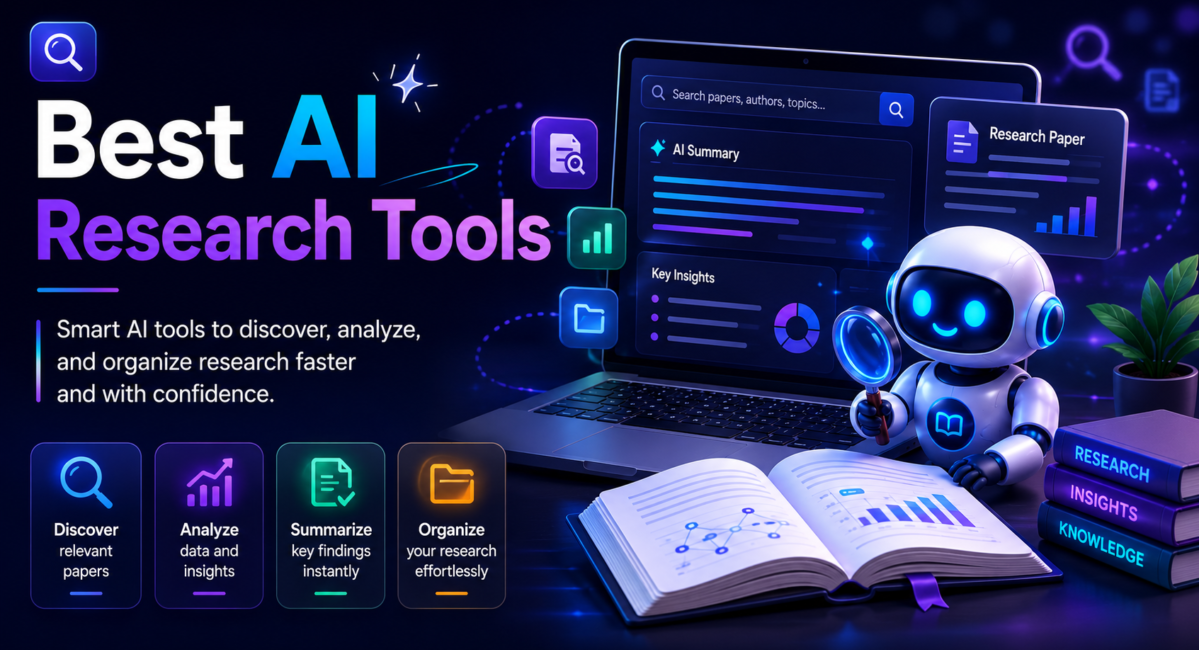
The best AI research tools split into four jobs. Use Perplexity for fast discovery, Deep Research agents (ChatGPT, Gemini, Claude) for long cited reports, Elicit and Consensus for peer-reviewed literature, and Scite for citation context. Most cost $10–20/month with strong free tiers — but always read the source before you cite it.

An AI research tool finds, reads and synthesizes sources for you — collapsing hours of manual literature mining into minutes of cited, structured output you still have to verify.
| Quick answer: Match the tool to the research phase rather than looking for one winner. Perplexity for fast multi-source discovery, Elicit for extracting data across many papers in a literature review, Consensus for evidence-weighted answers to specific questions, Semantic Scholar and Scite free for discovery and citation-context checking, and a Deep Research agent when you need a long cited report. Verify every citation against the original source before you use it — all of these can present a confident finding they never read. |
Table of Contents
Why do AI research tools matter?
AI research tools compress a slow process: they surface relevant material, extract key findings and synthesize across studies and the open web, saving a heavy user 10+ hours a week and freeing that time for analysis. But the category has fragmented — a fast web-search engine, a systematic literature-review platform and a long-horizon research agent solve genuinely different problems, so the tools are not interchangeable. They don’t make you a better thinker; they make you a faster gatherer, which rewards people who already know how to evaluate evidence. This guide sits inside our pillar on the best AI tools for business and anchors our guides to AI tools for academic research and AI medical research tools.
What are the four categories of AI research tools?
Understanding the categories is how you avoid buying the wrong tool.
- Deep research agents run multi-step investigations and produce a long-form, source-cited report from a single prompt (ChatGPT Deep Research, Gemini Deep Research, Claude’s research mode, Perplexity Deep Research).
- AI search engines deliver fast, real-time, multi-source discovery with inline citations — ideal for getting oriented quickly. Perplexity leads here.
- Academic literature tools search the peer-reviewed record — hundreds of millions of papers, preprints and trials — for evidence exploration and literature reviews (Elicit, Consensus, Semantic Scholar, SciSpace).
- Citation tools show how papers cite each other — supporting, contrasting or merely mentioning — so you can judge a source’s standing (Scite).
The principle: match the category to the job. A discovery engine won’t run a systematic review, and a literature tool won’t give you real-time web context.

The top AI research tools, reviewed by category
| Tool | Best for | Sources it searches | Free tier | Paid from |
|---|---|---|---|---|
| Perplexity | Fast multi-source discovery | Web + Academic focus mode | Usable | $20/mo Pro |
| Deep Research agents | Long cited reports | Web, multi-step browsing | Limited | $20/mo |
| Elicit | Literature reviews, data extraction across papers | Academic literature | Limited credits | Paid tiers |
| Consensus | Evidence-weighted answers to specific questions | Peer-reviewed literature | Yes | Paid tiers |
| Semantic Scholar | Free paper discovery | Academic corpus | Fully free | — |
| Scite | Citation-context checking | Citation statements | Limited | Paid tiers |
Read that as a routing table, not a leaderboard. The strongest workflow chains several: discover with Perplexity or Semantic Scholar, extract across papers with Elicit, check whether a finding is supported or disputed with Scite, then write. Pricing shifts often — verify on each vendor’s page before committing.
The leaders by category, what each does well, and 2026 pricing:
Perplexity — best for fast discovery
Perplexity is the standard for fast, multi-source discovery: conversational and quick, with an “Academic” focus mode, inline citations and an increasingly autonomous Deep Research mode. The free tier is usable; Pro is $20/month and includes 20 Deep Research queries a day plus frontier models. Its caveat: drawing from the open web, it can surface a blog post next to a peer-reviewed paper, so filter carefully.
Deep Research agents — best for long cited reports
ChatGPT Deep Research (ChatGPT Plus, $20/month) is the most comprehensive, pulling from 50–200 sources with multimodal analysis of text, images and PDFs. Gemini Deep Research (about $20/month) runs faster — often under 15 minutes across 30–150 sources — with Google’s freshness advantage and native Workspace and Docs export. Claude’s research mode rounds out the field.
Elicit — best for literature reviews
Elicit is the top choice for systematic literature reviews thanks to evidence-extraction tables and concept-based search that save hours per review. The free Basic plan includes 5,000 credits; Plus is $10/month; Pro at $49/month unlocks the Research Agents and systematic-review workflows that are Elicit’s real strength.
Consensus — best for evidence-based answers
Consensus answers specific scientific questions strictly from 200M+ research papers, with a “Consensus Meter” showing the degree of scientific agreement — ideal for validating a claim. The free tier gives 20 AI searches a month; Premium is $8.99/month, and a Pro tier near $15/month adds Deep Searches.
Semantic Scholar and Scite — best free discovery and citation checking
Semantic Scholar, from the Allen Institute for AI, is the strongest free discovery tool — a Google Scholar alternative indexing 214M+ papers with TLDR summaries and a completely free API. Scite is the citation specialist: its Smart Citations classify each citing statement as supporting, contrasting or mentioning, so you can gauge a paper’s standing (Individual plan $20/month).

A real-world use case: tool-chaining in practice
Maya, a first-year PhD student in public health, has three weeks to draft the background of a systematic review on sleep deprivation and workplace safety. On day one she opens Perplexity in Academic focus mode to map the landscape — the sub-topics, the recurring researchers, where the debate sits — using it to orient herself, not to cite. Then she moves to Elicit, enters her research question, and lets its evidence-extraction tables pull sample sizes, study designs and key findings from roughly forty candidate papers into one sortable screen. When a claim looks pivotal, she checks it in Consensus to see whether the evidence agrees, then runs the anchor papers through Scite to confirm they are cited supportively rather than contradicted. Finally, before any reference lands in her draft, she reads each original PDF herself. What used to be two weeks of database trawling becomes a few focused afternoons — and because a human verified every citation, her supervisor can trust the draft.
Which AI research tool should you use for which job?
The right tool depends on the task. For quick orientation, start with Perplexity. For a long-horizon, source-cited report, use a Deep Research agent. For a systematic literature review, Elicit is the strongest dedicated workflow. For an evidence-based answer to a specific scientific question, Consensus is purpose-built. For free discovery, Semantic Scholar leads; for citation context, Scite is the specialist.
Think about output format too. If you need a written deliverable to hand to someone, a Deep Research agent that produces a structured document is the right start. If you need raw inputs to process yourself — extracted data, candidate papers, a citation map — a specialist academic tool serves better. The most effective researchers chain tools: start broad in Perplexity, validate with Consensus, extract with Elicit, confirm citation standing with Scite. That workflow connects directly to using AI for data analysis.
How much do AI research tools cost, and are the free tiers any good?
Most use a freemium model — limited free queries, subscriptions for heavier use. The standard paid price in 2026 is around $20/month for the versatile tools (Perplexity Pro, ChatGPT Plus, Gemini), while academic tools are cheaper — Elicit Plus at $10/month, Consensus Premium near $9/month — with Elicit Pro (~$49) for serious review volume.
The free tiers are strong, especially for academic work: Semantic Scholar is fully free with 214M+ papers, and Elicit, Consensus and SciSpace all offer generous allowances. Start free, and subscribe only once you research often enough that a paid tier pays for itself. A sensible starter combination is Perplexity’s free tier for discovery plus a free academic tool like Semantic Scholar or Consensus for validation.
What are the limits and best practices?
The biggest danger is misplaced trust. AI tools will confidently summarize papers they have not actually read, generating plausible but fabricated findings, and they miss nuance and caveats. The non-negotiable rule: always read the original source for anything you will cite. An AI summary is a starting point, never the citation itself.
Three habits protect your work. Don’t treat AI search as exhaustive — supplement with Google Scholar, PubMed and manual citation-chaining. Check source quality: verify venue, peer-review status and author credentials. And for paywalled papers or preprints, upload the PDF and have the tool extract findings rather than guessing from an abstract. Used as a fast first pass a human verifies, these tools are transformative; used as an unchecked oracle, they manufacture confident errors — which is exactly why the same discipline runs through our guide to AI medical research tools, where the stakes are highest.
Frequently Asked Questions
What are the best AI research tools?
The leaders by category are Perplexity for fast discovery, ChatGPT and Gemini Deep Research for long cited reports, Elicit for literature reviews, Consensus for evidence-based scientific answers, Semantic Scholar for free discovery, and Scite for citation context. There is no single best — the right tool depends on the job.
Is Perplexity or Consensus better for research?
It depends on your goal. Use Perplexity for broad discovery, real-time web information and getting oriented quickly. Use Consensus for strict, peer-reviewed answers — it searches 200M+ papers and shows a Consensus Meter of agreement. Perplexity is faster and more versatile; Consensus is more rigorous. Many researchers use both.
What is the best AI tool for literature review?
Elicit is the top choice, thanks to evidence-extraction tables and concept-based search that synthesize data across many papers and save hours per review. Its Pro tier unlocks systematic-review workflows for screening and extraction. Consensus and Semantic Scholar complement it for evidence answers and free discovery respectively.
Are AI research tools free?
Most use a freemium model with limited free queries, and the academic free tiers are strong. Semantic Scholar is fully free, and Elicit, Consensus and SciSpace offer generous allowances. Perplexity has a free tier without Deep Research. Heavy-use paid plans run about $10-20/month and often pay for themselves quickly.
Can I trust AI research summaries?
Not blindly. AI tools can confidently summarize papers they have not fully read, producing plausible but fabricated findings, and they miss nuance. Always read the original source for anything you cite, check venue, peer review and author credentials, and supplement with Google Scholar and PubMed, since AI search is not exhaustive.
What is a deep research agent?
A deep research agent runs multi-step research — searching, reading and synthesizing dozens of sources — and produces a long-form, source-cited report from a single prompt. ChatGPT Deep Research, Gemini Deep Research and Claude’s research mode are the leaders, ideal for market scans or literature-backed briefs, typically around $20/month.
What are the best Elicit alternatives for researchers?
It depends which part of Elicit you are replacing. For data extraction across many papers — Elicit’s core strength — the closest substitutes are Consensus for evidence-weighted synthesis and, for structured screening at scale, dedicated systematic-review tooling rather than a general assistant. For discovery, Semantic Scholar covers the same corpus free and is often faster for known-item searching. For checking whether a claim holds up, Scite shows citation context — supporting, mentioning or disputing — which Elicit does not. Most researchers who move away from Elicit do so on cost or credit limits rather than capability, and end up chaining two free tools instead of one paid one.
Conclusion
AI research tools have turned days of literature mining into hours — but only with judgment. Think in four categories, match the tool to the job, chain them for the strongest workflow, start on free tiers, and always read and verify the original source before citing, because AI will confidently invent findings it never read. Speed plus skepticism is what turns AI research from impressive into trustworthy. To go deeper, see our pillar on the best AI tools for business and our guide to AI tools for academic research.
Related: legal and IP teams should see our AI patent research tools comparison.

6 Comments
Pingback: Best AI Tools for Business to Scale Without Extra Staff
Pingback: Best AI Patent Research Tools 2026: Top 8 for IP Teams
Pingback: Best AI Medical Research Tools for Faster Discoveries
Très bon article ! J’utilise Claude Fable 5 sur pour ce type de besoin. Claude Fable 5
Pingback: Best AI Tools for Academic Research That Save Time
Pingback: AI Patent Drafting Tools Comparison to Pick the Best