


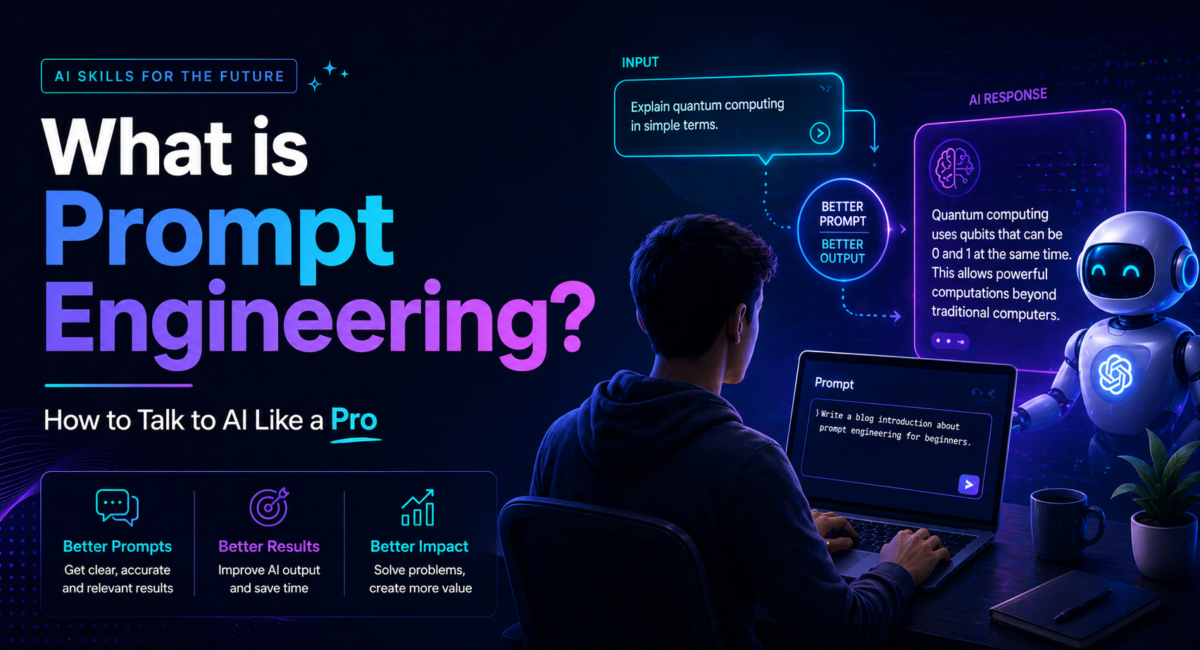
Ask an AI model to “write something about cybersecurity” and you get filler. Ask it for “a 900-word briefing for a non-technical clinic manager covering the five attacks that actually hit small healthcare practices, with one concrete fix for each,” and you get something you could forward without editing. Same model, same second of compute, wildly different value. That gap is the subject of this guide.
What has changed is why the gap exists. Closing it used to mean coaching the model through its own thinking. In 2026 the frontier models already reason before they answer, so the job has shifted from scripting reasoning to supplying the right raw material — and a fair amount of advice written two years ago now actively hurts.

| Quick answer: Prompt engineering is the practice of designing, testing and refining the instructions you give an AI model so it reliably produces the output you want. The durable ingredients are clarity, relevant context, worked examples and an explicit output format. On 2026 reasoning models, the emphasis has moved from scripting the model’s reasoning to supplying the right information. |
Table of Contents
What is prompt engineering, and what is it not?
Prompt engineering is the discipline of designing the input to a generative model — then testing that input, judging what comes back, and revising — so the output is good repeatedly rather than once by luck. The word “engineering” is doing real work there. Anyone can write a prompt. Engineering it means having a way to know whether version three beats version two.
Structurally, serious prompts have three layers: a system prompt setting role, constraints and standing rules; the user turn carrying the actual request; and supporting material — examples, retrieved documents, schemas, prior conversation. Chat interfaces hide the first and third layers, which is why prompting feels like a writing skill to most people and an information-architecture problem to anyone shipping a product.
It also helps to name what prompt engineering is not. It is not a list of magic phrases; incantations that once moved the needle, like appending “you are a world-class expert,” mostly wash out on current models. And it is no substitute for verification — a beautifully engineered prompt can still return a confident, well-formatted answer that is wrong.
Why does rewording a prompt change the answer?
Because a language model does not retrieve an answer; it continues a text. Everything in the context window — instructions, examples, pasted documents, the model’s own earlier turns — is the condition on which the next token is predicted. Change the condition and you change the distribution the answer is drawn from. Our explainer on what an LLM actually is covers those mechanics.
Two consequences follow. First, ambiguity is not neutral. Leave audience, length or format unstated and the model fills the blanks with whatever was most common in training, which is why unspecified prompts drift toward generic, mid-length, listicle-shaped prose. Naming the audience and format is not politeness; it removes degrees of freedom.
Second, everything in the window competes. Restating one rule three times does not triple its weight; it adds noise the model has to reconcile. That is the logic behind Anthropic’s own advice to start simple and add structure only when a test shows it helps.
Which techniques actually earn their keep?
The literature is enormous — The Prompt Report, a systematic survey from a 30-author team, catalogues 58 distinct text-prompting techniques. In daily use, a handful carry nearly all the weight.

| Technique | Best use |
| Zero-shot | Familiar, low-stakes tasks where the model already knows the shape of a good answer |
| Few-shot examples | Tone, formatting or edge cases that are hard to describe but easy to demonstrate |
| Chain-of-thought | Multi-step logic on non-reasoning models; largely redundant on extended-thinking models |
| Role and audience framing | Open-ended or stylistic work where voice and depth need pinning down |
| Explicit output format | Anything parsed by code, dropped into a template, or compared across runs |
| Prompt chaining | Long jobs that fail as one request — research, then outline, then draft, then check |
How we compare: we rank techniques by how reliably they change output on current frontier models, not by how often they trend in prompt-tip threads. A technique earns a place here only if the improvement survives rerunning the same prompt several times in fresh sessions, because single-run wins are usually sampling noise.
Chain-of-thought, in historical context
Chain-of-thought deserves its historical credit. The 2022 paper that introduced it showed eight-shot chain-of-thought prompting, paired with a calculator, lifting PaLM 540B to 58% on the GSM8K maths benchmark against a prior state of the art of 55% — the result that reframed prompting as a capability lever rather than a cosmetic one. It is also why the technique is now baked into the models themselves. For a deeper drill into each method, see our companion guide to the best prompt engineering techniques.
What are the current prompt engineering best practices?
Direct answer: the 2026 rules are shorter than the 2023 ones. Say precisely what you want and in what format, give examples only where format is hard to describe, put instructions before context, and stop adding reasoning scaffolding to models that reason natively. Prompts fail in production for being vague, not short.
The practices that still hold
Specify the output, not just the task. “Summarise this” lets the model choose length, structure and register; “summarise in three bullets, each under 20 words, no adjectives” removes the guesswork. Format specification is the highest-return habit and the one most people skip.
Put instructions before context in long prompts. When a prompt carries a large document, instructions placed after it compete with everything above. Leading with the task, then the material, is more reliable — which is why production templates are ordered that way.
Delimit sections explicitly. XML tags or markdown headings separating instructions, context and examples stop the model confusing your directions with your data — the cheapest defence against a document that happens to contain instruction-like text.
Show, don’t describe, when format is complex. Two or three worked examples convey a structure faster than a paragraph explaining it — but strong models need fewer, and too many anchor output to their specifics.
What changed for 2026
| Old practice | Why it changed | Do this instead |
|---|---|---|
| “Think step by step” on every prompt | Reasoning models already reason internally; the instruction is redundant and can disrupt their process | Omit it for reasoning models; keep it for smaller non-reasoning ones |
| Long few-shot blocks of 5-10 examples | Stronger instruction-following means fewer examples are needed, and long blocks anchor style too tightly | Start with zero-shot, add 2-3 examples only if the format drifts |
| Elaborate persona preambles | Rarely changes output quality on current models; consumes context | State the audience and constraints instead of inventing a character |
| Prompt-only iteration on vibes | Untestable prompts regress silently when models update | Keep a fixed set of test inputs and re-run them after every change |
Parameters are part of the prompt
Temperature controls how much randomness enters token selection, and it is routinely left at default when it should not be. Run it low for extraction, classification and anything you will parse — you want identical input to give identical output. Raise it for ideation and naming, where the default returns the most predictable answer rather than the most useful one. If a prompt works sometimes and fails otherwise on the same input, check temperature before rewording.
How have reasoning models changed the rules?

This is where most guides have not caught up. Frontier models shipping through 2026 — Claude Opus 5, released on 24 July 2026, and its peers across the field — run an internal reasoning pass before responding. Telling such a model to “think step by step” is at best redundant and at worst an interruption, because you are hand-scripting a process the lab has already tuned.
The direction of travel is subtraction. Rewriting its guidance for Claude 5-generation models, Anthropic reported removing over 80% of Claude Code’s system prompt with no measurable loss on coding evaluations. Most of what came out were guardrails written for weaker models — rigid absolutes like “never write multi-paragraph docstrings” — replaced by one judgement call: match the surrounding code.
The same post makes a genuinely counterintuitive point about examples. Newer models tend to constrain themselves to the samples you show, treating three examples as the boundary of the space rather than an illustration of it. Few-shot prompting still works beautifully for locking a format, but when you want range, a clear description of the goal now often beats a sample set. Conventions differ by model, too, as our roundup of the best AI models lays out.
What does this look like on a real team?
Consider Perpetua Lang, who runs a four-person customer-operations team at a logistics software company. Her problem is not writing; it is triage. Roughly 400 support tickets a week each need a category, a severity and a suggested first reply, and the queue was eating a working day per person.
Her first attempt was the classic mistake: one enormous prompt, about 1,200 words, stacking a persona, twelve rules, a tone guide and a list of things never to say. It performed well on the tickets she had tested with and fell apart on everything else, largely because several rules quietly contradicted each other.
The rebuild was mostly deletion. She cut the persona, kept the six rules a colleague could actually adjudicate, and pasted the current refund policy into the prompt instead of describing it. She specified output as a strict JSON object so results dropped straight into the helpdesk. Then came the step that made it engineering rather than guessing: she assembled 40 previously resolved tickets with known-correct labels and reran the prompt against that set after every edit.
That last habit separates a prompt that feels better from one that measurably is. Perpetua Lang is a composite of setups we see repeatedly, but the arc is real — the win came from a shorter prompt, better inputs, and a way to score it.
Where does prompting end and context engineering begin?
The phrase you will hear now is context engineering: designing the whole information environment a model sees — which documents get retrieved, which tools it can call, what it remembers between sessions, and the order it all arrives in. It is less a replacement for prompt engineering than the same instinct at larger scale, and current guidance leans on progressive disclosure: load context when it is needed rather than front-loading everything.
For most people typing into a chat box, classic prompting is still the entire game. For anyone building on top of a model — agents, retrieval pipelines, anything in our pillar guide to generative AI tools — the prompt is one component among several, and often not the one limiting your results.
Frequently Asked Questions
What is prompt engineering in simple terms?
It is writing the instructions you give an AI model carefully enough that it produces what you want reliably rather than occasionally. In practice that means stating the task plainly, supplying the context and source material the model cannot know, showing the format you expect, and revising based on what actually comes back.
Is prompt engineering still a useful skill in 2026?
Yes, though its shape has changed. Frontier models forgive sloppy phrasing far better than they used to, so clever wording matters less. What matters more is supplying accurate context, defining the output precisely, and testing changes against real examples. Those habits transfer to every model and every new release.
Do I still need to say “think step by step”?
Usually not. Reasoning models such as Claude Opus 5 already run an internal reasoning pass before answering, so explicit step-by-step instructions add little and can interfere. The phrase still helps on smaller, faster, non-reasoning models handling multi-step logic, and it costs nothing to test both versions on your own task.
How many examples should a few-shot prompt include?
Three to five is the standard starting point, and stop there unless testing shows more helps. Cover the range of inputs you expect rather than repeating one ideal case. Be aware that current models tend to treat examples as boundaries, so a narrow sample set can quietly limit output variety.
What is the most common prompt engineering mistake?
Vagueness, followed closely by over-specification. Asking a model to “make it better” gives it nothing to act on. Piling twelve overlapping rules into one prompt is the opposite failure and creates contradictions the model resolves arbitrarily. Aim for a handful of unambiguous constraints and one clearly stated task.
Is prompt engineering a real job?
It exists, but rarely as a standalone title now. The work has folded into AI engineering, applied research and product roles, where prompting sits alongside retrieval design, evaluation and tool integration. Employers hire for the ability to make model output measurably reliable, not for prompt wording on its own.
How do you protect prompts against prompt injection?
Assume any text your prompt did not author — user input, retrieved documents, file contents — may carry instructions aimed at your model. The defences that work are structural, not clever wording: delimit untrusted content explicitly, state in the system prompt that anything inside those delimiters is data and never instructions, and validate output against what the task should produce. Critically, never let model output trigger a consequential action — sending an email, running a query, making a payment — without a check that does not itself depend on the model. Prompt engineering reduces injection risk; it does not eliminate it.
What temperature should you use for prompts?
Low, typically 0 to 0.3, for extraction, classification and anything needing reproducibility. Higher, around 0.7 to 1.0, for brainstorming and naming where you want range rather than the most probable answer. The common mistake is leaving the default on structured tasks, then blaming the prompt when output varies on identical input.
Conclusion
Prompt engineering is structured thinking made explicit. Say what you want, say who it is for, hand over the material the model cannot know, define the shape of the answer, then check whether your change actually improved anything. Those five moves have survived every model generation so far.
What genuinely changed in 2026 is the direction of effort. The old instinct was to add — more rules, more scaffolding, more coaxing of the model’s reasoning. The current instinct is to remove: fewer contradictions, less redundant instruction, better inputs. A lab deleting most of its own system prompt without losing performance is a fair summary of where the craft has landed. Then verify the output: prompting improves your odds of a correct answer, it does not guarantee one.
Disclosure: TechieHub publishes independently. No vendor paid for or reviewed this guide before publication, and we have no commercial relationship with the AI labs cited here. Some links elsewhere on the site may earn us a commission.
When prompting alone stops being enough, our fine-tuning vs RAG comparison covers the next two steps and the order to try them in.

9 Comments
Pingback: What Are AI Hallucinations? Complete Guide 2026 | TechieHub
Pingback: Best AI Models 2026: GPT-5.5 vs Claude vs Gemini vs DeepSeek
Pingback: Using AI for Data Analysis – A Practical Step-by-Step
Pingback: Fine-Tuning vs RAG: Which AI Approach Wins in 2026?
Pingback: Generative AI for Content Creation That Saves Hours
Pingback: Best AI Tools Like ChatGPT You Need to Try Now
Pingback: Data Analyst AI – Smarter Decisions Without the Guesswork
Pingback: How Does Generative AI Work – Simply Explained
Pingback: Claude AI – What It Is, Features & How It Works