

| Quick answer |
|---|
| The best AI visibility tools for enterprise in 2026 are Profound on its custom Enterprise tier for the widest engine coverage, AthenaHQ from $295 a month rising to a custom tier with SAML SSO and multi-region monitoring, and Ahrefs Brand Radar, listed from $199 with its $699 all-platforms bundle reported, for predictable pricing at volume. |
| How we compare |
|---|
| Ranking is based on the controls enterprise procurement blocks on — SSO, API access, seat count, multi-region reporting and support SLA — plus published list pricing, rather than on engine counts. Prices were checked on vendor pricing pages in September 2026. Every price was re-checked against the vendor’s own pricing page in September 2026, and figures available only from third-party trackers are marked as reported. No vendor paid for placement. We ran no head-to-head lab test; every figure below is public and can be re-checked. |
Table of Contents
Why enterprise buying is different here
Every roundup in this category compares engine coverage, because engine coverage fits in a table. None of it is what stops an enterprise deal. What stops it is single sign-on, an API, seat count, data retention and whether the tool can report per market. For every category side by side, see our full AI tools list.
Look at what that does to the shortlist. AthenaHQ Starter covers a single region — fine for a startup, unusable for a business operating in nine markets. SAML and OIDC SSO sit on the Enterprise tier. Profound’s nine-engine coverage is Enterprise-only. The published tiers in this category are built for small teams, and the enterprise product is almost always a quote.
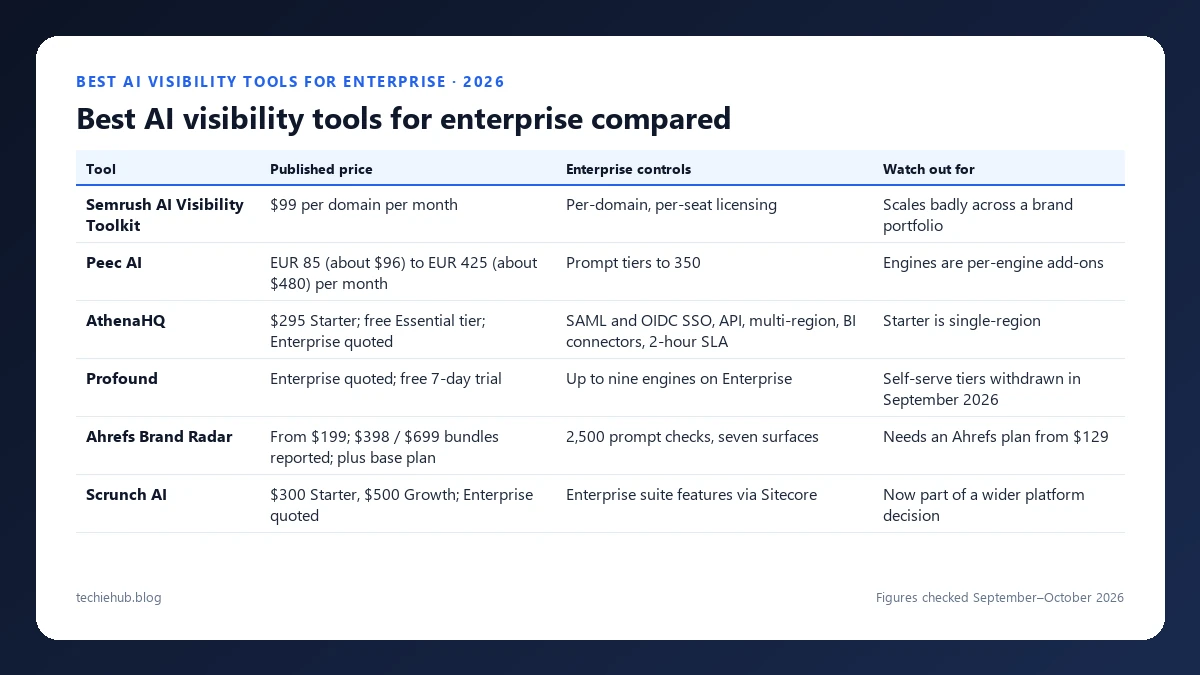
Best AI visibility tools for enterprise compared
| Tool | Published price | Enterprise controls | Watch out for |
|---|---|---|---|
| Semrush AI Visibility Toolkit | $99 per domain per month | Per-domain, per-seat licensing | Scales badly across a brand portfolio |
| Peec AI | EUR 85 (about $96) to EUR 425 (about $480) per month | Prompt tiers to 350 | Engines are per-engine add-ons |
| AthenaHQ | $295 Starter; free Essential tier; Enterprise quoted | SAML and OIDC SSO, API, multi-region, BI connectors, 2-hour SLA | Starter is single-region |
| Profound | Enterprise quoted; free 7-day trial | Up to nine engines on Enterprise | Self-serve tiers withdrawn in September 2026 |
| Ahrefs Brand Radar | From $199; $398 / $699 bundles reported; plus base plan | 2,500 prompt checks, seven surfaces | Needs an Ahrefs plan from $129 |
| Scrunch AI | $300 Starter, $500 Growth; Enterprise quoted | Enterprise suite features via Sitecore | Now part of a wider platform decision |
The portfolio maths that decides most of these deals
Enterprises rarely track one brand in one market, and per-unit licensing is where the cheap option stops being cheap.
Semrush AI Visibility Toolkit is $99 for one domain, 25 prompts and one seat. Each extra domain is another $99, each extra seat $45, and 50 more prompts is $60. Ten brands and five seats is about $1,170 a month before a single prompt top-up — and 25 prompts per brand is a thin prompt set. Against that, Ahrefs Brand Radar’s reported $699 bundle for 2,500 prompt checks looks economical rather than premium.
Do this arithmetic with your own brand count, seat count and prompt set before the first demo. For the wider market of trackers this list narrows down from, see our guide to ranking inside Google AI Overviews, which covers the page-side work these subscriptions only measure.
Cost per tracked prompt at portfolio scale
What decides enterprise deals is not price or engine count but what one tracked prompt costs once the licensing model meets a real portfolio. Each vendor publishes a price and a quantity, so the division is straightforward.
| Plan | Published monthly cost | Prompts that buys | Cost per prompt (our calculation) |
|---|---|---|---|
| Semrush AI Visibility Toolkit, single brand | $99 | 25 | $99 ÷ 25 = $3.96 |
| Semrush, 50-prompt top-up (marginal rate) | $60 | 50 | $60 ÷ 50 = $1.20 |
| Semrush, 10 brands and 5 seats | (10 × $99) + (4 × $45) = $1,170 | 250 (25 per brand) | $1,170 ÷ 250 = $4.68 |
| Ahrefs Brand Radar Select + base plan (reported) | $398 + $129 = $527 | 2,500 prompt checks | $527 ÷ 2,500 = $0.21 |
| Ahrefs Brand Radar All Platforms + base plan (reported) | $699 + $129 = $828 | 2,500 custom checks plus an unmetered organic pool | $828 ÷ 2,500 = $0.33 (upper bound) |
| Peec AI Starter | EUR 85 (about $96) | 50 | EUR 85 (about $96) ÷ 50 = EUR 1.70 |
| Peec AI Advanced | EUR 425 (about $480) | 350 | EUR 425 (about $480) ÷ 350 = EUR 1.21 |
| AthenaHQ Starter | $295 | 3,600 credits, ratio to prompts not published | Not derivable |
| Profound | Custom quote | Custom | Not derivable |
The spread is the finding. At ten brands and five seats, Semrush costs about 22 times more per tracked prompt than Ahrefs Brand Radar ($4.68 ÷ $0.21 = 22.3), and per-brand licensing makes that worse as the portfolio grows. Semrush’s own marginal rate makes the point internally: a topped-up prompt is $1.20 against $3.96 bundled, so the subscription is priced against the first 25 prompts and nothing else.
Two caveats before quoting this. Ahrefs prices per workspace rather than per brand, which is why the ranking inverts at scale, and the $0.33 All Platforms figure is an upper bound because the organic prompt pool is not metered. Where a vendor publishes credits rather than prompts, we left the row blank rather than invent a conversion rate.
The tools in detail
Profound
Profound published self-serve pricing in June 2026 and withdrew it again in mid-September: the pricing page, read on 11 October 2026, shows a free seven-day trial and a custom Enterprise tier reaching up to nine engines. For an enterprise buyer little changes, because the engine coverage this platform is bought for always sat on the custom tier.
AthenaHQ
AthenaHQ Starter is $295 a month with 3,600 credits, 11 models, unlimited seats and a single region (re-read on 11 October 2026), plus a free Essential tier with 300 credits for testing. Enterprise is a custom quote adding unlimited credits, multi-region monitoring, SAML and OIDC SSO, API access, BI integrations for Tableau, Power BI and Looker, a dedicated specialist and a two-hour support SLA. Credits mean the bill moves with usage.
Scrunch AI
Acquired by Sitecore for about $225 million in June 2026 and now positioned inside a digital experience suite rather than as a standalone tracker. That makes it straightforward if you already run Sitecore and harder to justify if you do not, because you are buying a platform strategy as well as a tracker.
Ahrefs Brand Radar
Ahrefs Brand Radar is listed from $199 a month; trackers report Select Platforms at $398 a month, covering AI Overviews, AI Mode, ChatGPT, Perplexity, Copilot, Gemini and Grok with 2,500 custom prompt checks; All Platforms is $699 and opens the full organic prompt pool. Both require an Ahrefs base plan from $129. Predictable pricing at volume, which procurement teams tend to prefer.
Semrush AI Visibility Toolkit
The Semrush $99 a month add-on covers one domain, 25 prompts and one seat, with each additional domain at another $99, each extra seat at $45, and 50 extra prompts at $60.
Peec AI
Prompt-metered rather than engine-metered, with unlimited seats on every tier; trackers report Starter at EUR 85 (about $96) for 50 prompts, Pro EUR 205 (about $232) for 150 and Advanced EUR 425 (about $480) for 350, with 15 per cent off annually and extra engines at roughly EUR 20 (about $23) to 30 each. Worth a look when the enterprise requirement is prompt breadth rather than SSO and multi-region.
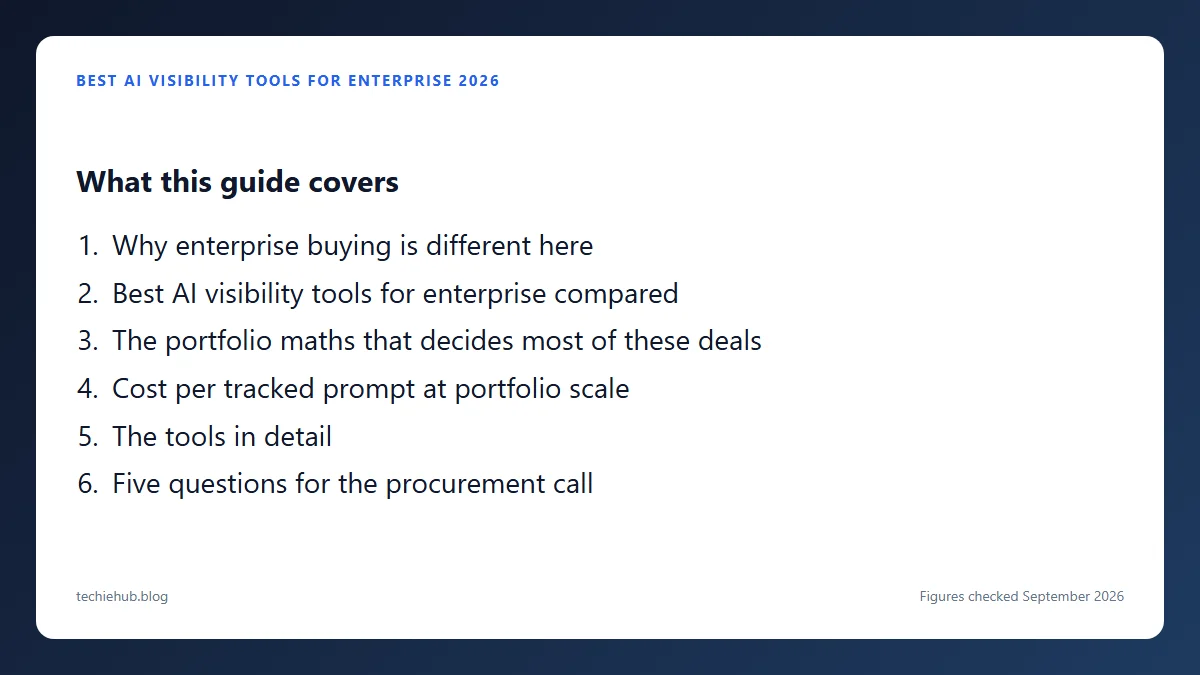
Five questions for the procurement call
- Is SSO on our tier or the one above? In this category it is almost always the one above.
- What is the refresh cadence, in writing? Weekly refresh cannot support a monthly reporting cycle that claims causality.
- How long is raw prompt-level data retained, and can we export it? Vendors rarely publish this and you will want the history if you switch.
- Can we report per country and per brand? A global average hides the market where you have vanished, and if any of those markets are in the EU, the EU AI Act may shape what your vendor is allowed to retain. NIST’s AI Risk Management Framework is the reference most enterprise governance teams map these questions to.
- Do competitors run on our prompt set? If not, the share of voice figure compares two different questions.
On the execution side, our guides to generative engine optimisation and answer engine optimization tools cover the work that moves these numbers, and AI search monitoring tools covers the wider category including options below enterprise scale.
Frequently Asked Questions
What are the best AI visibility tools for enterprise?
Profound Enterprise gives the widest engine coverage, and AthenaHQ Enterprise is the strongest on the controls procurement asks about — SAML SSO, API access, multi-region monitoring and a support SLA. Ahrefs Brand Radar, with a $699 all-platforms bundle reported, is the most predictable at volume, and Scrunch suits organisations already committed to Sitecore.
Do enterprise AI visibility tools help increase visibility, or only measure it?
Mostly they measure. The ones that come closest to acting add recommendations: Semrush ships an AI Search Site Audit alongside its prompt reports, Scrunch flags where your content is missing or misrepresented in AI answers, and AthenaHQ Enterprise includes content workflows. The increase still comes from publishing extractable answers on indexable pages.
How should an enterprise report AI visibility across brands and markets?
Per brand and per market, not as one company number. For each brand, track presence rate across a frozen prompt set, share of voice against a named competitor list, and citation rate — the share of appearances carrying a link. Then segment by country, because AI answers differ by market and a global average hides the one region where you have disappeared.
What should an enterprise AI visibility contract include?
Refresh cadence, data retention and export rights, in writing. A weekly refresh cannot support a monthly board pack that claims to show a campaign’s effect, and prompt-level history is what you lose if you switch vendors without an export clause. Ask where SSO sits too — in this category it is almost always the tier above.
Which AI engines should enterprises track first?
Start with Google AI Overviews, ChatGPT and Google AI Mode, then add Perplexity and Gemini. Beyond that, engine count is mostly a procurement talking point. Note the pricing consequence: Profound’s nine-engine coverage is Enterprise-only and quoted privately, while AthenaHQ Starter lists 11 models at $295. Engine coverage is a tier decision before it is a strategy decision.
Where this sits in a wider stack matters too: our roundups of AI tools for business and AI tools for marketing teams cover the systems that will have to consume this reporting.
What does brand visibility in AI search actually measure?
It measures whether your brand appears in an assistant’s answer to the questions buyers ask, where it appears in that answer, and whether your site is linked. That is different from rank tracking: a page can hold position one organically and still be missing from the AI answer shown above it, which is why these tools work from prompt sets rather than keyword lists. It is the core metric behind the best tools for tracking brand visibility in AI search.
Conclusion
For most enterprises the shortlist comes down to two: AthenaHQ Enterprise when SSO, multi-region reporting and BI connectors are the blockers, and Profound Enterprise when engine breadth is. Ahrefs Brand Radar is the pragmatic third option because its reported $699 bundle covers seven surfaces and 2,500 prompt checks without a quote cycle.
Price your own portfolio first. In enterprise SEO the per-domain and per-seat tools look cheapest on the pricing page and land highest on the invoice, and that reversal is the single most useful thing to know before you take the first call.
