
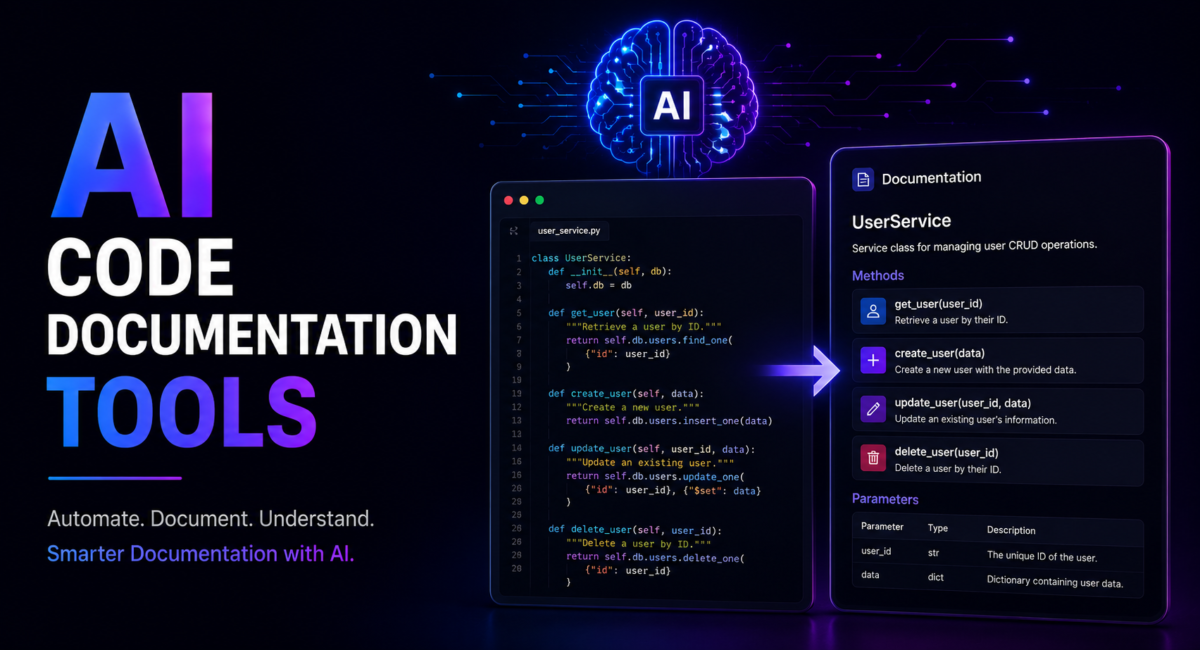
12 Best AI Code Documentation Tools 2026
Automate Your Code Docs – Complete Guide & Reviews
Table of Contents
1. Introduction: Why AI Code Documentation Matters in 2026
Code documentation has long been the most neglected yet most critical aspect of software development. Developers spend an estimated 58% of their time reading and understanding code rather than writing it, according to a 2024 GitHub study. Poorly documented codebases lead to longer onboarding times, increased bugs, and mounting technical debt. Yet writing documentation has always been tedious, time-consuming, and quickly outdated.
Enter AI-powered documentation tools—a new generation of popular AI documentation generators tools like Mintlify, Swimm, and others that automatically generate, update, and maintain code documentation using large language models and codebase-aware AI. These tools analyze your source code, understand context and logic, and produce human-readable explanations, docstrings, API references, and architectural guides without requiring developers to write a single line of documentation manually.
| Market Reality: The AI code documentation market reached $2.1 billion in 2025 and is growing at 42% CAGR. Over 85% of professional developers now use some form of AI assistance for documentation tasks. Tools like Mintlify, Swimm, DocuWriter, and GitHub Copilot have made it possible to generate comprehensive documentation in minutes rather than days. – GitHub Octoverse 2025, Stack Overflow Developer Survey |
The demand for the best ai-powered documentation tools 2025 2026 has exploded as engineering teams face increasing pressure to maintain clean, up-to-date codebases. Whether you need the best ai documentation tools for legacy code that has been neglected for years, or best ai code generation tools that aid with documentation and code explanation for a modern microservices architecture, the tools available today deliver results that were impossible just two years ago.
This comprehensive guide reviews the most popular code documentation tools 2026, helping you find the right solution whether you’re a solo developer, a startup team, or an enterprise engineering organization.
2. AI Code Documentation Market Statistics 2026
Understanding the scale and growth of AI-assisted documentation helps contextualize why these tools have become essential infrastructure for modern development teams.
2.1 Market Size and Growth
- $2.1 billion: Global AI code documentation tools market size in 2025 – MarketsandMarkets
- $8.5 billion: Projected market size by 2030 with 42% CAGR – Grand View Research
- 70%: Percentage of development teams using AI documentation tools in 2025 – GitHub
- 85%: Developers who say AI-generated docs are as good or better than manual docs – Stack Overflow
- 3x: Faster documentation generation compared to manual writing – Mintlify
- 45%: Reduction in onboarding time when AI docs are implemented – Swimm
2.2 Developer Adoption Statistics
- 58%: Time developers spend reading code vs writing it – GitHub
- 92%: Developers who consider good documentation critical for productivity – Stack Overflow
- 41%: Engineering teams with dedicated documentation workflows – JetBrains
- 67%: Organizations that report documentation debt as a major issue – SmartBear
- 10x: Increase in AI-assisted documentation adoption from 2023 to 2025 – Industry analysis
- 73%: Developers who would use more AI doc tools if available in their IDE – JetBrains Survey
2.3 ROI and Productivity Statistics
- 10x: Faster documentation with AI tools versus manual writing – Multiple vendor studies
- 45%: Reduction in new developer onboarding time – Swimm
- 60%: Decrease in documentation-related support tickets – Mintlify
- $1.2 million: Average annual savings per 100-developer organization from AI docs – Forrester
- 35%: Reduction in code review time with AI-generated documentation – GitHub
- 80%: Less time spent on README and API reference creation – DocuWriter
| Strategic Implication: AI code documentation tools aren’t just time-savers—they’re transforming how engineering teams communicate, onboard, and maintain codebases. The documentation debt crisis that has plagued software development for decades is finally being addressed at scale through popular AI documentation generators tools like Mintlify, Swimm, and other intelligent platforms. |
3. What Are AI Code Documentation Tools?
AI code documentation tools use large language models, static code analysis, and codebase-aware AI to automatically generate, update, and maintain technical documentation. They range from inline docstring generators to full-platform solutions that create API references, architecture guides, onboarding tutorials, and knowledge bases directly from your source code. These are the most popular code documentation tools 2026 that modern teams rely on.
3.1 Core Capabilities
Code Analysis & Understanding
- Parse source code to understand functions, classes, modules, and relationships
- Analyze code logic, data flow, and dependencies automatically
- Support for multiple programming languages and frameworks
- Context-aware understanding of design patterns and architectural decisions
Documentation Generation
- Inline docstrings and code comments generation
- API reference documentation from source code
- README and getting-started guide creation
- Architecture and system design documentation
Maintenance & Sync
- Auto-update documentation when code changes
- Detect stale or outdated documentation
- Version-controlled docs that stay in sync with code
- CI/CD integration for documentation pipelines
Collaboration & Knowledge Sharing
- Team knowledge bases and internal wikis
- Code walkthrough and explanation features
- Onboarding documentation for new team members
- Search and discovery across documentation
3.2 Types of AI Documentation Tools
- Inline Generators: Generate docstrings and comments directly in your IDE (e.g., GitHub Copilot, Kodezi)
- Platform Solutions: Full documentation platforms with AI capabilities (e.g., Mintlify, GitBook)
- Code-Coupled Docs: Documentation that lives alongside and syncs with code (e.g., Swimm)
- API Doc Generators: Specialized tools for API reference documentation (e.g., ReadMe, Theneo)
- Legacy Code Analyzers: Tools specifically designed as the best ai documentation tools for legacy code (e.g., Stenography, DocuWriter)
| 💡 Pro Tip: The most effective documentation strategy combines an inline generator for day-to-day coding with a platform solution for maintaining comprehensive project documentation. This dual approach ensures both code-level and project-level documentation stay current. |
4. 12 Best AI Code Documentation Tools 2026 (Complete Reviews)
The following reviews cover the leading popular AI documentation generators tools like Mintlify, Swimm, and other top solutions across IDE-integrated, platform-based, and specialized categories. Each review includes features, AI capabilities, pricing, and ideal use cases. Whether you need the best ai code generation tools that aid with documentation and code explanation or a specialized legacy code analyzer, this guide covers the complete landscape.
4.1 Mintlify – Best AI-Native Documentation Platform
| 🏆 Editor’s Choice: Best for developer-first teams wanting beautiful, auto-generated documentation with AI-native workflows |
Mintlify is the leading AI-native documentation platform trusted by over 5,000 companies including Anthropic, Coinbase, Cursor, Vercel, and Zapier. It combines a docs-as-code workflow with powerful AI capabilities including an Autopilot agent, AI-assisted writing, and reader-facing AI chat. Among popular AI documentation generators tools like Mintlify, Swimm, Mintlify stands out for its polished design and deep GitHub integration.
Key Features
- AI Autopilot Agent: Automatically drafts, edits, and updates documentation tied to GitHub changes
- AI Assistant: Reader-facing conversational AI that answers questions from your docs
- Docs-as-Code: Documentation lives in Git, follows PR workflow, auto-deploys on push
- MDX Support: Markdown with React components for interactive documentation
- API Playground: Auto-generated from OpenAPI specs with live endpoint testing
- LLM Optimization: First platform to implement /llms.txt for AI discoverability
- Analytics: Built-in tracking of page views, search queries, and user behavior
- Web Editor: Visual WYSIWYG editor for non-technical contributors
Ease of Use
- Learning Curve: Low for developers familiar with Git and Markdown
- Setup: Minutes from GitHub connect to live documentation site
- Interface: Clean, modern, beautiful output by default
- Documentation: Excellent self-documentation and guides
Pricing
- Hobby (Free): Single editor, custom domain, web editor
- Pro: $25/month for teams with collaboration and advanced AI
- Enterprise: Custom pricing with SSO, SLAs, dedicated support
- 14-day free trial on all plans
🔗 Mintlify
✅ Pros
• Beautiful documentation output by default
• AI Autopilot keeps docs synced with code changes
• Trusted by Anthropic, Coinbase, Cursor, Vercel
• Reader-facing AI assistant for instant answers
• Deep GitHub integration with PR-based workflow
• LLM optimization for AI discoverability
• API playground with live testing
❌ Cons
• Pro plan pricing may be steep for solo developers
• Heavily GitHub-dependent workflow
• Advanced customization requires MDX knowledge
• Limited language support for non-standard stacks
• Some features locked behind paid plans
4.2 Swimm – Best for Code-Coupled Living Documentation
| Best for: Teams needing documentation that automatically stays in sync with code changes |
Swimm pioneered the concept of “code-coupled documentation”—documents that are directly linked to specific code snippets and automatically flag or update when those snippets change. This makes Swimm one of the best ai-powered documentation tools 2025 2026 for teams that struggle with documentation going stale. As one of the popular AI documentation generators tools like Mintlify, Swimm, it focuses uniquely on keeping docs alive.
Key Features
- Code-Coupled Docs: Documentation linked directly to code snippets that auto-update
- AI Doc Generation: Generate documentation from code using AI with one click
- Smart Tokens: Dynamic references that update when code changes
- IDE Integration: Write and read docs directly in VS Code and JetBrains
- CI/CD Integration: Verify documentation freshness in pull requests
- Auto-sync: Automatically detect and flag stale documentation
- Markdown Editor: Rich editor with code snippet embedding
- Onboarding Playlists: Guided learning paths for new team members
Ease of Use
- Learning Curve: Low to medium—intuitive for developers
- Setup: Quick integration with existing repositories
- Interface: Clean, developer-focused experience
- IDE Integration: Seamless workflow without context switching
Pricing
- Free: Up to 5 users, basic features
- Team: $20/user/month with full features
- Enterprise: Custom pricing with SSO, audit logs, premium support
🔗 Swimm
✅ Pros
• Documentation never goes stale—auto-syncs with code
• Excellent for onboarding new developers
• Deep IDE integration
• CI/CD verification of doc freshness
• AI-powered generation saves hours
• Smart Tokens track code changes
• Guided learning playlists
❌ Cons
• Best suited for internal documentation
• Less focused on public-facing API docs
• Requires team adoption for maximum value
• Pricing per user can add up for large teams
• Smaller ecosystem than Mintlify
4.3 GitHub Copilot – Best IDE-Integrated Documentation Assistant
| Best for: Developers wanting inline documentation generation directly in their code editor |
GitHub Copilot is the most widely adopted AI coding assistant, and its documentation capabilities make it a powerful best ai code generation tool that aids with documentation and code explanation. Beyond code completion, Copilot generates docstrings, explains complex code blocks, and creates inline comments that serve as living documentation.
Key Features
- Inline Docstrings: Auto-generate function and class documentation
- Code Explanation: Explain complex code blocks in plain English
- Comment Generation: Create meaningful inline comments
- PR Summaries: Auto-generate pull request descriptions and summaries
- Chat Interface: Ask questions about your codebase conversationally
- Multi-IDE Support: VS Code, JetBrains, Neovim, Visual Studio
- Multi-Language: Supports virtually every programming language
- Context-Aware: Understands project structure and dependencies
Pricing
- Free: Limited completions for individual developers
- Individual: $10/month with full AI features
- Business: $19/user/month with admin controls and policies
- Enterprise: $39/user/month with IP indemnification, audit logs
✅ Pros
• Most widely adopted AI coding tool
• Seamless IDE integration
• Excellent docstring generation
• Understands codebase context deeply
• Multi-language, multi-IDE support
• Affordable individual pricing
• PR summary automation
❌ Cons
• Documentation is inline only—no standalone doc platform
• No public-facing documentation generation
• Quality depends on code quality
• Can generate inaccurate explanations
• Enterprise pricing adds up quickly
4.4 DocuWriter.ai – Best Automated Documentation from Source Code
| Best for: Generating comprehensive documentation directly from repositories including API docs, tests, and UML diagrams |
DocuWriter.ai is a dedicated AI code documentation platform that generates complete technical documentation from your source code files. It connects to your Git repositories and automatically creates code docs, Swagger-compliant API references, test suites, and UML diagrams. It’s one of the best ai documentation tools for legacy code since it can analyze and document existing codebases without any prior documentation.
Key Features
- Code Documentation: Auto-generate from source code files
- Swagger API Docs: Swagger-compliant JSON documentation from code
- Test Generation: AI-generated test suites for your codebase
- Code Refactoring: AI-powered code cleanup and optimization
- UML Diagrams: Auto-generate architecture diagrams
- MCP Integration: Works with AI coding assistants via MCP
- n8n Integration: Automate documentation workflows
- Team Spaces: Organize and share documentation centrally
Pricing
- Credit-based system: Each generation costs one credit
- Starter plans available for individual developers
- Team and Enterprise plans for organizations
- Free trial available
✅ Pros
• Complete documentation from source code
• Swagger API doc generation
• UML diagram automation
• Test suite generation included
• Excellent for legacy codebases
• MCP and n8n integration
• Team collaboration spaces
❌ Cons
• Credit-based pricing can be unpredictable
• Quality varies by code complexity
• Smaller community than major platforms
• Limited IDE integration
• Best for batch documentation, not real-time
4.5 Kodezi – Best AI Code Assistant with Documentation & Debugging
| Best for: Developers wanting an all-in-one AI assistant that combines code correction, documentation, and explanation |
Kodezi is an AI-powered development toolkit that goes beyond documentation to include code debugging, optimization, and explanation. Think of it as Grammarly for code—it automatically detects bugs, suggests fixes, and generates documentation in real-time. It’s a strong choice among best ai code generation tools that aid with documentation and code explanation, offering a unique combination of code quality and documentation features.
Key Features
- Auto-Debug: Automatically detect and fix code bugs
- Code Documentation: Generate docstrings and comments instantly
- Code Explanation: Explain any code block in plain English
- Code Optimization: Suggest performance improvements
- Multi-Language: Support for 30+ programming languages
- IDE Extension: Available for VS Code and other editors
- Code Translation: Convert code between programming languages
- Team Features: Shared standards and collaboration tools
Pricing
- Free Tier: Basic features with limited usage
- Pro: $19/month for full features
- Team: Custom pricing for organizations
🔗 Kodezi
✅ Pros
• All-in-one: debugging + docs + optimization
• Grammarly-like experience for code
• 30+ language support
• Real-time code explanation
• Code translation between languages
• Affordable pricing
• Easy to use for beginners
❌ Cons
• Less specialized for documentation than dedicated tools
• Smaller user community
• Not designed for large-scale platform docs
• Limited enterprise features
• Code quality suggestions can be subjective
4.6 Stenography – Best for Real-Time Code Explanation
| Best for: Developers who want automatic code explanations generated as they write code |
Stenography generates explanations and documentation as you code, directly in your editor. It’s designed for developers who want zero-friction documentation that happens passively in the background. As one of the best ai-powered documentation tools 2025 2026, Stenography is particularly effective for teams where documentation is constantly neglected.
Key Features
- Auto-Explanation: Generates code explanations in real-time as you code
- IDE Integration: Works directly in your code editor
- Multi-Language: Supports popular programming languages
- Passive Documentation: No manual trigger needed—happens automatically
- Context-Aware: Understands function purpose and logic flow
- Export: Export documentation in various formats
- Git Integration: Track documentation alongside code changes
Pricing
- Free tier available for individual developers
- Pro plans for teams and organizations
- Enterprise: Custom pricing
✅ Pros
• Zero-friction—documentation happens automatically
• Real-time code explanation
• No workflow disruption
• Good for legacy code understanding
• Lightweight and fast
❌ Cons
• Limited to code-level documentation
• No platform-level documentation features
• Smaller community and ecosystem
• Less polished than major competitors
• Limited customization options
4.7 GitBook – Best for Team Knowledge Bases with AI
| Best for: Cross-functional teams needing both internal wikis and public-facing documentation with AI features |
GitBook is a comprehensive documentation platform used by over 150,000 organizations. It supports both visual editing and Git-based workflows, making it ideal for teams where product, support, and engineering all contribute to documentation. It ranks among the most popular code documentation tools 2026 for mixed-skill teams.
Key Features
- AI-Powered Search: Intelligent search across documentation
- Visual Editor: WYSIWYG editor for non-technical contributors
- Git Sync: Bi-directional sync with GitHub/GitLab
- OpenAPI Integration: Auto-generate API docs from specs
- Adaptive Content: Personalize docs based on user attributes
- Collaboration: Real-time team editing and review
- Publishing: Custom domains, SEO, analytics built-in
- Integrations: Slack, Jira, Linear, and 50+ tools
Pricing
- Free: For personal projects
- Plus: $8/user/month for team collaboration
- Pro: $12/user/month with advanced features
- Enterprise: Custom pricing with SSO and audit logs
🔗 GitBook
✅ Pros
• Excellent for mixed technical/non-technical teams
• Beautiful visual editor
• Git sync for developers
• 150K+ organizations trust it
• Strong API documentation features
• Affordable pricing tiers
❌ Cons
• AI features limited to higher tiers
• Less code-aware than specialized tools
• API docs less polished than Mintlify
• Customization can be limited
• Pricing increased significantly recently
4.8 ReadMe – Best for Interactive API Documentation
| Best for: API-first companies needing interactive, developer-friendly API documentation |
ReadMe creates beautiful, interactive API documentation with features like API explorer, code samples, and developer dashboards. It’s a top choice for companies whose primary documentation need is API references.
Key Features
- API Explorer: Try API endpoints directly in documentation
- Auto-Generated Docs: Import OpenAPI/Swagger specs
- Developer Dashboard: Track API usage and errors
- Custom Branding: Match documentation to your brand
- Changelog: Built-in product changelog
- Suggested Edits: Community-driven doc improvements
- Code Samples: Auto-generated in multiple languages
- Webhooks: Real-time notifications for doc changes
Pricing
- Free: Basic features for small projects
- Starter: $99/month for growing teams
- Business: $399/month with enterprise features
- Enterprise: Custom pricing
🔗 ReadMe
✅ Pros
• Best interactive API documentation
• Developer dashboard with API insights
• Beautiful, branded output
• Community-suggested edits
• Excellent developer experience
❌ Cons
• Expensive for smaller teams
• Focused on API docs only
• Less suited for general code documentation
• Limited AI-native features
• Starter plan pricing is high
4.9 Theneo – Best AI-Powered API Documentation Generator
| Best for: Teams wanting AI to automatically generate and maintain API documentation from code |
Theneo uses AI to automatically generate comprehensive API documentation from your codebase, Postman collections, or OpenAPI specs. It’s designed to eliminate the manual effort of writing and maintaining API docs.
Key Features
- AI Generation: Auto-generate API docs from code or specs
- Postman Import: Generate docs from Postman collections
- Multi-Format: OpenAPI, GraphQL, REST support
- Collaboration: Team editing and review workflows
- Custom Branding: White-label documentation portals
- Versioning: Manage multiple API versions
- Code Samples: Auto-generated in popular languages
- Webhooks and CI/CD: Automate doc updates
Pricing
- Free: Basic API documentation
- Startup: $120/month for teams
- Growth: $250/month with advanced features
- Enterprise: Custom pricing
🔗 Theneo
✅ Pros
• Strong AI documentation generation
• Postman and OpenAPI import
• GraphQL support
• Clean, modern output
• Good collaboration features
❌ Cons
• API-focused only
• Smaller user base
• Limited general code documentation
• Pricing can be steep for small teams
• Fewer integrations than competitors
4.10 Sourcery – Best for Code Quality + Documentation
| Best for: Python developers wanting automated code review, refactoring, and documentation |
Sourcery combines AI code review with documentation generation, focusing primarily on Python codebases. It automatically suggests refactoring improvements and generates documentation as part of a code quality workflow.
Key Features
- Code Review: Automated AI code reviews
- Refactoring: Suggest code improvements
- Documentation: Generate docstrings and comments
- Python Focus: Deep Python language support
- IDE Integration: VS Code and PyCharm support
- GitHub Integration: Reviews on pull requests
- Custom Rules: Define team coding standards
- CI/CD: Integrate into build pipelines
Pricing
- Free: For open-source projects
- Pro: $12/month per seat
- Team: $24/month per seat with advanced features
- Enterprise: Custom pricing
🔗 Sourcery
✅ Pros
• Combined code quality + documentation
• Excellent Python support
• Automated PR reviews
• Custom coding standards
• Affordable pricing
❌ Cons
• Python-focused primarily
• Documentation is secondary to code review
• Limited to inline docs
• Smaller tool ecosystem
• Not for platform-level documentation
4.11 Qodo (formerly CodiumAI) – Best for Test-Driven Documentation
| Best for: Teams wanting AI-generated tests that also serve as living documentation for code behavior |
Qodo generates meaningful tests and code reviews that double as behavioral documentation. By documenting what code does through comprehensive test suites, Qodo creates a form of living documentation that is always up to date. For teams searching for the best ai code review tool that understands graphql schemas and complex architectures, Qodo’s deep code analysis stands out.
Key Features
- AI Test Generation: Generate comprehensive test suites from code
- Code Review: Intelligent PR reviews with behavior analysis
- Code Explanation: Understand code logic and edge cases
- GraphQL Support: Understands GraphQL schemas and resolvers
- Multi-Language: Python, JavaScript, TypeScript, Java, and more
- IDE Integration: VS Code and JetBrains support
- PR Integration: GitHub and GitLab pull request reviews
- Custom Rules: Configure team-specific review standards
Pricing
- Free: For individual developers
- Pro: $12/month per seat
- Team: $24/month per seat
- Enterprise: Custom pricing with self-hosting option
🔗 Qodo
✅ Pros
• Tests as documentation—always accurate
• Excellent code review capabilities
• GraphQL schema understanding
• Multi-language support
• Strong enterprise features
• Custom compliance rules
❌ Cons
• Not a traditional documentation tool
• Requires understanding of test-driven approach
• Documentation is implicit via tests
• Learning curve for configuration
• Best for experienced developers
4.12 AskCodi – Best Budget-Friendly AI Code Documentation
| Best for: Individual developers and students wanting affordable AI-powered code documentation and explanation |
AskCodi provides AI-powered code documentation, explanation, and generation at an accessible price point. It’s designed for developers who need quick documentation help without committing to expensive enterprise tools.
Key Features
- Code Documentation: Generate docstrings and comments
- Code Explanation: Explain code in plain English
- Code Generation: Generate code from natural language
- Multi-Language: Support for major programming languages
- IDE Integration: VS Code extension available
- Workbook: Interactive coding environment
- SQL Generation: Generate SQL queries from natural language
- Time Complexity: Analyze code performance
Pricing
- Free: Limited credits per month
- Premium: $9.99/month with full features
- Teams: Custom pricing for organizations
🔗 AskCodi
✅ Pros
• Very affordable pricing
• Good for students and beginners
• Multi-feature AI assistant
• SQL and time complexity analysis
• Interactive workbook feature
❌ Cons
• Less powerful than premium tools
• Limited credits on free plan
• Not enterprise-grade
• Smaller community
• Documentation quality can vary
5. Comprehensive Comparison Tables
5.1 Platform Overview Comparison
| Tool | Best For | Ease of Use | Starting Price | IDE Support |
| Mintlify | Doc Platform | Easy | Free | GitHub |
| Swimm | Code-Coupled | Easy-Med | Free | VS Code/JB |
| GitHub Copilot | Inline Docs | Very Easy | $10/mo | Multi-IDE |
| DocuWriter.ai | Full Doc Gen | Medium | Credit-based | Git |
| Kodezi | All-in-One | Easy | Free | VS Code |
| Stenography | Real-Time | Very Easy | Free | IDE |
| GitBook | Knowledge Base | Easy | Free | Git |
| ReadMe | API Docs | Easy | $99/mo | N/A |
| Theneo | API Gen | Medium | Free | API |
| Sourcery | Python Quality | Medium | Free | VS Code/PyCharm |
| Qodo | Test-Driven | Medium | Free | VS Code/JB |
| AskCodi | Budget AI | Easy | Free | VS Code |
6. How to Choose the Right Tool
6.1 By Use Case
Public-Facing API Documentation
- Best: Mintlify, ReadMe, Theneo
- Why: Beautiful output, API playground, OpenAPI support
Internal Code Documentation
- Best: Swimm, GitBook, DocuWriter.ai
- Why: Code-coupled, team collaboration, comprehensive generation
Inline Code Documentation
- Best: GitHub Copilot, Kodezi, Stenography
- Why: IDE-integrated, real-time, zero workflow disruption
Legacy Code Documentation
- Best: DocuWriter.ai, Stenography, Swimm – the best ai documentation tools for legacy code
- Why: Can analyze and document existing codebases without prior docs
6.2 By Budget
$0–$20/month (Individual/Student)
- GitHub Copilot: $10/month for inline docs
- Kodezi: Free tier + $19/month pro
- AskCodi: Free tier + $9.99/month premium
- Sourcery: Free for open-source
$20–$100/month (Small Team)
- Swimm: $20/user/month for code-coupled docs
- Mintlify: $25/month for AI-powered platform
- Qodo: $12–$24/month per seat
$100+/month (Enterprise)
- ReadMe: $99–$399/month for API documentation
- Theneo: $120–$250/month for AI API docs
- GitBook: Enterprise plans with SSO
7. Industry Use Cases and Applications
7.1 Startups & SaaS Companies
- API Documentation: Mintlify or ReadMe for developer-facing docs
- Internal Knowledge: Swimm for engineering team documentation
- Code Quality: GitHub Copilot + Sourcery for inline docs and review
7.2 Enterprise & Financial Services
- Compliance Documentation: DocuWriter.ai for comprehensive code docs
- Legacy Modernization: DocuWriter.ai and Swimm for legacy code documentation
- API Governance: Theneo or ReadMe for standardized API references
7.3 Open Source Projects
- Public Docs: Mintlify or GitBook for contributor-facing documentation
- Code Explanation: GitHub Copilot for inline contributor guidance
- README Generation: DocuWriter.ai for auto-generated project READMEs
8. Implementation Guide and Best Practices
8.1 5-Step Implementation Process
Step 1: Audit Your Documentation Gaps (Week 1)
- Identify undocumented or poorly documented areas
- Determine priority: API docs, internal docs, or inline docs
- Assess team technical skills and preferences
Step 2: Choose Your Tools (Week 1–2)
- Match tool capabilities to your documentation needs
- Start with free tiers before committing
- Consider IDE integration requirements
Step 3: Set Up and Integrate (Week 2–3)
- Connect repositories and configure AI settings
- Set up CI/CD documentation verification
- Define documentation standards and templates
Step 4: Generate Initial Documentation (Week 3–4)
- Run AI generation on existing codebase
- Review and refine AI-generated content
- Fill gaps where AI output needs human input
Step 5: Maintain and Iterate (Ongoing)
- Enable auto-sync and stale doc detection
- Monitor documentation quality metrics
- Iterate based on team and user feedback
8.2 Success Factors
- Start Small: Document one module or API first before scaling
- Team Buy-In: Get developers to adopt the tool in their workflow
- Quality Over Quantity: Review AI output—don’t publish blindly
- CI/CD Integration: Make documentation part of the build process
- Regular Audits: Schedule quarterly documentation reviews
9. Security and Compliance Considerations
9.1 Data Security
- Encryption: Ensure code and docs are encrypted in transit and at rest
- Access Controls: Role-based permissions for sensitive codebases
- Code Privacy: Verify tools don’t use your code for AI model training
- On-Premise Options: Consider self-hosted solutions for sensitive code
9.2 Compliance
- SOC 2: Mintlify, GitBook, and ReadMe are SOC 2 certified
- GDPR: European data protection for documentation platforms
- IP Protection: Verify intellectual property policies
- Audit Logs: Enterprise tools should provide full audit trails
10. FAQs: AI Code Documentation Tools
Hey Siri, what are the most popular AI documentation generators in 2026?
The most popular AI documentation generators tools like Mintlify, Swimm, GitHub Copilot, and DocuWriter.ai lead the market in 2026. Mintlify is the top choice for beautiful public-facing documentation with AI Autopilot, Swimm excels at code-coupled living documentation that auto-syncs with your code, GitHub Copilot provides the best inline docstring generation directly in your IDE, and DocuWriter.ai generates comprehensive documentation from source code. These are the most popular code documentation tools 2026 for teams of all sizes.
Alexa, what is the best AI documentation tool for legacy code?
The best ai documentation tools for legacy code are DocuWriter.ai, Stenography, and Swimm. DocuWriter.ai can connect to your repository and generate complete documentation from undocumented legacy source code, including API references and UML diagrams. Stenography generates real-time code explanations that help developers understand legacy logic. Swimm creates code-coupled documentation that links explanations directly to specific code sections, making it easier for new team members to navigate old codebases.
OK Google, which AI tool can help me generate documentation and explain my code at the same time?
The best ai code generation tools that aid with documentation and code explanation include GitHub Copilot, Kodezi, and Stenography. GitHub Copilot generates docstrings and explains code blocks in plain English directly in your editor. Kodezi works like Grammarly for code, automatically generating documentation while also detecting bugs and suggesting improvements. Stenography passively generates explanations as you write code with zero manual effort.
Hey Siri, is Mintlify better than Swimm for code documentation?
It depends on your needs. Mintlify is better for public-facing documentation with beautiful design, API playgrounds, and AI chat for readers. It is trusted by Anthropic, Coinbase, and Vercel. Swimm is better for internal engineering documentation with its unique code-coupled approach that automatically flags and updates docs when code changes. Many teams use both—Mintlify for external docs and Swimm for internal engineering knowledge.
Alexa, what is Kodezi and is it good for code documentation?
Kodezi is an AI-powered development toolkit often described as Grammarly for code. It combines automatic code debugging, documentation generation, code explanation, and optimization in one tool. It supports 30 or more programming languages and is available as a VS Code extension. Kodezi is good for individual developers who want an all-in-one assistant rather than separate documentation tools, though dedicated platforms like Mintlify or Swimm offer more comprehensive documentation features.
OK Google, what is the best AI code review tool that understands GraphQL schemas?
Qodo, formerly known as CodiumAI, is the best ai code review tool that understands GraphQL schemas and complex API architectures. It uses deep code analysis to understand resolver patterns, schema relationships, and query dependencies. Beyond GraphQL, Qodo generates comprehensive test suites that serve as behavioral documentation, creates intelligent pull request reviews, and supports custom compliance rules for team-specific standards.
Hey Siri, what are the best free AI tools for code documentation?
Several best ai-powered documentation tools offer generous free tiers in 2026. GitHub Copilot has a limited free plan for individuals. Mintlify offers a free Hobby plan with a single editor and custom domain. Swimm provides free access for up to five users. GitBook has a free tier for personal projects. Sourcery is free for open-source projects, and AskCodi offers free credits monthly. Kodezi also has a free tier with basic documentation features.
Alexa, how do AI documentation tools save time for development teams?
AI documentation tools save development teams an average of 10 times the time compared to manual documentation writing. They reduce new developer onboarding time by 45 percent, decrease documentation-related support tickets by 60 percent, and cut code review time by 35 percent. Popular AI documentation generators tools like Mintlify, Swimm generate comprehensive docs in minutes instead of days. The average 100-developer organization saves roughly 1.2 million dollars annually by adopting AI documentation.
OK Google, which AI documentation tool is best for API reference generation?
For API reference documentation, Mintlify, ReadMe, and Theneo are the top choices. Mintlify auto-generates interactive API docs from OpenAPI specifications with a built-in playground. ReadMe provides the best interactive API explorer with developer dashboards and usage analytics. Theneo uses AI to generate API docs from code, Postman collections, or OpenAPI specs. For teams using GraphQL, Qodo is the best ai code review tool that understands GraphQL schemas.
Hey Siri, can AI documentation tools work with my existing IDE and Git workflow?
Yes, most popular code documentation tools 2026 integrate seamlessly with existing workflows. GitHub Copilot works directly in VS Code, JetBrains, and other IDEs. Swimm has IDE extensions for VS Code and JetBrains with Git-based syncing. Mintlify follows a docs-as-code approach with GitHub auto-deployment. Kodezi and Sourcery offer VS Code extensions. Most tools also integrate with CI and CD pipelines to verify documentation freshness on every pull request.
11. Conclusion and Recommendations
AI code documentation tools have transformed how engineering teams create, maintain, and share technical knowledge. The era of outdated, incomplete documentation is ending—replaced by intelligent tools that generate, sync, and update docs automatically. From popular AI documentation generators tools like Mintlify, Swimm to specialized solutions like Kodezi and Qodo, the right tool depends on your team’s specific needs.
Key Takeaways
- Mintlify leads for beautiful, AI-native public-facing documentation
- Swimm is best for code-coupled internal docs that never go stale
- GitHub Copilot provides the most accessible inline documentation in any IDE
- DocuWriter.ai excels at generating comprehensive docs from legacy codebases
- Kodezi offers the best all-in-one code quality and documentation assistant
- Qodo is the top choice for teams needing test-driven behavioral documentation
- Market growing 42% annually—AI documentation is now essential infrastructure
Quick Recommendations
Solo Developer / Student
- Start: GitHub Copilot ($10/month) + AskCodi (free) for inline docs
- Scale: Add Mintlify (free) for project documentation
Small Team / Startup
- Primary: Mintlify for public docs + Swimm for internal docs
- Support: GitHub Copilot for inline documentation in IDE
Enterprise Organization
- Documentation Platform: Mintlify or GitBook Enterprise
- Code Documentation: Swimm + GitHub Copilot Enterprise
- API Docs: ReadMe or Theneo for comprehensive API references
- Code Quality: Qodo for test-driven documentation and review
Start documenting smarter—the AI tools are ready to eliminate your documentation debt!
Explore the technology behind these transformations in our How Generative AI Works Guide.
Discover tools driving AI productivity in our Generative AI Tools Guide.


5 Comments
Pingback: 10 Best AI Patent Drafting Tools 2026: Complete Guide
Pingback: 15 Best Answer Engine Optimization Tools 2026 Complete Guide
Pingback: 10 Best Local AI Video Generators in 2026 (Tested & Ranked)
Pingback: Best AI Phone Call Agents for Business Communication [2026]
Pingback: Best AI Phone Call Agents with Noise Cancellation [2026]